

































Prunus armeniaca 'GOLDRICH' apricot tree - medium late

 Symbivit Tric (arbuscular)
 Symbivit (arbuscular)
Prunus
The apricot, Prunus armeniaca, is one of the oldest fruit trees cultivated by humans. Although its Latin name refers to Armenia, where it was widely grown in antiquity and from where it reached Europe, its true origin lies further east – in Central Asia, northern China and the Tian Shan mountains, where genetically rich wild populations still grow and form the foundation of the species. The apricot reached Europe via Persia and Armenia, where it was cultivated as early as the time of Alexander the Great. The Romans knew it as malum armeniacum and spread it throughout their empire. In the Middle Ages it survived mainly in monastic gardens and in the warmer parts of southern Europe. It arrived in Central Europe later but adapted quickly thanks to its ability to tolerate continental climates, even though growers had to accept its defining trait – its tendency to flower very early, often exposing the blossoms to frost damage. Yet the fruit is so delicious that even regions at risk were unwilling to give it up. The apricot is a velvety drupe with orange flesh rich in carotenoids and a large stone whose kernel may be sweet or bitter depending on origin. The tree has a deep, strong root system that allows it to withstand drought, but it requires well‑drained soils free of waterlogging. The species is genetically highly variable – European, Central Asian, Chinese and Armenian lines differ in phenology, flavour, fruit size and resilience, forming the basis of modern breeding.
The apricot holds an unexpectedly strong position in many cultures. In China it is a symbol of talent, learning and spring. The old saying “to study beneath the apricot tree” refers to the legend of the scholar Dongfang Shuo, who taught his students under an apricot tree, and from this tradition comes the classical term for the medical profession: xinglin (杏林) – “the apricot grove”. In Persia and Armenia, the apricot was regarded as the fruit of the sun. Armenian tradition sees it as a national symbol, and apricot wood is used to make musical instruments, especially the duduk, whose warm, melancholic tone is closely tied to Armenian identity. Around the Mediterranean the apricot was associated with fertility and feminine beauty. In Arab cultures it was considered an aphrodisiac fruit, a theme reflected in poetry and cuisine. In Europe it became a symbol of early spring and fragility, as its blossoms are easily damaged by late frosts — a vulnerability that found its way into literature. In Czech culture the apricot has long been part of regional identity through its culinary traditions: meruňkovice (apricot eau‑de‑vie), apricot dumplings, preserves and dried apricots are cherished specialities. In folk tradition the apricot tree was seen as one that “brings the first joy of spring”, yet also as a capricious tree – it blooms beautifully, but the harvest is never guaranteed. In art the apricot appears less frequently than the cherry or peach, but its blossoms inspired many painters, especially in East Asia. In Chinese and Japanese painting, the apricot flower symbolises purity, renewal and delicate beauty, often depicted alongside bamboo and pine as part of the trio known as the “Three Friends of Winter” (歳寒三友).
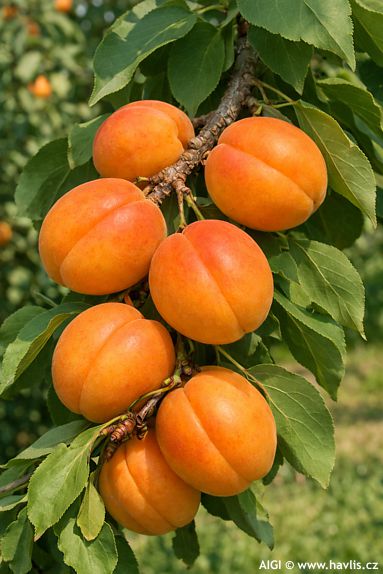
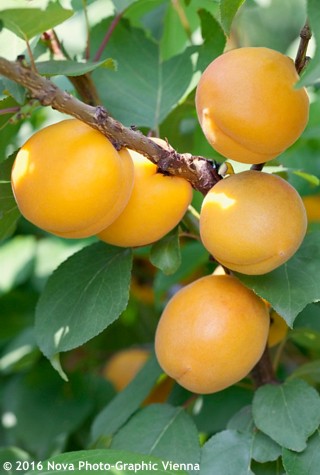
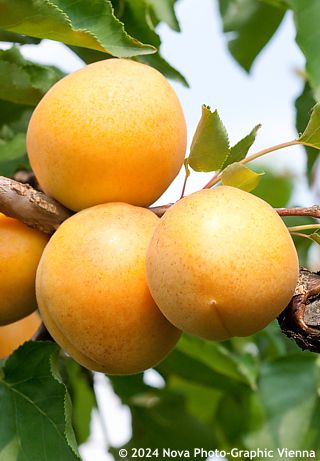
The fruit of Goldrich apricot is large to very large, broadly oval, with a smooth, firm skin of deep orange colour and a fine red blush on the sun‑exposed side. The flesh is orange, firm and moderately juicy, with a balanced ratio of sugars and acids; the flavour is sweet, refreshing and slightly spicy. The stone is large and separates cleanly. The tree is vigorous, forming a spreading crown with long, strong shoots and abundant fruiting wood. Flowering is mid‑late; the flowers are white and medium‑sized. The cultivar is partially self‑fertile and requires pollinators (e.g. ‘Hargrand’, ‘Harcot’) for heavy yield.
‘Goldrich’ was bred in the United States (Washington State University, Pullman) in 1969 from the cross ‘Sungold’ × ‘Perfection’. It was introduced into the European assortment in the 1980s and remains one of the most widely grown large‑fruited cultivars for commercial production. It is noted for its high frost resistance, particularly of the wood, and good tolerance to late spring frosts, which makes it suitable even for Central Europe. It ripens mid‑early to mid‑late, approximately 7–10 days after ‘Velkopavlovická’. The fruit are very attractive and firm, with excellent transport and storage qualities, and are therefore often used for the export market. The flavour is balanced, less aromatic than that of southern cultivars, yet stable and reliable. For Central Europe, ‘Goldrich’ is highly suitable: it tolerates winter frosts well (wood down to −25 °C), the flower buds are moderately hardy (−18 °C), and the tree shows strong growth and high vigour. It requires a sunny, warm site and well‑drained soil; in humid locations it may suffer from gummosis. Under optimal conditions it produces large, uniform fruit of high market value and dependable yield.
Last update 03-05-2026
Apricots require a warm, airy site with deep, well‑drained soil, as they tolerate short periods of drought far better than prolonged waterlogging, which leads to root dieback and canker‑type necroses. In the first years after planting they need regular watering; later, moderate irrigation and mulching are preferable to excessive watering. Nitrogen is problematic in apricots: it promotes vigorous growth but impairs wood maturation, increases frost sensitivity and encourages brown rot of the fruit, so potassium and magnesium are generally more beneficial. Pruning must be approached with care — apricots bear on two‑year‑old and older wood and do not tolerate heavy winter cuts into old branches, especially in cold, wet weather, which easily opens the way to cankers. The best approach is light summer to late‑summer pruning that keeps the crown airy, removes overloaded or crossing branches and gradually renews fruiting wood, but it should not be performed mechanically every year. Large cuts should be made only when truly necessary — apricots do not respond well to “rejuvenation pruning” on old wood.
o
The most significant diseases include blossom and shoot blight, brown rot of the fruit, apricot rust and various forms of branch and trunk canker. Blossom blight attacks flowers during cold, wet weather; flowers turn brown and remain attached, shoots die back and exude gum. The same pathogen later causes fruit rot, especially when “mummies” remain on the tree. Apricot rust leads to premature leaf fall and weakens the tree. Hygiene is the foundation of protection: removing mummified fruits, heavily infected branches and fallen rotten fruit. Chemical treatments are meaningful only when timed to risk periods — wet spring during bloom and the pre‑harvest period — otherwise it is better to leave the tree alone rather than chase every minor symptom. Apricots are relatively short‑lived fruit trees: under good conditions they may reach 40–50 years, but the period of high‑quality, regular cropping usually lasts 15–25 years. Older trees show greater yield fluctuations, more frequent branch dieback and increased susceptibility to cankers; at a certain point it is wiser to plant a new tree than to maintain an ageing one. European apricots generally have good winter hardiness in the wood down to at least –25 °C, though differences between cultivars are notable. Goldrich tolerates temperatures around –25 °C without difficulty (USDA zone 5b).

Goods are shipped all over Europe. For Russia and U.K. and for further details please read about SHIPPING OPTIONS HERE.
Are you interested in a serious discount for orders NOV-FEB? Check your options here.
THE PRICES INCLUDE VAT of 15%. For quick conversion you can use 1 CZK = approx. 0.04 EUR
- STANDARD QUALITY - Plants of this group are 1st class quality with number of branches and overall density adequate to their size and age, considering they were container grown.
- DE LUXE QUALITY - This label guarantees a luxurious quality of manually selected plants that, compared to their height and age, are exceptionally dense and beautiful.
- EXTRA - These plants are usually mature and bigger specimens with exceptional overall appearance.
- STANDARD (as described in the plant form) means a tree with a trunk of 190-210 cm and a crown at the top, unless specified differently. The commercial size for trees is their girth measured in the height of 1m from ground.
- HOBBY - These plants are of the same quality as our standard-quality plants but younger and therefore cheaper.
- SHRUB - a woody plant with branches growing bushy from the ground level.
- HALF-STANDARD or MINI-STANDARD - a small tree with shorter trunk, its size is usually specified.
- FEATHERED - These are trees with branches growing already from the base of the trunk and up along the stem.
- GRASSES and PERENNIALS - Sizes given usually read the diameter of the pot or the clump, as specified.
