



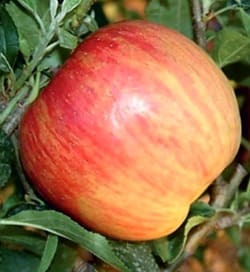






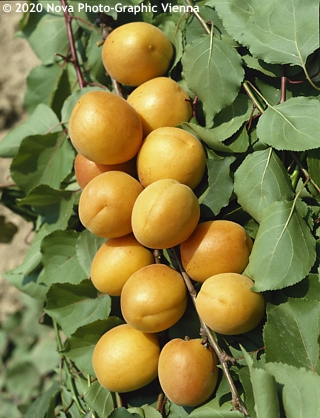
Prunus armeniaca 'ROYAL' apricot tree - medium late

 Symbivit Tric (arbuscular)
 Symbivit (arbuscular)
Prunus
The apricot, Prunus armeniaca, is one of the oldest fruit trees cultivated by humans. Although its Latin name refers to Armenia, where it was widely grown in antiquity and from where it reached Europe, its true origin lies further east – in Central Asia, northern China and the Tian Shan mountains, where genetically rich wild populations still grow and form the foundation of the species. The apricot reached Europe via Persia and Armenia, where it was cultivated as early as the time of Alexander the Great. The Romans knew it as malum armeniacum and spread it throughout their empire. In the Middle Ages it survived mainly in monastic gardens and in the warmer parts of southern Europe. It arrived in Central Europe later but adapted quickly thanks to its ability to tolerate continental climates, even though growers had to accept its defining trait – its tendency to flower very early, often exposing the blossoms to frost damage. Yet the fruit is so delicious that even regions at risk were unwilling to give it up. The apricot is a velvety drupe with orange flesh rich in carotenoids and a large stone whose kernel may be sweet or bitter depending on origin. The tree has a deep, strong root system that allows it to withstand drought, but it requires well‑drained soils free of waterlogging. The species is genetically highly variable – European, Central Asian, Chinese and Armenian lines differ in phenology, flavour, fruit size and resilience, forming the basis of modern breeding.
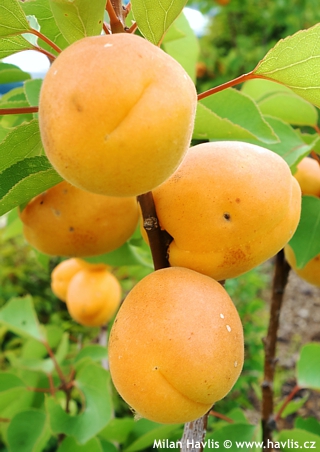
Royal is one of the most popular apricot tree varieties valued for regular and high yields. It is a midseason variety producing golden yellow to orange fruit with orange flesh of excellent taste: aromatic, sweet, and very juicy. Freestone. Fruit is great for fresh consumption and fresh market sale as well as processing. It is self-fertile (needs no other tree to pollinate its flowers) but will benefit from a different variety grown nearby.
The tree has moderate vigour forming a wide canopy. It is frost and drought resistant. Hardy to about -29°C (USDA zone 5).
Last update 01-09-2020