












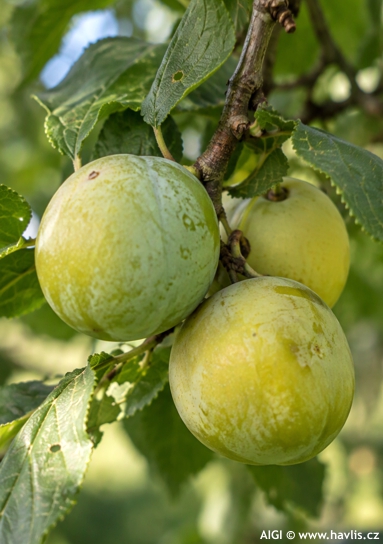
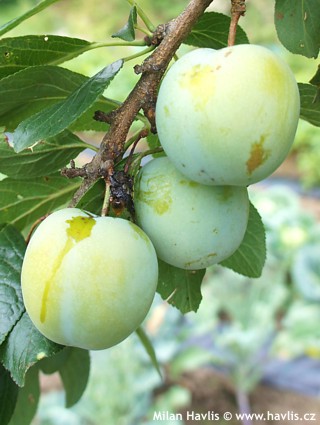
Prunus domestica 'REINE CLAUDE VERTE' greengage - medium early

 Symbivit Tric (arbuscular)
 Symbivit (arbuscular)
Prunus
Prunus is one of the richest and most diverse genera in the plant kingdom. If we set aside its ornamental representatives, it deserves one remarkable distinction: the genus Prunus has given the world more fruit crops than perhaps any other temperate-zone genus. It includes sweet cherries, sour cherries, plums, apricots, peaches, and almonds – fruits that have accompanied human civilisation for several thousand years. Archaeologists continue to discover their stones in ancient settlements stretching from the Balkans to China, and many of these species were already being cultivated long before domesticated apples became widespread across Europe. Special attention was devoted to their origins by the Russian botanist Nikolai Ivanovich Vavilov (1887–1943), who identified the Caucasus, Iran, and Central Asia as one of the principal centres of diversity for stone fruits. It was from these regions that ancient trade routes carried cherries, plums, and apricots into the Mediterranean world and later throughout Europe.
Greengages belong to the same botanical lineage as plums, damsons and mirabelles, yet they have earned a distinct place in European gardens. While many traditional plums were valued for drying, preserves and distillation, greengages were cultivated primarily for their exceptional dessert quality. Growers therefore selected trees bearing particularly sweet, juicy and richly flavoured fruits, often with a dense, aromatic flesh that set them apart from ordinary plums. The boundaries between the various groups of Prunus domestica are not always clear-cut, and some cultivars display characteristics that overlap with plums or damsons. During the 18th and 19th centuries, numerous greengage cultivars were developed and refined, especially in France, Germany and England, where they became prized inhabitants of both kitchen gardens and estate orchards. To this day, greengages remain one of the finest groups of European plums, combining the reliability of traditional orchard fruit with outstanding dessert quality.
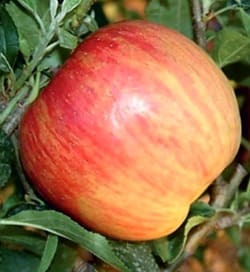
Reine Claude Verte is a greengage variety bearing fruits that have been regarded for centuries as among the finest of all plums. They are among the largest of the gages, almost perfectly round and typically 4 to 4.5 cm across. At maturity they remain green to yellow-green, sometimes developing a delicate pink blush on the sunniest side and often carrying the characteristic russet-like netting on the skin. The flesh is yellow, exceptionally juicy and melting, almost dissolving on the tongue. The flavour is intensely sweet, low in acidity, yet rich, spicy and highly aromatic. It is precisely this combination that has made the cultivar the benchmark against which other gages are judged. The skin is thin and tender, but when harvested slightly early the fruits are firm enough for compotes, where they retain their shape rather than cooking down. The tree is moderately vigorous and develops a broad, rounded crown. The cultivar is self-sterile or only partially self-fertile and requires another simultaneously flowering plum for reliable cropping. Good pollinators include other gages, many mirabelles, and some traditional plum cultivars, such as 'Althann's Gage', 'Mirabelle de Nancy' and 'Victoria'.
Its origins are equally shrouded in mystery. The cultivar is reliably documented in France as early as the fifteenth century, although its earlier history remains unknown. Some authors trace its roots to Armenia or Syria, while others point towards the Mediterranean region. What is certain is that it spread throughout almost the whole of Europe over the centuries. Perhaps for that very reason it accumulated an almost impenetrable thicket of names. In France it is known as Reine Claude Verte, in Germany as Große Grüne Reneklode, in Britain as Green Gage, while in Czech it became established as either velká zelená renklóda or velká zelená bluma. Moreover, Reine Claude Verte has long been regarded as the archetype of the entire gage group, traditionally known in Central Europe as blumas.
The term bluma has traditionally been used in Czech for sweet dessert plums with rounded fruits, softer flesh and a higher sugar content. They are valued primarily for fresh eating, while their culinary uses tend to be more limited than those of traditional plum cultivars. The series of cultivars bearing the name Reine Claude commemorates Claude of France (1499–1524), wife of King Francis I of France, in whose honour the original cultivar was named. The identity of the breeder or discoverer, however, remains unknown.
Last revision: 14 November 2026

Goods are shipped all over Europe. For Russia and U.K. and for further details please read about SHIPPING OPTIONS HERE.
Are you interested in a serious discount for orders NOV-FEB? Check your options here.
THE PRICES INCLUDE VAT of 15%. For quick conversion you can use 1 CZK = approx. 0.04 EUR
- STANDARD QUALITY - Plants of this group are 1st class quality with number of branches and overall density adequate to their size and age, considering they were container grown.
- DE LUXE QUALITY - This label guarantees a luxurious quality of manually selected plants that, compared to their height and age, are exceptionally dense and beautiful.
- EXTRA - These plants are usually mature and bigger specimens with exceptional overall appearance.
- STANDARD (as described in the plant form) means a tree with a trunk of 190-210 cm and a crown at the top, unless specified differently. The commercial size for trees is their girth measured in the height of 1m from ground.
- HOBBY - These plants are of the same quality as our standard-quality plants but younger and therefore cheaper.
- SHRUB - a woody plant with branches growing bushy from the ground level.
- HALF-STANDARD or MINI-STANDARD - a small tree with shorter trunk, its size is usually specified.
- FEATHERED - These are trees with branches growing already from the base of the trunk and up along the stem.
- GRASSES and PERENNIALS - Sizes given usually read the diameter of the pot or the clump, as specified.
