











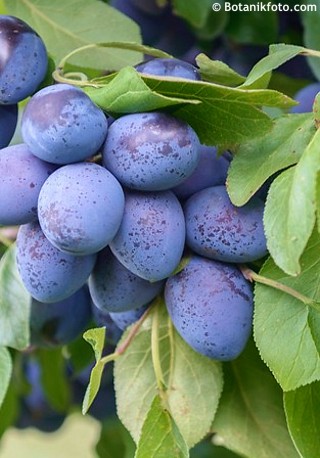
Prunus domestica 'STANLEY' moyer plum, early, self-fertile

 Symbivit Tric (arbuscular)
 Symbivit (arbuscular)
Prunus
Prunus is one of the richest and most diverse genera in the plant kingdom. If we set aside its ornamental representatives, it deserves one remarkable distinction: the genus Prunus has given the world more fruit crops than perhaps any other temperate-zone genus. It includes sweet cherries, sour cherries, plums, apricots, peaches, and almonds – fruits that have accompanied human civilisation for several thousand years. Archaeologists continue to discover their stones in ancient settlements stretching from the Balkans to China, and many of these species were already being cultivated long before domesticated apples became widespread across Europe. Special attention was devoted to their origins by the Russian botanist Nikolai Ivanovich Vavilov (1887–1943), who identified the Caucasus, Iran, and Central Asia as one of the principal centres of diversity for stone fruits. It was from these regions that ancient trade routes carried cherries, plums, and apricots into the Mediterranean world and later throughout Europe.
Unlike cherries or apricots, the European plum does not have a straightforward origin story. As recently as the 19th century it was regarded as a naturally occurring species, but modern genetic research has revealed a far more complex picture. Botanists now generally agree that Prunus domestica most likely originated as an ancient interspecific hybrid involving cherry plum (P. cerasifera), blackthorn (P. spinosa), and possibly other Eurasian plum species whose contribution is now difficult to trace. Even its exact place of origin remains uncertain. The region most frequently proposed lies between the Balkans, the Caucasus, and Western Asia, where populations of these species naturally overlapped and where people were already cultivating stone fruits thousands of years ago. Early growers selected trees with larger, tastier, or better-storing fruit and favoured them over less desirable seedlings. Generation after generation, this quiet process of selection gradually transformed wild plums into the ancestors of today's recognised cultivars of plums, greengages, and mirabelles.
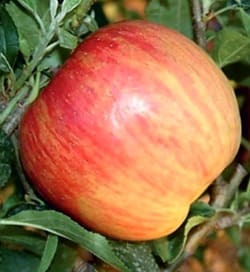
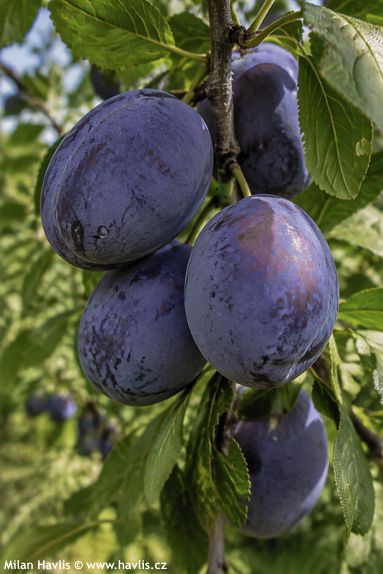
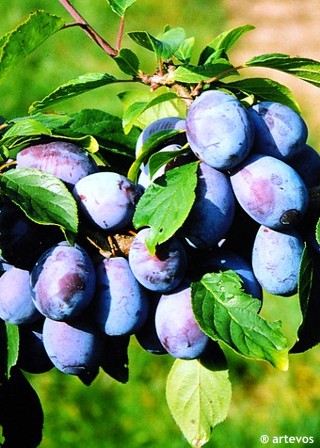
Stanley is one of the most tasteful and reliable varieties of plums. The fruit is sweet and juicy, though firm. Flesh is orange-yellow, skin is smooth, deep violet-blue. The fruit is excellent fresh as well as canned, high sugar content makes them ideal for drying.
It blooms late in the spring and is mostly self-fertile, though it benefits from a pollinator nearby. However, even on its own crops sufficiently. The fruit ripens from late August till mid September.
This variety comes from the USA. It has proved crop reliable and very hardy. It even does better in areas with cold and wet spring. It is fully hardy to -34°C (USDA zone 4).
Last update 02-03-2008
Growing European plums is generally straightforward. They perform best in full sun and in deep, fertile, well-drained soils with adequate moisture. While they tolerate short periods of summer drought reasonably well, prolonged dryness reduces fruit quality and restricts growth. If your soil is light and dry, trees grafted onto cherry plum (Prunus cerasifera) rootstocks are often the best choice, as they develop a deeper and more resilient root system. Depending on the cultivar, plums may be fully self-fertile, partially self-fertile, or self-sterile, in which case a compatible pollinator is required. The pollinating variety may grow in the same garden, but it can be equally effective when planted in a neighbouring property. Growers often speak of “bee flight distance”, yet in practice overlapping flowering times are usually more important than the actual distance. Besides other plums and semi-prune plums, some cultivars can also be pollinated by greengages, mirabelles, or cherry plums, provided they flower at the same time.
Tree-form plums should be securely staked after planting, either with one strong pole or, in the case of standard trees, with a tripod support for at least three years. During this establishment period, keep the area around the trunk free from grass and weeds, which compete for water and nutrients. Most European plums are among the hardiest fruit trees and mature specimens commonly tolerate winter temperatures below −30 °C (USDA zone 5). Far more vulnerable than the wood itself are the flowers and young fruitlets, which may be damaged by late spring frosts. Regular pruning is not essential for successful cultivation, and plum trees can grow and crop well without formal training. However, occasional thinning of dense crowns or heavily cropping cultivars may improve both fruit quality and tree health. The flesh of the fruit is perfectly safe to eat, but the stones contain cyanogenic glycosides and are not intended for consumption.

Goods are shipped all over Europe. For Russia and U.K. and for further details please read about SHIPPING OPTIONS HERE.
Are you interested in a serious discount for orders NOV-FEB? Check your options here.
THE PRICES INCLUDE VAT of 15%. For quick conversion you can use 1 CZK = approx. 0.04 EUR
- STANDARD QUALITY - Plants of this group are 1st class quality with number of branches and overall density adequate to their size and age, considering they were container grown.
- DE LUXE QUALITY - This label guarantees a luxurious quality of manually selected plants that, compared to their height and age, are exceptionally dense and beautiful.
- EXTRA - These plants are usually mature and bigger specimens with exceptional overall appearance.
- STANDARD (as described in the plant form) means a tree with a trunk of 190-210 cm and a crown at the top, unless specified differently. The commercial size for trees is their girth measured in the height of 1m from ground.
- HOBBY - These plants are of the same quality as our standard-quality plants but younger and therefore cheaper.
- SHRUB - a woody plant with branches growing bushy from the ground level.
- HALF-STANDARD or MINI-STANDARD - a small tree with shorter trunk, its size is usually specified.
- FEATHERED - These are trees with branches growing already from the base of the trunk and up along the stem.
- GRASSES and PERENNIALS - Sizes given usually read the diameter of the pot or the clump, as specified.
