











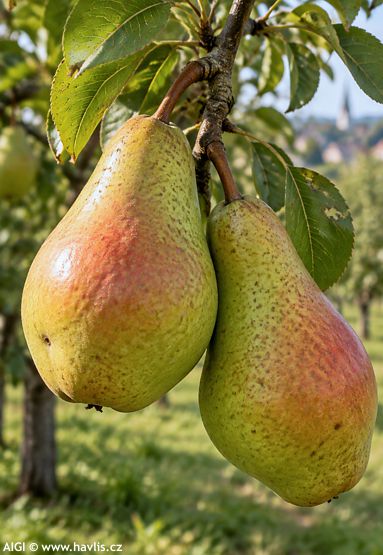
Pyrus communis 'Beurré Clairgeau' pear - medium late

 Symbivit Tric (arbuscular)
 Symbivit (arbuscular)
Pyrus
The genus Pyrus was described by Carl Linnaeus (1707-1778) in his landmark work Species Plantarum in 1753. The number of accepted species varies considerably depending on the taxonomic concept followed. While Flora of China recognises approximately 25 species, the Plants of the World Online database maintained by the Royal Botanic Gardens, Kew currently accepts more than 70. The genus comprises trees and shrubs distributed from western Europe through the Caucasus, Asia Minor and the Himalayas to China, Korea and Japan. Fossil evidence shows that pears were already widespread across the Northern Hemisphere during the Tertiary period, long before the appearance of humans. Although most people associate pears with fruit-laden orchard trees, the genus also includes some of the most important ornamental trees of modern times, notably Pyrus calleryana, which is widely planted along streets and avenues throughout the world. Typical features of the genus include white five-petalled flowers, pomes of widely varying size, and exceptionally hard, fine-grained timber that has been prized for centuries for rulers, drawing instruments, musical instruments, wood engraving blocks and fine carving. The limits of the genus have never been entirely straightforward, and relationships between the European and Asian species continue to occupy taxonomists today.
European pear, Pyrus communis, is among the oldest fruit crops cultivated by humanity. Its origins lie in a broad region stretching from the Balkans through Asia Minor and the Caucasus to northern Iran, where the genetic foundations of thousands of later cultivars were established. Even Theophrastus (c. 371-287 BC), often regarded as the father of botany, distinguished between wild and cultivated pears, while several centuries later Pliny the Elder (AD 23-79) described dozens of pear varieties grown throughout the Roman Empire. During the Middle Ages pears became an integral part of both monastic and rural orchards, and during the eighteenth and particularly the nineteenth century they entered a true golden age thanks to Belgian and French pomologists. It was during this period that most of the famous butter pears, or beurré pears, were raised, many of whose names still appear regularly in historic pomological literature and some of which remain among the finest pears ever grown. Few fruit trees are as closely woven into everyday life. Pears were eaten fresh, dried for winter use, pressed into juice, distilled into pear brandy and, in some parts of Europe, gave rise to the traditional drink known as perry, the pear equivalent of apple cider.
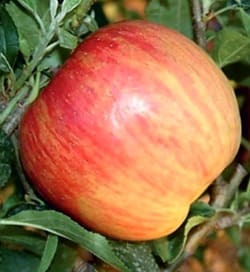
Beurré Clairgeau ranks among the most distinctive autumn pears of the 19th century, above all for its large and striking fruits. They are often somewhat variable in shape, most commonly pyriform to elongated conical, sometimes slightly irregular or curved. At picking time, they display a greenish-yellow to yellow ground colour overlaid on the sunny side with an attractive orange-red flush. The skin is lightly russeted, particularly around the stalk cavity. The flesh is white to creamy white, juicy, sweet with a refreshing acidity and pleasantly aromatic. Under favourable conditions it becomes semi-buttery to melting, although in poorer sites it may be coarser and slightly gritty around the core. This is a mid to late autumn pear. The fruits are harvested from late September into early October and, unlike summer pears, are not usually at their best immediately after picking. Their flavour develops after a short period of storage in a cool pantry or cellar. Under good cellar conditions they generally keep until November and in commercial cold storage may remain sound until late winter. Thanks to their relatively firm skin they tolerate handling and transport well, a quality that once made them an important market variety. The tree is moderately vigorous to vigorous, comes into bearing fairly early and is valued for its high and regular yields.
The cultivar originated in Nantes, France, where the gardener Pierre Clairgeau raised it from a chance seedling around 1838. It was first exhibited publicly in 1848 and quickly attracted attention because of the size and appearance of its fruits. The original tree was subsequently acquired by Belgian nurserymen who helped spread the variety across Europe, transforming a local French novelty into one of the most widely cultivated pears of its era. It may also be encountered under the names Clairgeau de Nantes or simply Clairgeau. Its exact parentage remains unknown, although Pierre Clairgeau himself suggested that it may have arisen from a cross involving the cultivar Duchesse d'Angoulême. 'Beurré Clairgeau' is self-sterile and requires a suitable pollinating partner for reliable crops. Unlike certain other fruit species, such as medlar, medlar relatives, and some cherries and plums that can produce at least a modest crop on their own, traditional European pears depend far more heavily on compatible pollen from another cultivar. The presence of a simultaneously flowering pollinator therefore increases fruit set, total yield and often the quality of the crop itself, producing larger, more uniform and better-developed fruits. Suitable pollinators include 'Williams', 'Conference', 'Beurré Bosc' and 'Doyenné du Comice'.
Last revised 19 November 2026
European pear performs best in full sun and in deep, well-drained, fertile soils. Thanks to its deep root system it generally tolerates drought better than most apples once established, although prolonged waterlogging and compacted ground are unsuitable. It grows best in neutral to slightly alkaline soils but is among the more adaptable fruit trees. Pears naturally tend to produce upright shoots, and in specialist orchards branches are sometimes tied down or trained to wider angles to encourage earlier cropping. They do not require routine pruning, and frequent shortening of shoots often results in denser growth rather than a better crown structure. Where thinning, rejuvenation or the removal of damaged branches is needed, pruning is usually carried out after harvest or in late winter before growth resumes. Vigorous cultivars grafted onto seedling rootstocks develop exceptionally long-lived trees capable of bearing fruit for several generations, whereas those on quince rootstocks remain smaller and come into production sooner. Young trees and half-standards benefit from a simple support for the first two to three years after planting, while standard trees require a sturdy tripod support system for at least three to four years. The area around the trunk should remain free of grass and perennial weeds during this establishment period. Most cultivars grown in Central Europe are fully hardy to approximately -34 °C.

1 176 Kč
Goods are shipped all over Europe. For Russia and U.K. and for further details please read about SHIPPING OPTIONS HERE.
Are you interested in a serious discount for orders NOV-FEB? Check your options here.
THE PRICES INCLUDE VAT of 15%. For quick conversion you can use 1 CZK = approx. 0.04 EUR
- STANDARD QUALITY - Plants of this group are 1st class quality with number of branches and overall density adequate to their size and age, considering they were container grown.
- DE LUXE QUALITY - This label guarantees a luxurious quality of manually selected plants that, compared to their height and age, are exceptionally dense and beautiful.
- EXTRA - These plants are usually mature and bigger specimens with exceptional overall appearance.
- STANDARD (as described in the plant form) means a tree with a trunk of 190-210 cm and a crown at the top, unless specified differently. The commercial size for trees is their girth measured in the height of 1m from ground.
- HOBBY - These plants are of the same quality as our standard-quality plants but younger and therefore cheaper.
- SHRUB - a woody plant with branches growing bushy from the ground level.
- HALF-STANDARD or MINI-STANDARD - a small tree with shorter trunk, its size is usually specified.
- FEATHERED - These are trees with branches growing already from the base of the trunk and up along the stem.
- GRASSES and PERENNIALS - Sizes given usually read the diameter of the pot or the clump, as specified.
