

































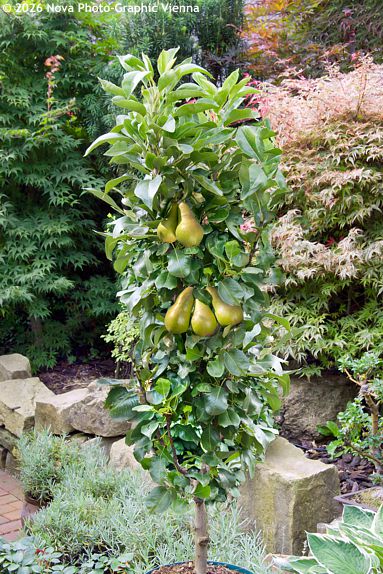
Pyrus communis SLOUPOVITÉ / COLUMNAR pear trees - narrow growing

 Symbivit Tric (arbuscular)
 Symbivit (arbuscular)
Pyrus
The genus Pyrus – the pear – is among the oldest fruit groups cultivated by humans, with a history stretching back thousands of years to the regions of the Caucasus, Asia Minor and Iran, from where pears spread into Europe and China. Wild species inhabit light woodlands, mountain slopes and dry rocky hillsides, and share several common traits – a deep root system, great longevity and the ability to produce firm, resilient wood. These characteristics are also reflected in Pyrus communis, which over centuries of domestication has been bred and selected into dozens of growth forms, from vigorous tall standards to modern dwarf types suitable for small gardens.
The need to save space has, in recent decades, led to efforts to breed pears with narrow, compact growth. Unlike apples, however, pears lack the Co-type genetic mutation that produces true columnar forms. Expert sources agree that no genetically true columnar pear currently exists, and that all commercially offered “columnar pears” are in fact naturally narrow-growing cultivars or ordinary pears grafted on weak rootstocks that can be trained into a columnar shape (source: sad‑i‑ogorod.ru/kolonovidnye‑grushi, biologist M. V. Kachalkin). Their columnar appearance is therefore the result of genetically slender growth combined with an appropriate rootstock and correct pruning, rather than a distinct growth mutation. Even so, these cultivars and forms represent an important group that allows pears to be grown where there is no room for a traditional tree. Their advantages include a narrow crown, limited branching and the ability to bear fruit on short fruiting spurs close to the trunk. In practice, they behave similarly to columnar apples, even though they are not truly columnar.
Condo
Condo is a narrowly growing, upright cultivar with a compact crown that maintains a slender shape and produces only a few side branches. The fruits are medium to large, greenish-yellow with a slight blush, juicy, sweet and aromatic, with a flavour reminiscent of Conference, from which it originated through a cross with Doyenné du Comice. It ripens in late September and is partially self-fertile, capable of setting fruit without a pollinator, although a suitable pollinating partner improves yield significantly. When stored properly, the fruits keep until November or sometimes longer.
Saphira
Saphira forms a very slender, elegant tree with minimal lateral branching, making it the most “columnar-looking” of the three cultivars. The fruits are medium-sized, yellow-green, with a gently sweet, slightly tangy flavour and juicy flesh. It ripens early, usually in the first half of September, and is self-sterile, though in small gardens it often sets at least a modest crop even without a pollinator. It is suitable only for short-term storage, typically until October.
Decora
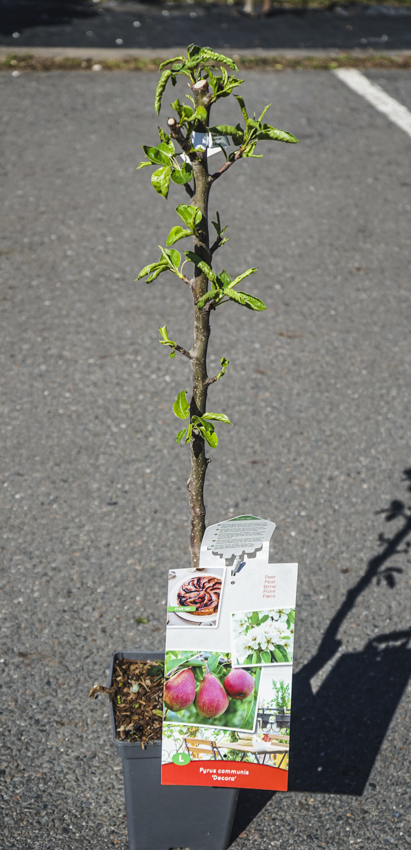
Decora has a narrowly upright habit but produces a somewhat richer framework of branches than Condo or Saphira, giving it a fuller appearance. It originates from a cross of Conference × Clapp’s Favourite. The fruits are medium-sized, yellow-green with a delicate red blush, sweet, soft and very juicy, ideal for fresh eating. It ripens in mid-September and is self-sterile, usually producing only a limited crop without a pollinator. Its storage life is short, generally until October, though it lasts slightly longer in cool conditions.
Narrow-growing pears are an excellent choice for small gardens, tight spaces, front gardens and modern urban plantings where airiness and light are important. Thanks to their slender, upright growth, they can be planted at closer spacing or trained along fences and walls without taking up much room. They thrive best in sunny sites with well-drained, fertile soil, where they enter fruiting quickly and maintain a compact habit. They are also suitable for growing in larger containers, provided they receive regular watering and feeding, making them an attractive option for terraces, balconies and courtyards. Their narrow crowns combine well with other fruit trees and can also serve as vertical accents in ornamental plantings.
Last update 18-04-2026
Narrow-growing pears require regular but gentle care to maintain their slender shape and support the formation of fruiting spurs. The key task is monitoring the development of longer lateral shoots and, when they appear, carrying out summer pruning by shortening these shoots to two or three buds to keep the crown narrow and light-permeable. Young trees need consistent watering in the first years after planting and during dry periods, as their narrow growth often corresponds with a smaller root system. Feeding should be moderate, ideally with compost or slow-release fertilisers, to support fruiting rather than excessive vegetative growth. It is always advisable to follow the description of each cultivar, especially regarding self-fertility or the need for a pollinator; in small gardens, however, nearby trees in neighbouring plots or limited self-fertility usually ensure at least a basic crop. These pears are hardy to approximately –34 °C.
Goods are shipped all over Europe. For Russia and U.K. and for further details please read about SHIPPING OPTIONS HERE.
Are you interested in a serious discount for orders NOV-FEB? Check your options here.
THE PRICES INCLUDE VAT of 15%. For quick conversion you can use 1 CZK = approx. 0.04 EUR
- STANDARD QUALITY - Plants of this group are 1st class quality with number of branches and overall density adequate to their size and age, considering they were container grown.
- DE LUXE QUALITY - This label guarantees a luxurious quality of manually selected plants that, compared to their height and age, are exceptionally dense and beautiful.
- EXTRA - These plants are usually mature and bigger specimens with exceptional overall appearance.
- STANDARD (as described in the plant form) means a tree with a trunk of 190-210 cm and a crown at the top, unless specified differently. The commercial size for trees is their girth measured in the height of 1m from ground.
- HOBBY - These plants are of the same quality as our standard-quality plants but younger and therefore cheaper.
- SHRUB - a woody plant with branches growing bushy from the ground level.
- HALF-STANDARD or MINI-STANDARD - a small tree with shorter trunk, its size is usually specified.
- FEATHERED - These are trees with branches growing already from the base of the trunk and up along the stem.
- GRASSES and PERENNIALS - Sizes given usually read the diameter of the pot or the clump, as specified.
