










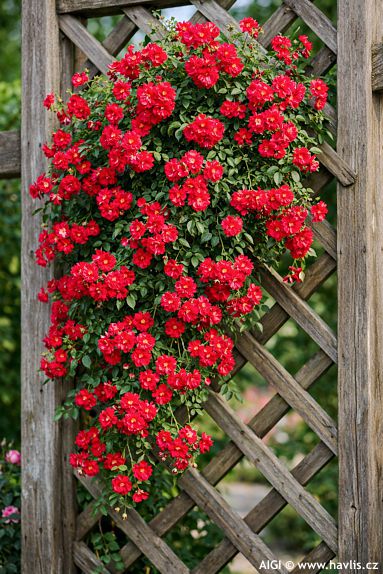
Rosa 'Korsilu 06' CRIMSON SILUETTA climbing rose

 Symbivit Tric (arbuscular)
 Symbivit (arbuscular)
Rosa
The genus Rosa, the roses, comprises roughly 100 to 150 species, with the exact number varying according to different taxonomic interpretations, as roses hybridise readily and form numerous intermediate types. They occur naturally across the temperate regions of the Northern Hemisphere, from Europe through western and central Asia to North America, reaching even into subarctic zones where the hardiest species, such as Rosa acicularis and Rosa majalis, can thrive. The greatest species diversity is concentrated in the mountainous areas of the Caucasus and south‑western China. Fossil evidence of Rosa is known from the Eocene and Oligocene, confirming the ancient origin of the genus, and the first written references to roses appear on Sumerian tablets and later in Theophrastus’ Historia Plantarum (371–287 BC), where he distinguished between single and double flowers. The modern botanical circumscription of the genus was established by Carl Linnaeus (1707–1778) in 1753, who designated Rosa gallica as the type species, a role it still fulfils as the nomenclatural anchor of the entire genus. Rosa is divided into several well‑recognised sections, such as Caninae, Cinnamomeae and Synstylae, which differ in hip morphology, growth habit and chromosome numbers. Roses show naturally high variability, as many species are polyploid and have hybridised extensively in the past. Modern genetic studies therefore continue to refine earlier views on the relationships among species.
The foundation of today’s garden roses rests on several botanical species that reached Europe from different parts of the world over the centuries and gradually became the building blocks of modern hybridisation. European species such as R. gallica and R. alba contributed a sturdy shrubby habit, resilience and the classic fragrance that defined the quality of old garden roses. From Persia and the Middle East came key species including R. damascena, R. moschata, R. phoenicia and R. fedtschenkoana, bringing intense aroma, musky scent, finer petal texture, vigour and, in some lineages, the ability to flower repeatedly. Chinese species – notably R. chinensis and R. gigantea – introduced the crucial trait of remontancy, the capacity to bloom repeatedly through the season, which made the development of modern 19th‑century roses possible. Japanese and East Asian species such as R. multiflora and R. rugosa added vigour, disease resistance and a lighter, more delicate inflorescence structure.
Roses have accompanied humankind for so long that they emerge from history before written records even begin. In ancient Mesopotamia they appeared on clay tablets as plants worthy of royal gardens; in Persia they became symbols of beauty and melancholy, woven into poetry and daily customs alike – from rosewater to festivals celebrating their flowering. Around the Mediterranean they were known to both Greeks and Romans, though each culture saw them differently: the Greeks linked them with Aphrodite and the fleeting nature of beauty, while the Romans used them in gardens, baths and banquets, where rose petals drifted onto tables like a silent snowfall. In China the rose served as both a medicinal plant and an ornament of imperial gardens, its scent mingling with incense during Han‑dynasty rituals. In medieval Europe it entered monastic gardens and, at the same time, heraldry, becoming a sign of lineage – in the Czech lands it was borne by the Rožmberk family, who chose the rose because, in medieval symbolism, it represented noble origin, legitimacy and the right to hold land, while its five‑petalled form evoked the five branches of the ancient Vítkovec clan from which they descended. In the Renaissance the rose became a star of the earliest botanical gardens, a plant uniting science, art and horticultural craft. Every culture perceived it differently, yet all saw in it something that transcends an ordinary flower – memory, fragrance, symbol, story.
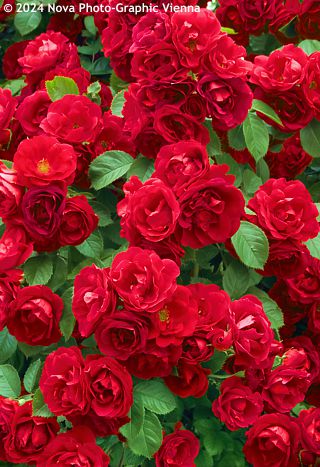
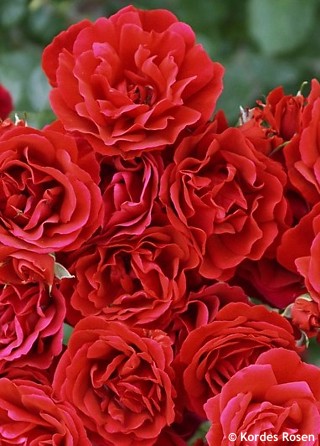
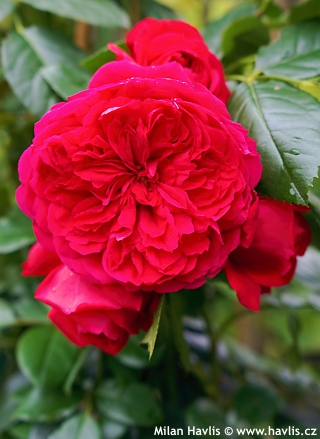
CRIMSON SILUETTA is a small‑flowered miniature climbing rose with a compact, dense habit and slender, flexible shoots bearing numerous small, rich crimson‑red, fully double flowers about 2–3 cm across. The blooms appear in clusters, creating a striking colour effect even on a limited surface. The foliage is small, dark green and very healthy, enhancing the plant’s overall decorative value.
• Fragrance — ★☆☆☆☆ very faint, rather unobtrusive
• Disease resistance — ★★★★☆ high resistance to black spot and powdery mildew
• Care — undemanding; due to its fine shoots it requires regular tying‑in
• Flowering — repeat‑flowering; main flush June–July, followed by smaller waves until autumn
• Hardiness — approximately –20 to –23 °C
• Pruning — remove entire spent clusters after flowering; in spring only light maintenance pruning
• Breeder — Kordes, Germany, 2006
Climbing roses are ideal for pergolas, arches, trellises, pillars and walls where a vertical element and a generous flowering surface are needed. They flower best when their long shoots are trained at an angle or horizontally, which encourages the formation of lateral branches with blooms. They require a firm support and regular tying‑in to prevent breakage and to keep the plant tidy. They suit even smaller gardens, as they take little ground space and flower mainly “in the air”. When grown against walls, it is advisable to leave a 20–30 cm gap for air circulation. They are especially effective near paths or seating areas, where the flowers are carried at eye level. In favourable conditions, climbing roses become long‑lived woody plants that gain beauty and character with age.
Last update 21-06-2026
Roses can grow and flower with remarkable vitality when given the conditions they require. They thrive best in a sunny position with at least six hours of direct light a day; light determines the intensity of flowering, the depth of colour and the overall vigour of the plant. The soil should be deep, humus‑rich and well drained, as roses dislike prolonged waterlogging yet need a steady supply of moisture in the deeper root zone. A slightly acidic to neutral, fertile soil rich in organic matter is ideal, as it maintains even moisture and supports the formation of fine feeder roots. Throughout the growing season they require sufficient nitrogen, phosphorus and potassium. They respond best to regular feeding in small doses, which maintains steady growth without sudden surges. Mulching with compost or well‑rotted manure helps retain soil moisture, improves structure and releases nutrients gradually – something roses appreciate far more than single, heavy applications of mineral fertilisers.
Good air circulation around the plant is essential for healthy foliage and flowers, as it reduces the risk of fungal diseases. Roses therefore dislike overcrowded plantings or places where humid air lingers, though they do not mind weaving gently through one another. Watering should be directed to the base of the plant rather than the foliage. In dry periods, less frequent but deep watering encourages the roots to grow downwards. Spent flowers should be removed regularly; once an entire cluster has finished, cut it back to the first leaf with five leaflets to encourage new shoots with buds and to prolong the flowering season. In a favourable site, roses are long‑lived woody plants.