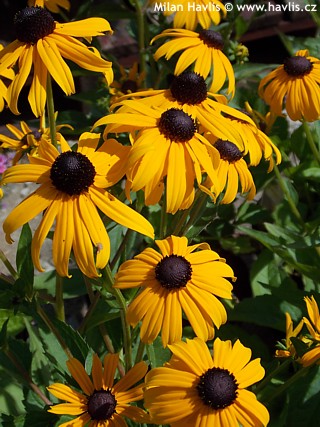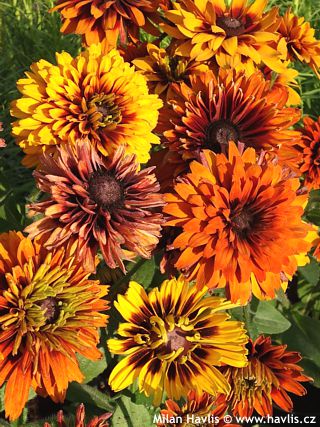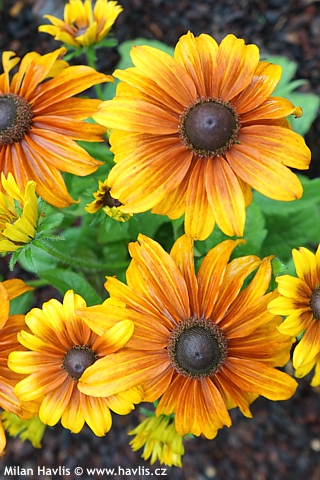











Rudbeckia hirta CHEYENNE 'Double Gold Brown Eye' gloriosa daisy

 Symbivit Tric (arbuscular)
 Symbivit (arbuscular)
Rudbeckia
The genus Rudbeckia belongs to the daisy family and includes around twenty species native mainly to the eastern and central parts of North America. These plants are typical of bright, open and often disturbed places: prairies, woodland edges, light savannas, embankments, post‑fire sites and abandoned, unirrigated ground. All species share the same basic flower structure, with broad ray florets in shades of yellow, orange and brown and a dark, often domed central cone made up of tiny tubular florets. The genus was described by Carl Linnaeus in 1753 and named after two Swedish naturalists, Olof Rudbeck the Elder (1630–1702) and Olof Rudbeck the Younger (1660–1740), who played a key role in the early botanical research at Uppsala. In the past there was uncertainty about the placement of some species, with various authors shifting them between Rudbeckia, Echinacea and Ratibida because of their similar cone structure. Modern studies, however, have confirmed that Rudbeckia forms a distinct evolutionary lineage that has become one of the botanical symbols of the North American grasslands.
Rudbeckia hirta, the black‑eyed Susan or gloriosa daisy, is a North American wanderer of the sun, growing wherever there is light, warmth and soil that drains quickly yet never dries out completely. Linnaeus described it in 1753 and named it after his teacher Olof Rudbeck (1630–1702), a physician and botanist whose family later became connected with Alfred Nobel. The symbolism is rather fitting: Rudbeck sought to link botany with medicine, and the plant bearing his name was used in its homeland as a medicinal herb, with root decoctions taken for colds, earache and even snakebite. Its natural range stretches from southern Canada across most of the United States to northern Mexico, and throughout this vast area it appears on sunny meadows, embankments and woodland margins. It reached Europe in the 19th century and settled in quickly; in Central Europe it was first recorded in the wild in 1873. Here it is often grown as a short‑lived perennial or annual, yet thanks to its reliable self‑seeding it behaves as if it had lived on the same spot for generations. Cottage gardens, parks and public plantings welcomed it readily, as its flowers bring a bright, sunlit accent from mid‑summer into autumn and can illuminate a late‑season border where many other species have already finished their work.
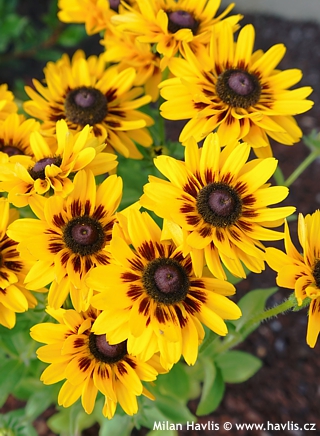
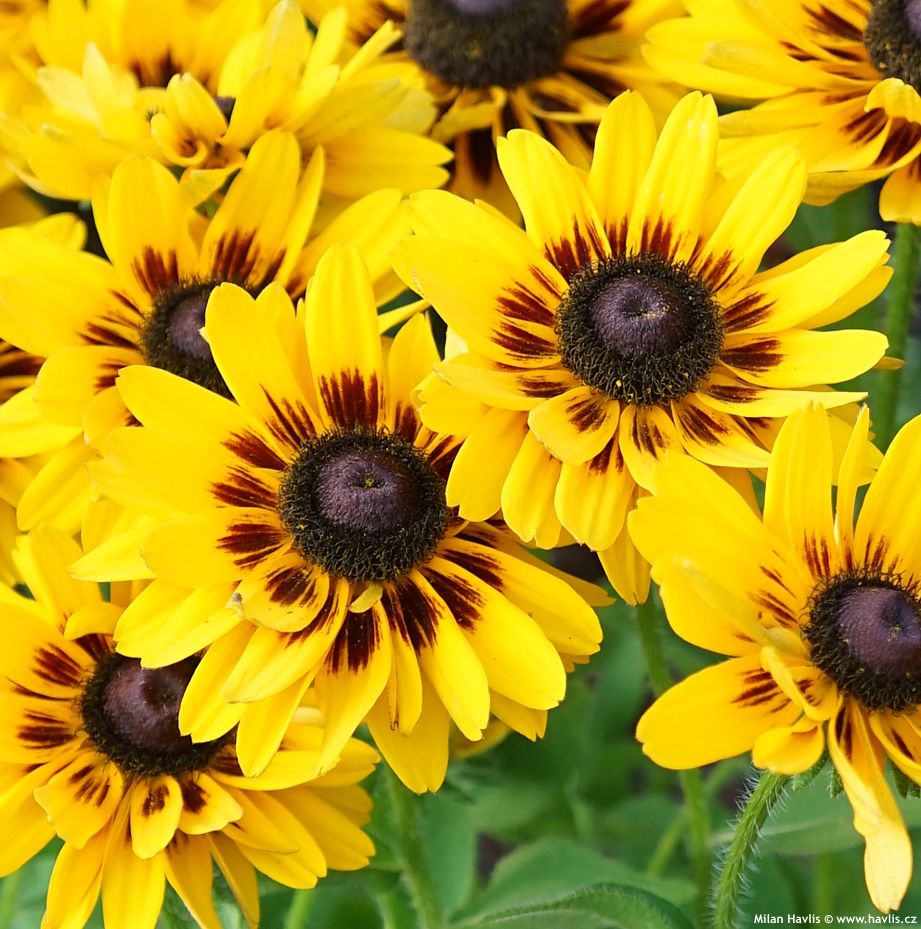
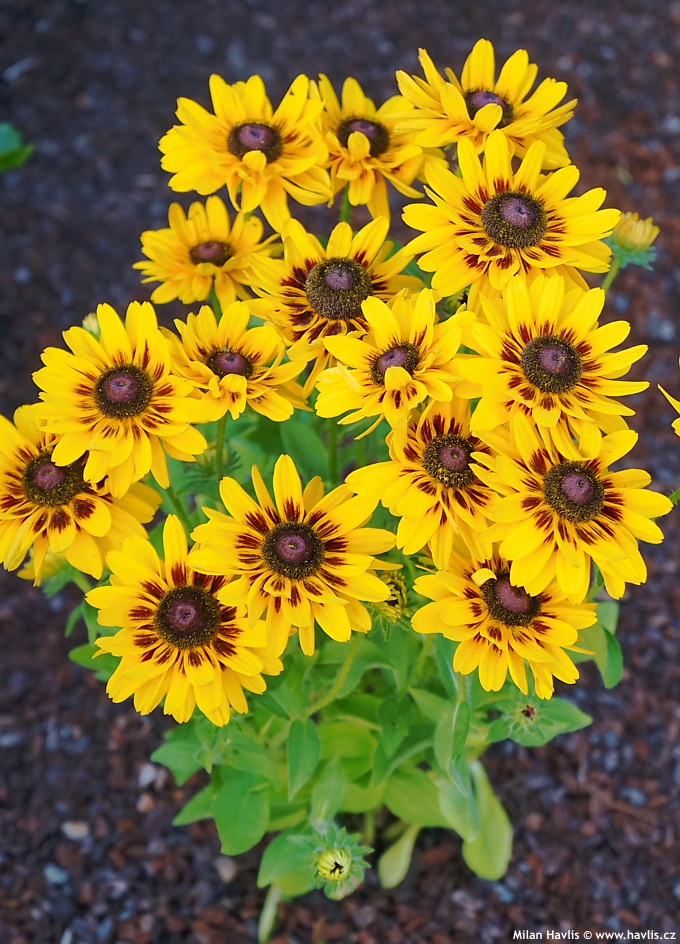
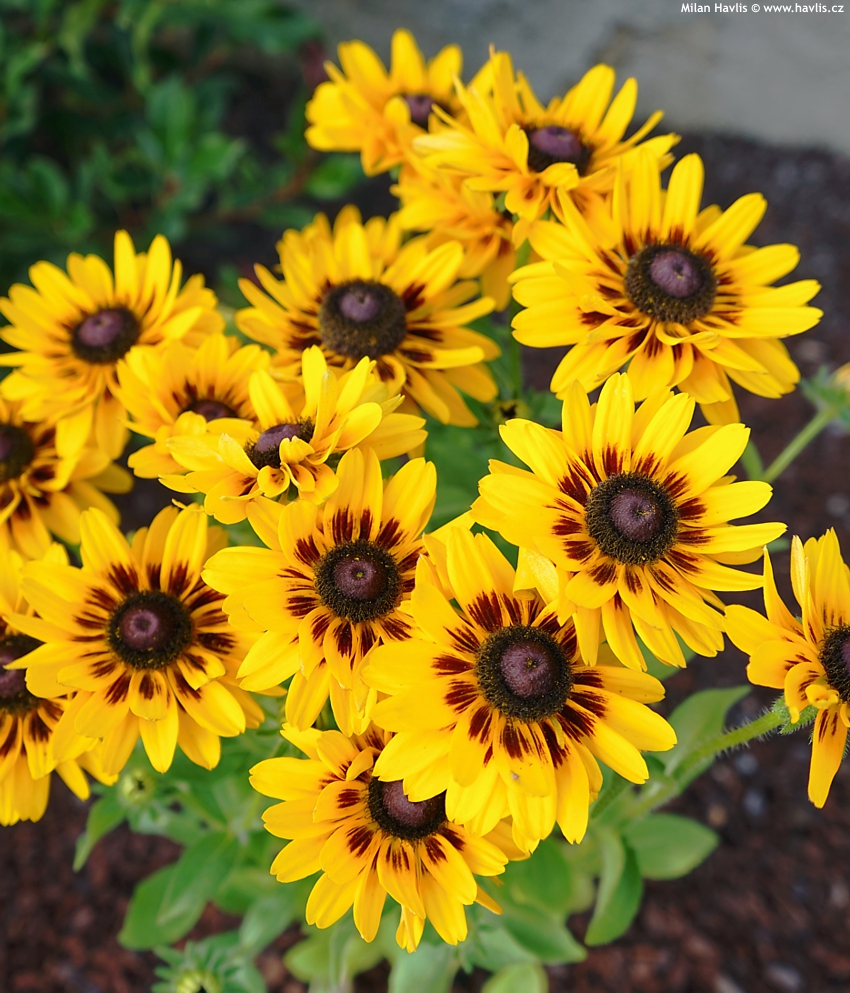
Cheyenne is a gloriosa daisy series named after a town in Wyoming, USA, where winter temperature can easily drop down to -30 °C. Double Gold Brown Eye produces immensely beautiful, bright golden yellow, semi-double flowers with two or three tiers of petals where each one is decorated with a small chocolate brown marking near the central cone that is even deeper brown. When the flowers come out in early July they bring such a joy with their warm and optimistic colours that each garden or patio should have one in this tough and difficult world. The leaves are large, ovate, light green, and hairy.
Gloriosa daisy is best used among earlier‑flowering perennials to brighten borders in the second half of summer. It shows off alongside plants from similar habitats – prairie types such as taller yet fine‑textured grasses (deschampsia, molinia, stipa), coneflowers, verbenas, gaura, catmints, penstemons, asters, gypsophila and even poppies, which it replaces beautifully once they fade. It suits colourful cottage‑style plantings as well as modern single‑species schemes, naturalistic gardens full of bees, butterflies and other pollinators, and even urban landscapes, as it tolerates heat, wind and drier conditions. In mass plantings it creates a bold, almost festive effect, yet it works equally well as a solitary accent among finer perennials. Thanks to its long‑lasting blooms it is excellent for cutting, holding longer in the vase than most other rudbeckias. Combined with grasses and late‑season perennials, it can create one of the most striking scenes of late summer.
Last update 23-07-2020;06-06-2026
Gloriosa daisy is best considered a short‑lived perennial or biennial which, in temperate climates, behaves much more like an annual and persists mainly through self‑seeding rather than the true longevity of the mother plants. It grows best in full sun and in well‑drained, light to medium soils that do not remain wet over winter, as waterlogging is more damaging to it than drought. Once established it tolerates short dry spells well, although extremely poor, sandy soils lead to weak growth and sparse flowering. It thrives in heat. It does not require fertilising, since excess nitrogen produces lush but soft growth and fewer flowers. Spent flower heads may be removed to prolong blooming, but some must be left to ripen seed, otherwise the planting will disappear within one or two seasons. Container growing is possible only for a short time, as the plants quickly exhaust the substrate and pots are prone to freezing in winter. In spring it is vulnerable to slugs, which can destroy all new leaves to the point that the plant weakens and dies. Its hardiness ranges from −29 to −34 °C (USDA zone 4-5).