.jpg)


Salvia FASHIONISTA™ 'BALLERINA PINK' hybrid meadow clary

 Symbivit Tric (arbuscular)
 Symbivit (arbuscular)
Salvia
The genus Salvia is one of the largest within the mint family, comprising around 900 species distributed from the Mediterranean across the Americas to East Asia. Mediterranean sages have accompanied European cultures since antiquity, American species played a role in the rituals of Indigenous peoples, and in the 18th and 19th centuries sages became popular targets of botanical expeditions. Ernest Wilson (1876–1930) introduced several Asian species to Europe and helped lay the foundations for modern breeding. Botanically, Salvia is remarkable for its unique lever‑like stamen mechanism. Carl Linnaeus (1707–1778) described it in the 18th century, but only later botanists recognised how perfectly it is adapted to pollinators. An insect reaching for nectar presses the lower arm of the stamen, causing the upper arm to deposit pollen onto its back. It is one of the most striking examples of evolutionary engineering in the plant kingdom. In Central Europe, the species most grown is common sage, the familiar evergreen “grandma’s herb” that has accompanied gardens and household medicine for centuries. Subtropical species are also popular; grown as annuals in temperate climates, they have the wonderful ability to flower continuously from late spring into early autumn. And then there is a third group that has gained increasing attention in recent decades: ornamental perennial sages. You may be surprised how modern and attractive these plants can be – sturdy, long‑lived, with generous flower spikes and colours capable of brightening even the most ordinary border.
Meadow sage, Salvia pratensis, is a long‑familiar presence in European grasslands. It grows from the Pyrenees to the Caucasus and for centuries appeared in cottage gardens and traditional summer bouquets. Its violet‑blue flower spikes and strongly scented leaves are as much a part of the European summer as the sound of crickets or the smell of drying hay. People have always kept it close – not only for its nectar value but also for its height, strength and ability to thrive where many other perennials hesitate. It also became one of the key building blocks of modern garden sages. When it became clear that it hybridises naturally with Salvia nemorosa, a new generation of hybrids emerged, combining the large flowers and stately presence of meadow sage with the compact habit, toughness and long season of woodland sage.
Into this hybrid lineage stepped American breeder Hans A. Hansen (born 1963) of Walters Gardens, one of the most influential perennial nurseries in North America. His work on the FASHIONISTA® series had a clear aim: to create sages that would act as visually bold “style icons” among perennials. Large flowers, striking colours, a firm habit and the ability to catch the eye even from a distance – these were the qualities Hansen pursued. Each cultivar has its own personality, yet all share several traits: a long flowering season, sturdy stems, a willingness to rebloom and the ability to hold their shape even in hot weather. These are sages that can stand alone as focal points, yet fit just as naturally into modern perennial plantings, where they add colour, rhythm and structure.
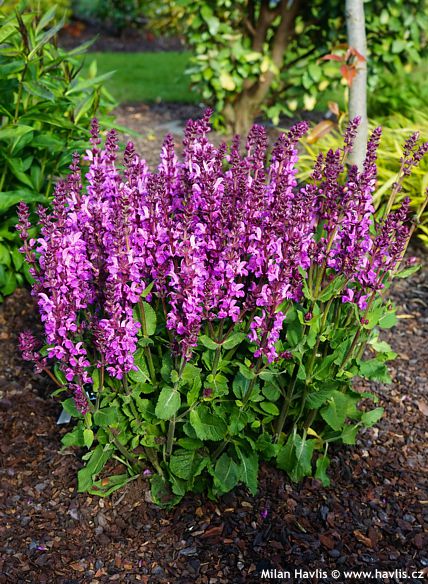
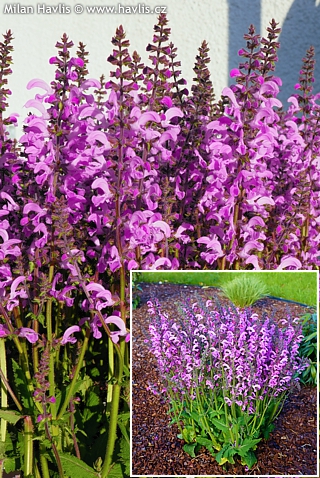
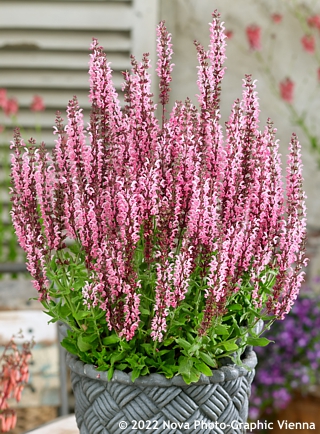
“Chop chop, come on, girls: en pointe, arabesque, relevé and plié!” What else would a young dancer hear from her demanding ballet teacher? Except that this beauty is a sage that only carries the name Ballerina. Yet its colour, lightness, delicacy and grace… that really is a ballerina in full form, isn’t it? Ballerina Pink meadow clary steps into a border like a dancer onto a stage – with large, soft pink flowers that look fuller and more expressive than those of ordinary hybrids. The flower spikes are dense, firm, well-branched and hold their shape even in heat, so the plant stays fresh-looking throughout its flowering period. The foliage forms a compact, dark green mound that doesn’t flop and keeps the plant in an elegant, upright posture. It flowers in May and offers repeat bloom only occasionally. The cultivar was bred by Hans A. Hansen at Walters Gardens, USA, and was granted patent no. PP29957 in 2018.
All meadow-sage hybrids are classic “stage plants”: they need space where their brightly coloured flowers can really shine. They perform best at the front or middle of a border, where you can easily appreciate their upright, compact habit and firm spikes. Their pastel shades combine beautifully with other perennials of the same season, and it is wise to plant species with different flowering times nearby so the border changes gradually through the year. Thanks to their disciplined height they are ideal for smaller gardens, where they never overwhelm the space. I like to pair them with hardy hibiscus, which are only just emerging when the sages are in full flower, and later naturally take over the space once the sages are cut back. They also work wonderfully with grasses, which emphasise their lightness – calamagrostis, deschampsia or low-growing molinia fill the border after the sages finish in a similar, airy way. And the whole composition works surprisingly effortlessly – the border has something to offer all year and behaves completely naturally.
Last update 29-05-2026
Hybrid meadow sages rank among the most reliable perennials for sunny borders. They thrive in full sun and in well-drained, rather dry soil that warms up quickly in spring. They dislike permanently wet ground, but are otherwise remarkably tolerant – coping with poorer soils, summer heat and occasional drought. After the first flush of flowers it is best to cut the plants back hard, almost to the base, which encourages quick regrowth and a second bloom. In spring, simply remove the dry remains of last year’s foliage and lightly clean the clump. Feeding is unnecessary; overly rich soil would only produce softer, floppier stems. These plants are fully hardy and long-lived, making them ideal for plantings where minimal maintenance and consistent performance are expected. Hardiness reaches roughly –37 °C (USDA zone 3), and the plants are suitable even for outdoor containers.