Sambucus nigra 'Sanivalk' INSTANT KARMA European elder, elderberry

 Symbivit Tric (arbuscular)
 Symbivit (arbuscular)
Sambucus
The genus Sambucus belongs to the family Adoxaceae and comprises roughly ten to twelve species distributed mainly across the Northern Hemisphere. The greatest species diversity occurs in Europe, western and central Asia and North America, with a smaller number of species extending into northern Africa and the mountainous regions of South America. Sambucus occupies a wide range of habitats, from floodplain forests and moist thickets to woodland margins and ruderal sites, where it benefits from rapid growth and the ability to resprout readily from roots and stumps. The taxonomy of the genus was long a subject of dispute; botanists tore their hair over herbarium sheets and may even have grabbed each other by the beard in taverns when they could not agree where to place the elder 😊. It was formerly included in Caprifoliaceae or treated as a separate group. Modern phylogenetic studies, however, have firmly anchored the genus within Adoxaceae, where it forms a distinct and well‑defined lineage. Typical traits of the genus include hollow young shoots with conspicuous white pith, opposite pinnate leaves and large, flat inflorescences composed of small five‑petalled flowers. The fruits are small drupes, usually dark purple to black, and red in some North American species. The first formal descriptions of individual species date from the eighteenth century, when Carl Linnaeus (1707–1778) included Sambucus in Species Plantarum (1753).
Humans have been closely connected with elders for a very long time. Older written sources describe it as a protective shrub planted near houses, barns and wells to ward off illness and evil spirits. In some regions it was believed that a household guardian spirit lived within the plant, and the shrub was therefore not to be cut without reason. Its wood, thanks to the hollow shoots, was used for whistles, small tools and fine tubes for craftwork. The flowers and fruits of edible species became the basis of homemade syrups, wines, juices and dyes, and elder gradually moved from the woodland edge into the kitchen. In folk medicine it held an almost sacred position: infusions of the flowers were used for colds, the fruits as a strengthening remedy and the bark as a purgative. Its visual variability then became a tempting target for breeders, who shrewdly noticed the resemblance of some lines to Japanese maples. The twentieth century became the cradle of dark‑leaved, golden‑leaved, variegated and deeply dissected cultivars that, with a little exaggeration, can form almost an entire garden on their own avoiding troubles which are sometimes connected with Japanese maples.
Sambucus nigra, the European elder or elderberry, is the most widespread and best‑known species of the genus, a shrub that has become almost synonymous with the word “elder”. It is native to Europe, western Asia and northern Africa and, thanks to its adaptability, has spread to North America, where it has naturalised in many areas. It grows along woodland margins, in thickets, in floodplain habitats and frequently escapes onto waste ground, where it even copes with poor soils. It tolerates a wide range of soil conditions, thrives in sun or partial shade and succeeds where many other shrubs fail. Its inflorescences, large flat clusters of small white flowers, are among the most characteristic features of the European late‑spring landscape. The fruits ripen to a deep purple‑black and have become the basis of many traditional recipes and modern products. This combination of resilience, rapid growth and striking appearance has made elderberry an ideal starting point for breeding. Its natural variability in leaf colour, vigour and inflorescence size has given breeders a wide field of possibilities, and since the twentieth century cultivars have appeared that no one would have associated with elder a century ago.
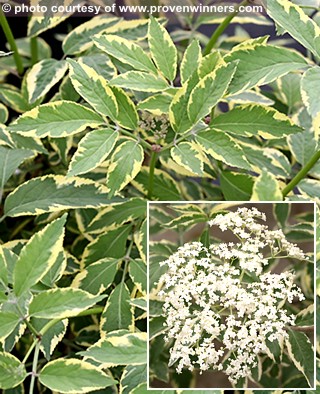
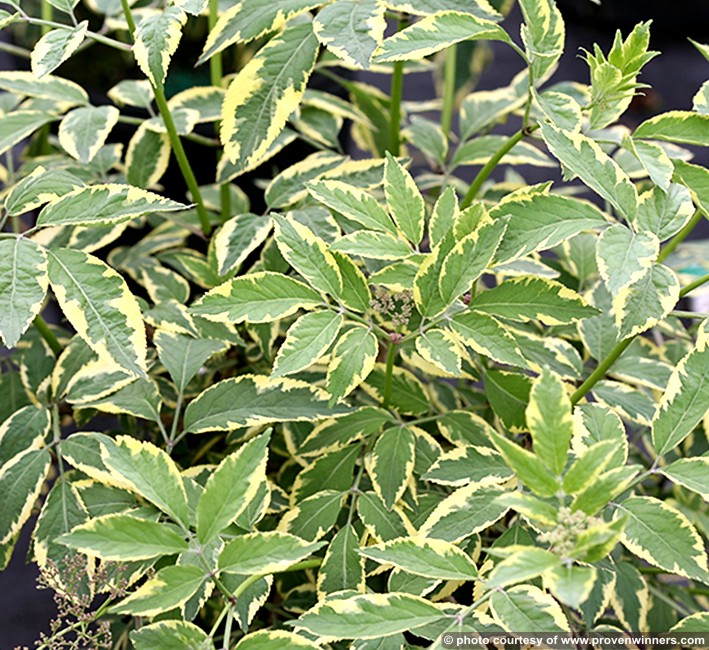
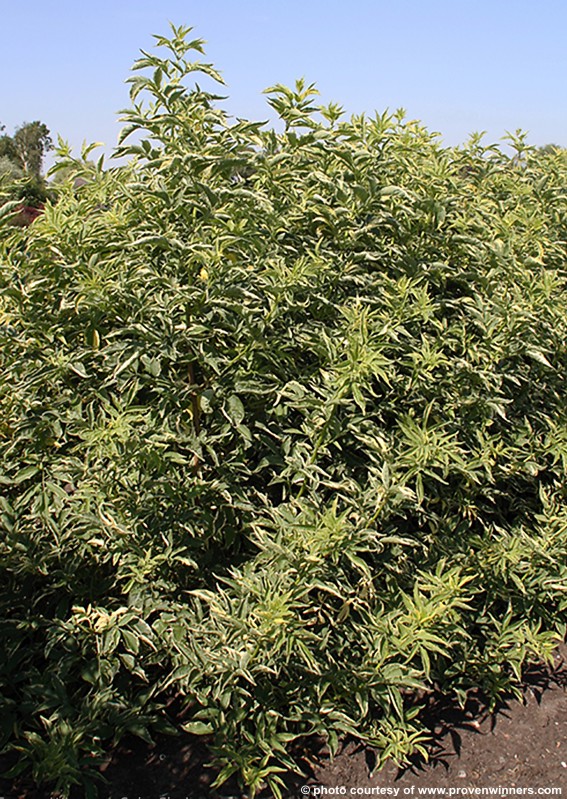
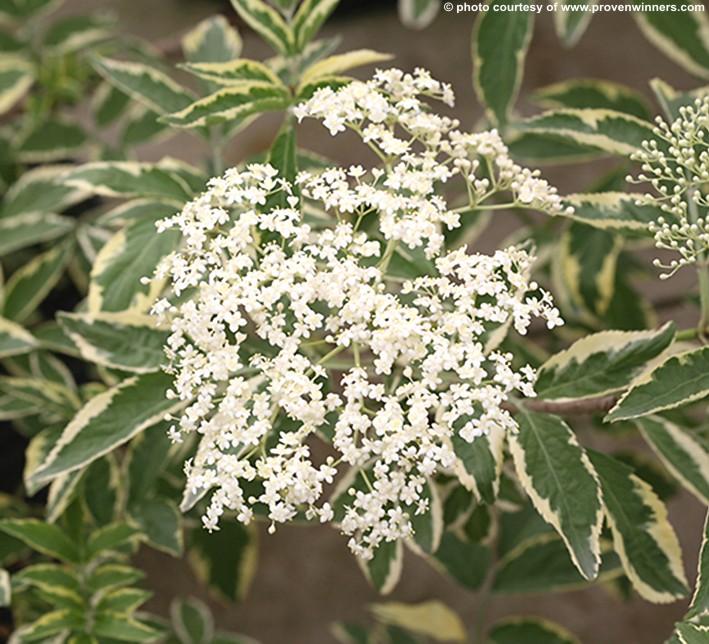
INSTANT KARMA is a unique variety of European elder, found as a natural mutation in England in 2013. It produces variegated leaves with thin, soft yellow margins when young, maturing to almost white in summer. In late spring appear flattened panicles of white flowers which are followed by edible berries in late summer if pollinated by another elder. INSTANT KARMA exhibits medium vigour and makes a shrub about 2.5 tall and wide. Patented as PP28314 in 2015.
Last update 12-02-2018
Black elder thrives in full sun or partial shade and grows best in fertile, fresh to moist soils with good drainage; it tolerates less favourable conditions, too, but does not withstand permanently wet ground. It is a fast‑growing, strongly regenerating shrub that responds well to pruning. Annual spring rejuvenation encourages density, vigour and the formation of young shoots, and older shrubs can be cut back more heavily every few years. Both fruits and flowers are used in the kitchen: fruits for juices, pressed drinks, syrups, jams and homemade wines, flowers eaten raw, used for syrups, sparkling drinks, teas or fried as traditional “kosmatice”. The plant is fully hardy to at least –34 °C, undemanding, tolerant of wind and urban conditions and requires no special protection. It can also be grown in containers, but only under certain conditions: it needs a large pot, preferably wider than tall, protected from overheating, with regular watering and excellent drainage, as its shallow roots dry out quickly and suffer from heat in confined spaces. If given enough space, moisture and protection from summer heat, it can thrive for several years on a terrace or balcony, although in the long term it always performs better in the ground