












.jpg)
Sanguisorba hakusanensis 'LILAC SQUIRREL' Korean burnet

Sanguisorba
The genus Sanguisorba, known as burnet, belongs to the rose family and comprises roughly twenty species distributed mainly across the temperate regions of the Northern Hemisphere, from Europe through the Caucasus and Siberia to North America and eastern Asia. It appears in European herbarium collections as early as the 16th century, when physicians and early botanists mentioned it as a plant with supposed medicinal properties. It was first described by Carl Linnaeus (1707–1778), who included Sanguisorba in Species Plantarum in 1753. Since then, the taxonomy of the genus has been reshuffled several times – some species were temporarily moved to Poterium or Agrimonia – but modern botany recognises Sanguisorba as a distinct and well‑defined lineage. The species inhabit wet meadows, mountain slopes and open woodland edges, often in regions with long winters, which explains their hardiness and ability to form firm, persistent clumps. Fossil evidence is scarce, but several Pleistocene finds suggest that the genus had a broader distribution during the Ice Age.
Sanguisorba hakusanensis, the Korean Burnet, is one of the most graceful and visually dynamic burnets of eastern Asia. Its natural habitat in Japan’s Hakusan Mountains gives it a character that cannot be replicated by any other plant in the garden. It grows on moist subalpine meadows and light woodland clearings at elevations of 1,000 to 2,000 metres, where it moves all summer in the steady flow of mountain wind, appearing as a small, constantly shifting presence. The species was described scientifically by Tomitaro Makino (1862–1957), one of the most influential figures in Japanese botany, based on collections from Hakusan – an area explored by university expeditions since the late 19th century, which gradually produced one of the richest botanical records in Japan. Korean Burnet differs from other species of the genus in the fineness of its inflorescences and the elegance of its clump, which gives it an almost dancing quality. It entered international horticulture only in recent decades, when modern cultivars began to spread, offering stronger colours, longer flowering and firmer flower spikes that preserve the lightness of the wild species while providing a more pronounced garden effect.
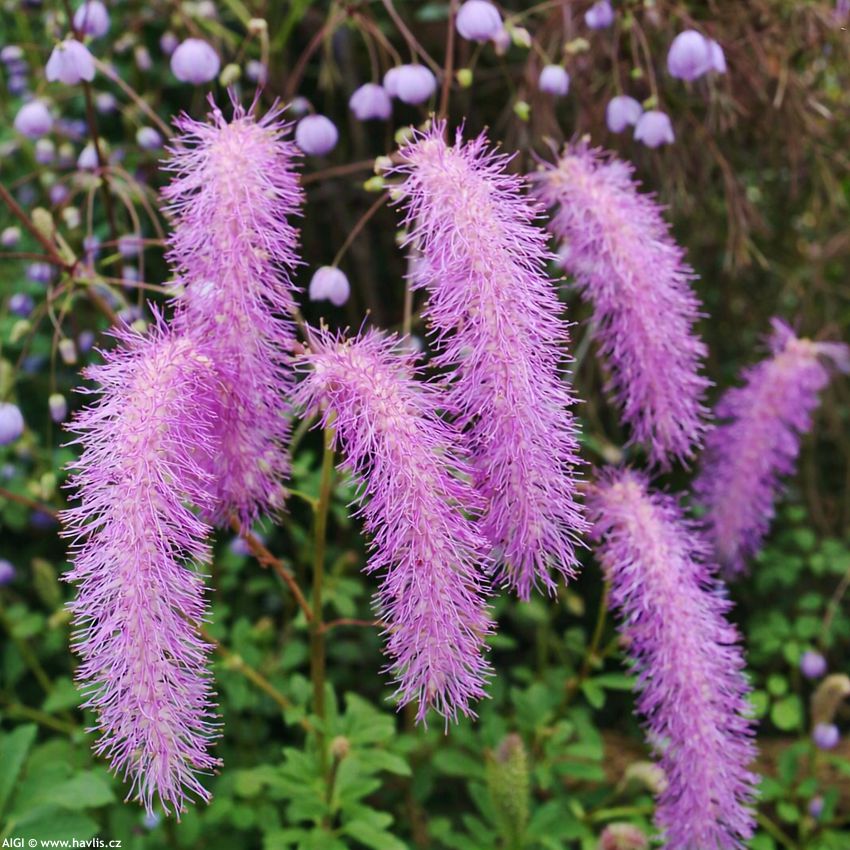
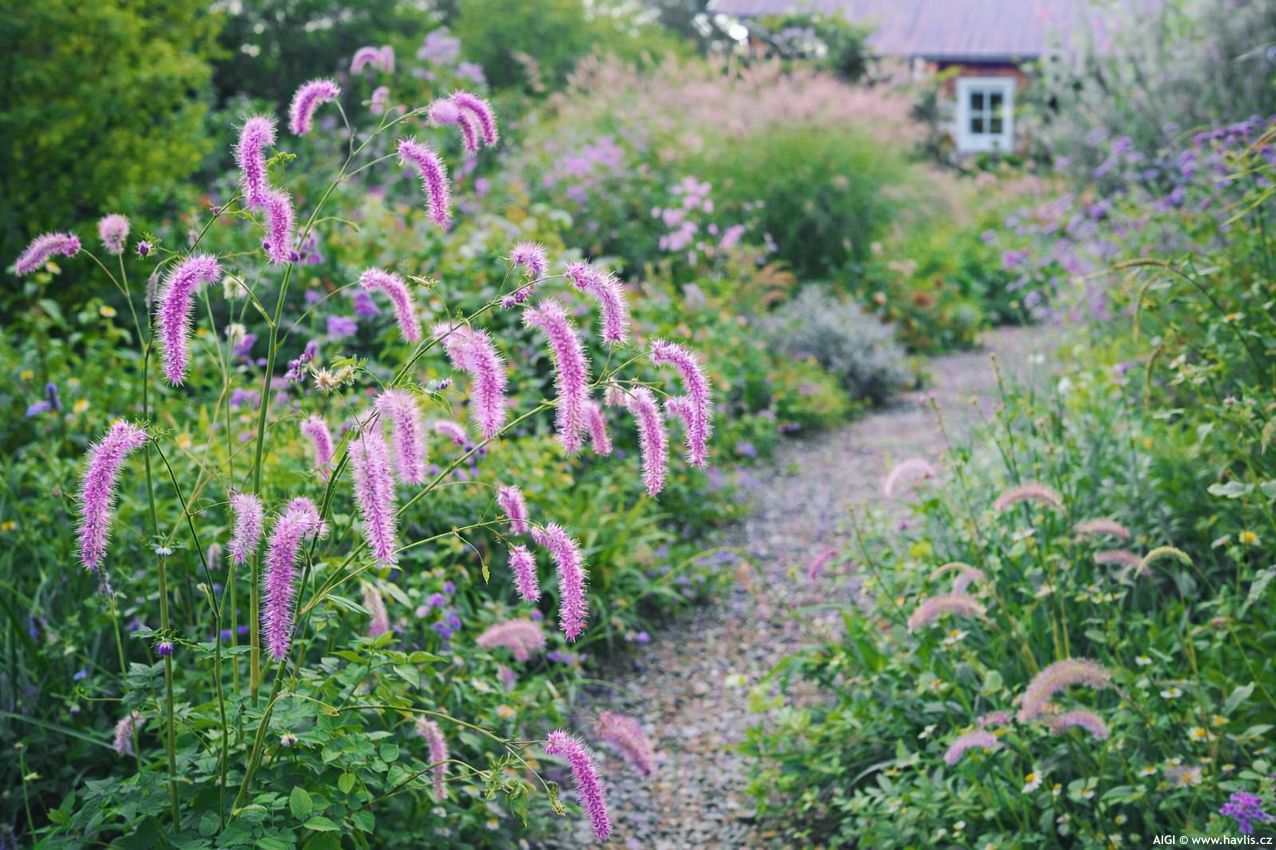
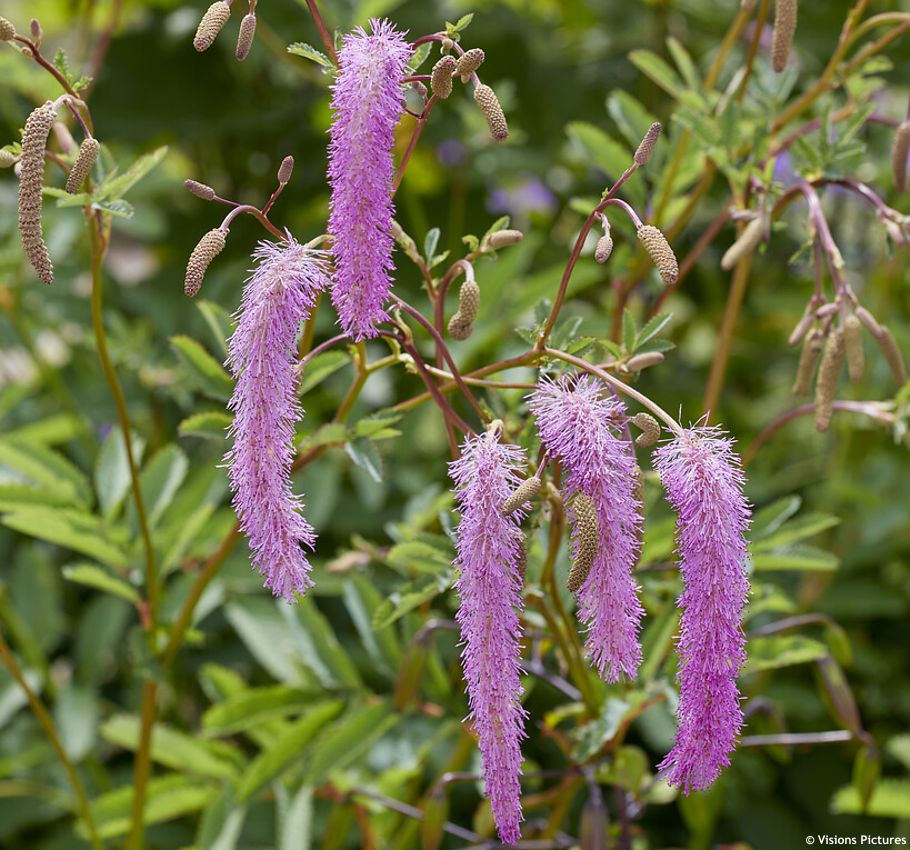
Lilac Squirrel Korean Burnet carries not only its own beauty but also a playful, charming name. And how else could one describe a plant whose inflorescences are as fluffy as the tail of a squirrel or a fox, coloured in soft lilac‑pink shades reminiscent of spring lilacs? The flower spikes reach 20–30 cm and are so light that they move with every breath of wind, just like a squirrel’s tail when the little rascal darts across the grass or climbs a tree. They are pendulous, and as the plant matures, they become longer and more numerous, multiplying the cascading effect until, at full bloom, they resemble a pink avalanche spilling down a slope. Flowering lasts from early August to mid‑September, with no repeated bloom.
The leaves are light green with a pea‑green undertone, matte, pinnate and distinctly serrated along the margins, similar to the leaves of strawberries or potentillas. The clump is airy, with thin, flexible stems that bend in wide arcs in the wind, so the inflorescences never stand stiffly. The cultivar was selected as a modern improvement focused on colour, length and density of the inflorescences – traits that were attractive in the wild species but less pronounced. The aim was to preserve the lightness of Korean Burnet while adding an effect suited to contemporary plantings that demand stronger structure and movement.
It was bred by Hans Kramer (1949–2022) of the Netherlands and introduced around 2012. Kramer was a grower with an exceptional eye for natural plant habit; at his nursery De Hessenhof he created dozens of cultivars that significantly influenced European naturalistic plantings. He worked with many genera – including Sanguisorba, Echinacea, Aster, Helenium, Phlox, Veronicastrum and others – and his plants became reliable staples in the projects of Piet Oudolf.
Korean Burnet lightens planting schemes and adds movement. It forms a tidy, non‑spreading clump (unlike some other burnet species), widening only gradually with age, which makes it suitable even for smaller gardens or places where it needs to stay in one spot. It works best in the middle part of a border or along paths, where its pendulous flower spikes can be seen moving with every breeze. It pairs well with plants that have firmer shapes or more substantial foliage: veronicastrums, deschampsias, solidagos, late asters and phloxes, while the lower layer can be filled with geraniums, dark‑leaved heucheras or persicarias, which provide contrast in both colour and texture. In larger plantings it can be used in groups, but because it is visually prominent, it is better to form larger clumps that create a clear contrast with their surroundings; in broad, uniform plantings it would likely appear excessive.
Last revised 10-10-2026
Sanguisorba hakusanensis is a reliable, long‑lived perennial with modest cultivation requirements. It grows best in full sun to light partial shade and in well‑drained, moderately fertile soil that retains moisture but does not remain waterlogged. It appreciates even moisture, especially during the first two years after planting while establishing its root system; once established, it tolerates ordinary drought, though in extremely dry soils it flowers less. The clump expands naturally with age but remains tidy and does not require control. Feeding can be light, once or twice a year, ideally with compost or a gentle organic fertiliser. Spent inflorescences should be removed to maintain shape and prevent the plant from exhausting itself by producing seed; in autumn it is left to dry naturally and in spring the entire clump is cut back to the ground. The species is fully hardy to about −29 °C (USDA zone 5), needs no winter protection and is not prone to diseases or pests – the most common issue is excessive moisture and heavy, poorly drained clay soils, which may lead to root rot. On the other hand, it tolerates poorer soils, including those that are partly stony or composed of fractured clay that allows water to drain.

Goods are shipped all over Europe. For Russia and U.K. and for further details please read about SHIPPING OPTIONS HERE.
Are you interested in a serious discount for orders NOV-FEB? Check your options here.
THE PRICES INCLUDE VAT of 15%. For quick conversion you can use 1 CZK = approx. 0.04 EUR
- STANDARD QUALITY - Plants of this group are 1st class quality with number of branches and overall density adequate to their size and age, considering they were container grown.
- DE LUXE QUALITY - This label guarantees a luxurious quality of manually selected plants that, compared to their height and age, are exceptionally dense and beautiful.
- EXTRA - These plants are usually mature and bigger specimens with exceptional overall appearance.
- STANDARD (as described in the plant form) means a tree with a trunk of 190-210 cm and a crown at the top, unless specified differently. The commercial size for trees is their girth measured in the height of 1m from ground.
- HOBBY - These plants are of the same quality as our standard-quality plants but younger and therefore cheaper.
- SHRUB - a woody plant with branches growing bushy from the ground level.
- HALF-STANDARD or MINI-STANDARD - a small tree with shorter trunk, its size is usually specified.
- FEATHERED - These are trees with branches growing already from the base of the trunk and up along the stem.
- GRASSES and PERENNIALS - Sizes given usually read the diameter of the pot or the clump, as specified.
