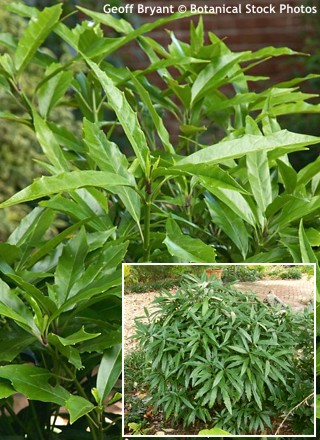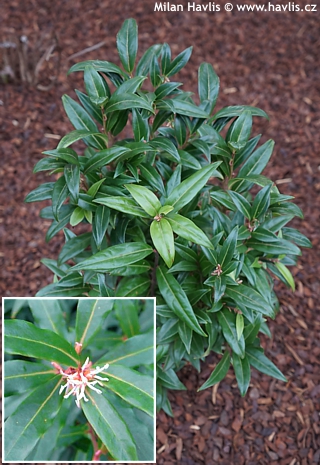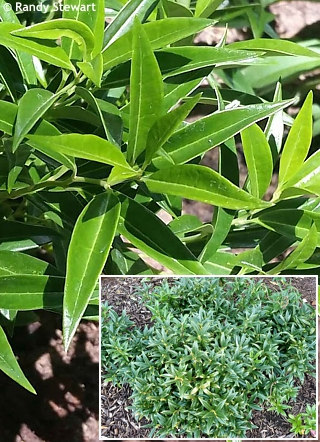





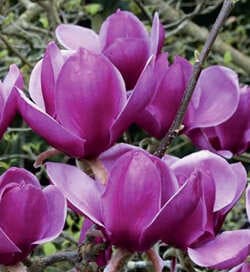






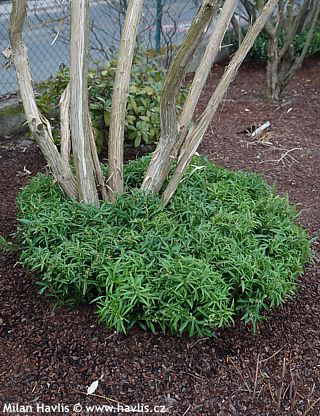


Sarcococca saligna willow-leaved sweet box

 Symbivit Tric (arbuscular)
 Symbivit (arbuscular)
Sarcococca
The genus Sarcococca, commonly known as sweet box, comprises approximately fifteen species of evergreen shrubs and small woody plants belonging to the box family (Buxaceae), distributed from Afghanistan through the Himalayas to China and Southeast Asia. The genus was described by John Lindley (1799-1865) in 1826 and named for its fleshy fruits, reflected in the Greek words sarx (flesh) and kokkos (berry or grain). Although sweet boxes are closely related to boxwood, their taxonomic classification was not always fully settled, and several species were repeatedly transferred between related genera. The greatest diversity of species occurs in the forested regions of the Himalayas and south-western China, where they form part of the evergreen understorey of mountain and foothill forests. For gardeners, sweet boxes represent an attractive group of shrubs combining easy growth in shade, year-round foliage and unusually early winter flowering.
Sarcococca saligna, willow-leaved sweet box, represents the Himalayan branch of the genus, with a story reaching back to the very beginnings of botanical exploration in this part of Asia. The species was first described by David Don (1799-1841) in 1825 under the name Buxus saligna, while its current placement within the genus Sarcococca was published by Johannes Müller Argoviensis (1828-1896) in 1869. The epithet saligna means “willow-leaved” and refers to its narrow foliage reminiscent of willow (Salix) leaves, a feature that readily distinguishes it from most other sweet box species. Its natural range extends from Pakistan and the western Himalayas through Nepal and northern India into other parts of southern and south-eastern Asia, making it one of the most widely distributed members of the genus. Although cultivated today chiefly as an ornamental shrub valued for its winter fragrance and evergreen character, it is also known in northern Pakistan under the local name “sheha”, where it has been used in traditional medicine for generations.
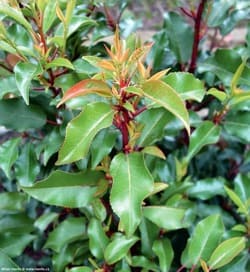
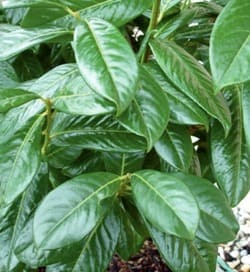
Willow-leaved sweet box is a charming, low-growing evergreen shrub whose narrow leaves genuinely resemble those of a willow, except that they remain on the plant throughout the year. They are up to 14 cm long, fresh green, leathery, and highly glossy. In the latter half of winter, once temperatures rise above freezing for several consecutive days, the tiny, white, tassel-like flowers begin to open. Unlike all other commonly grown sweet box species, they are only faintly fragrant or completely scentless, yet they tolerate night-time temperature drops several degrees below freezing without damage. The female flowers are later followed by small, black, fleshy fruits, which are neither edible nor poisonous.
Willow-leaved sweet box is treasured for its slightly cascading character. Its slender stems gradually arch with age, giving the shrub the appearance of a miniature bamboo and making it particularly well suited to quiet corners and Japanese-inspired or zen-style gardens. It grows slowly and eventually reaches about 1.5 metres in height, although this takes time as the plant first spreads outward before gaining height. It is often used beneath taller multi-stemmed shrubs or trees and, once established, becomes remarkably drought tolerant. It creates an elegant evergreen presence in places where a lack of sunlight prevents most other plants from thriving, yet where something attractive is still desired. Willow-leaved sweet box is reliably hardy down to at least -18 °C, and ongoing observations suggest it may tolerate a few degrees lower still.
Last update 04-03-2023; 15-11-2026
Most sweet boxes are elegant, naturally compact shrubs that require little if any pruning. Should shaping or size control be necessary, prune shortly after flowering and only lightly so that the plant retains its natural character. Many species gradually spread by short underground rhizomes, eventually forming continuous colonies unless restrained by root barriers or weed-suppressing fabric. They perform best in partial shade or full shade, where their foliage retains a rich, healthy colour throughout the year. They can also be grown in full sun but will require additional moisture and may suffer leaf scorch after severe winters when bright sunshine coincides with frozen ground.
Sweet boxes are valuable as evergreen ground cover or as smaller structural shrubs beneath tree canopies, along shaded paths, or in secluded corners where many other evergreens struggle to thrive. They prefer well-drained, humus-rich soil of acidic to neutral reaction with even moisture, although established plants cope surprisingly well with long periods of drought. We recommend maintaining a layer of mulch, which protects the shallow root system against both summer heat and winter temperature fluctuations. Although often recommended only for the mildest regions of Central Europe, experience from recent years suggests that, given a sheltered position, they cope perfectly well with ordinary winters across much wider areas, provided they are not exposed to prolonged frost without snow cover or drying winter winds.