










.jpg)
Sedum (Hylotelephium) 'NIGHT EMBERS' orpine

 Symbivit Tric (arbuscular)
 Symbivit (arbuscular)
Sedum
The genus Sedum is one of the largest genera in the family Crassulaceae, comprising more than 400 species native to a wide range of the Northern Hemisphere, from the Atlantic to the Far East and from arctic regions to subtropical mountains. The first scientific consolidation of the genus was made by Carl Linnaeus in 1753 in Species Plantarum, where he described European species based on their succulent leaves and star-shaped flowers. In the 19th century the genus became a subject of intensive botanical interest: Joseph Nelson Rose (1862–1928) and Nathaniel Lord Britton (1859–1934) studied North American species, while Alwin Berger (1871–1931) highlighted the marked differences between ground-covering species and tall, stem-forming ones. In the 20th century the genus expanded further thanks to European and Asian botanists who described new taxa from the Caucasus, Central Asia and the Far East. Individual groups differ according to local climate: European species are mostly low, mat-forming, often evergreen and flowering in spring or summer; Central and East Asian species exhibit later growth and flowering; North American taxa include alpine species as well as prairie forms adapted to drought and intense sunlight; southern Europe and Asia Minor host species with extreme tolerance to summer heat, which limit growth during the hottest part of the year.
Tall, stem-forming species were historically placed within the same broad genus Sedum, but already in the 19th century Alwin Berger (1871–1931) noted that these species differ significantly from low, mat-forming stonecrops in both morphology and phenology. Chloroplast DNA analyses later showed that the tall group forms a separate evolutionary lineage, while the genus Sedum as a whole is polyphyletic. Based on these results, Hideaki Ohba (*1948) reinstated the original genus Hylotelephium in 1995, which had a valid historical name, and authoritative databases therefore prioritise the name Hylotelephium telephium.
Hylotelephium telephium is one of the longest-known and culturally most significant tall stonecrops of Eurasia. In northern Europe it was a common part of traditional gardens and open landscapes, and in folk medicine it was valued as a source of “living water” because its fleshy leaves were used as soothing poultices. Its horticultural importance stems from exceptional adaptability: it grows across a wide belt from the Atlantic to Siberia, tolerates poor soils, drought and frost, and its appeal is not limited to late summer flowering, as it often offers attractive foliage in several colours. When Asian species such as H. spectabile began to be cultivated in the 19th century, it became clear that H. telephium hybridises readily with them, producing plants with larger inflorescences, stronger structure and more vivid colours. These interspecific hybrids became the foundation of modern cultivars that dominate autumn perennial borders. They combine the robustness and cold tolerance of H. telephium with the showy flowers and late seasonal peak of H. spectabile.
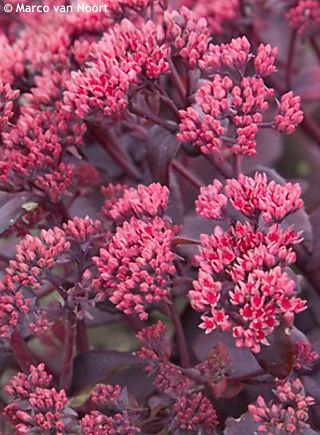
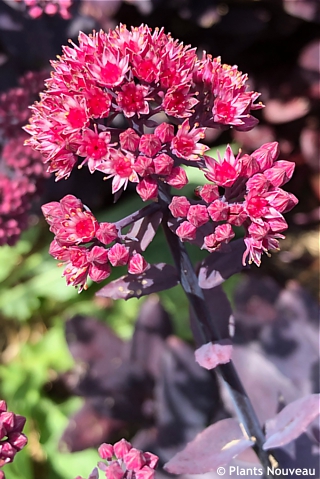
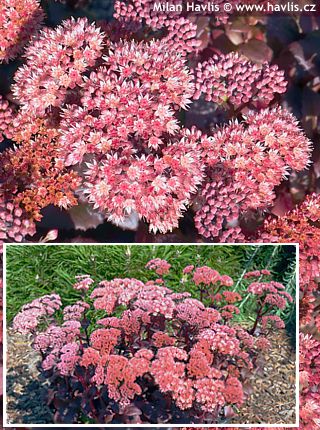
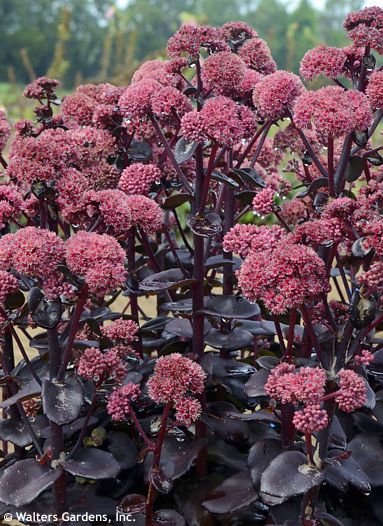
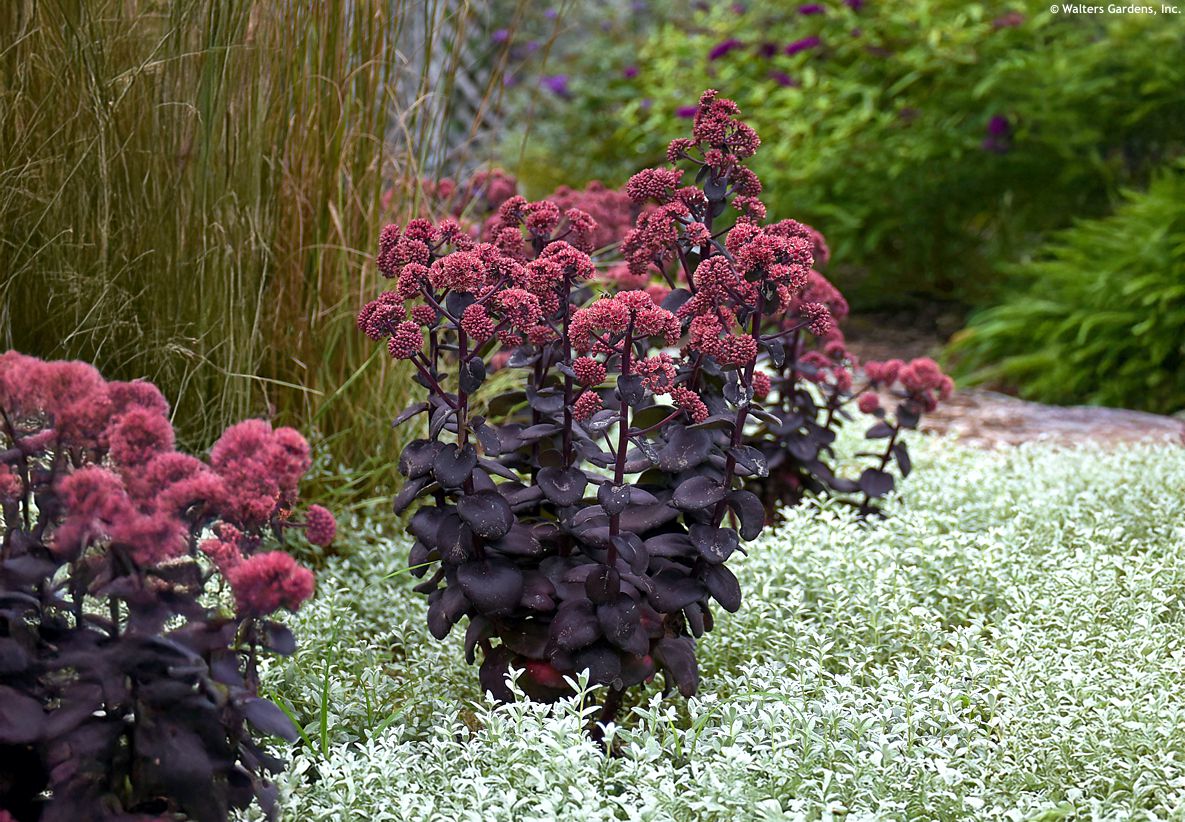
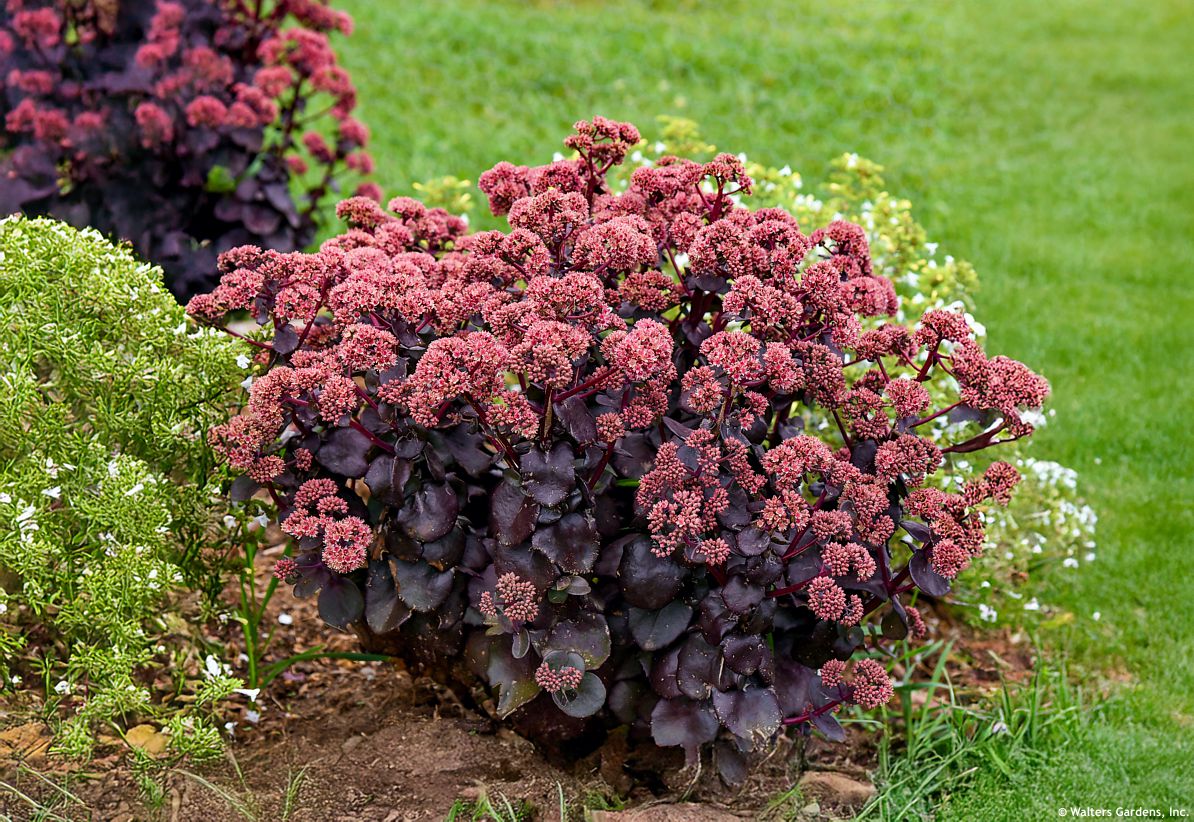
Are you drawn to bold garden structure? They’re called “architectural features” for a reason. 😊 Night Embers stonecrop demands attention even from a distance – it stands like a dark sculpture among pastel-toned perennials. Its undeniable focal point is the foliage: plum-purple to almost black, fleshy, ovate to rounded leaves with striking metallic sheen – neither glossy nor matte. They grow along fleshy stems reaching 50–60 cm tall, topped by rounded clusters of small, star-shaped flowers that appear in late summer. They are dusty pink to light mauve which makes a stunning contrast against dark backgrounds, like flames glowing in twilight.
The plant grows upright, forming a narrow vase-shaped clump about 50–60 cm wide when mature and maintains a tidy form without flopping. The foliage is highly resistant to powdery mildew, so spraying is rarely necessary. Its nectar-rich flowers attract bees and provide vital forage at the start of autumn. They bloom for roughly six weeks before the flower heads begin to dry. If you don’t mind their faded look and the stems remain firm, leave them on the plant—they decorate autumn beds beautifully when covered in hoar.
This cultivar was bred by American perennial guru Hans A. Hansen from Walters Gardens in Michigan and is protected under patent no. PP29211 from 2018. Night Embers loves full sun, where its colours shine brightest, and thrives with minimal watering, making it an excellent partner for drought-loving plants. For maximum effect, use bold contrast – think silver foliage like Santolina, Helichrysum or Artemisia. Garden classics such as brightly coloured Echinacea or compact rockery friends like Delosperma, Dianthus, or low-growing Gypsophila are great matches. You can also play with texture by adding smaller drought-tolerant grasses like steel-blue, beige, or fresh green Festuca.
Last update 25-07-2025
Orpine requires full sun and a well-drained, rather lean soil. Heavy soils that remain wet for long periods reduce its vitality and the number of flowering stems, and they are a common cause of premature decline. Watering should be moderate, as the species is naturally adapted to dry spells and excess moisture leads to softening of the tissues, bending or even breaking of longer stems, and lower resistance to fungal diseases. Feeding is not necessary, or only very light in spring, so that growth does not become excessive at the expense of a firm structure. If powdery mildew appears on the leaves, it is important to act quickly with an appropriate treatment to prevent the foliage from being spoiled for the rest of the season.
In early spring, cut all old stems back to just above ground level, carefully, not to damage the basal crowns where the small, folded buds of future leaves are often visible from autumn onwards. The plant is long-lived and stable, but after several years the clump may lose its compact shape; at that point it is best divided and rejuvenated in spring. If a lower height is desired, the stems can be shortened from mid to late June: removing the upper third to a half of the shoots encourages branching and produces a lower, denser habit. This intervention delays flowering slightly, but the inflorescences are usually firmer, and the plant holds its shape better. Tall cultivars respond well to this mid-season pruning, while the species remains naturally restrained. Orpine grows well in containers, too, provided there is a drainage layer and no saucer underneath, so that all excess water can run off freely. Most cultivars are fully hardy to about -40 °C (USDA zone 3), and some tolerate even lower temperatures without requiring winter protection.