

































Spiraea japonica ('Shirobana') 'GENPEI' Japanese spiraea

 Symbivit Tric (arbuscular)
 Symbivit (arbuscular)
Spiraea
Genus Spiraea was first described by Carl Linnaeus in 1753 in his Species Plantarum. The name derives from the Greek word speira – “wreath” – referring to the delicate arrangement of flowers into wreath‑like corymbs. Spiraeas comprise around seventy species of deciduous shrubs distributed across the temperate regions of the Northern Hemisphere. Botanists traditionally divide them into three groups based on inflorescence type: the salicifolia group with terminal panicles, the japonica group with flat corymbs, and the canescens group with simpler corymbs on short lateral shoots. The advantage of this classification is clarity – gardeners can easily infer flowering time and pruning method. Its drawback is artificiality: boundaries are not always clear and hybrids between groups complicate taxonomy. Nevertheless, the system helps navigate the rich assortment and simplifies practical decisions.
Spireas became renowned not only for their beauty but also for chemical compounds isolated from them – salicylates, which formed the basis of aspirin, one of the most famous drugs in modern history. Its effects against pain, fever, and inflammation profoundly shaped twentieth‑century medicine. The first introductions of spiraeas into European gardens occurred in 18th and 19th centuries, when new species were imported from China and Japan. In England and France, they quickly became fashionable shrubs, offering abundant flowering and ease of cultivation. Modern research further shows that the Spiraea japonica complex is key to understanding the evolution of East Asian flora: genetic studies reveal differentiation beginning in the early Miocene more than 20 million years ago. Three evolutionary lineages emerged, each with unique diterpenoid alkaloids tied to specific regions – the Hengduan Mountains, central China, and eastern China. Japanese populations formed via a continental land bridge about 6.7 million years ago and have maintained stable demographics ever since. This history illustrates how spiraeas became part of the broader geological and botanical story of East Asia.
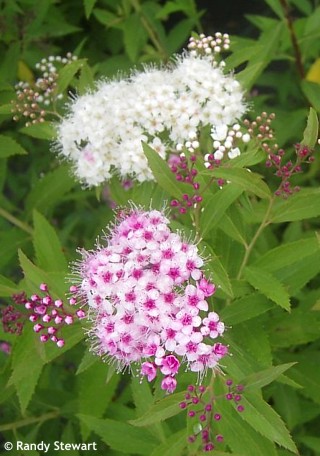
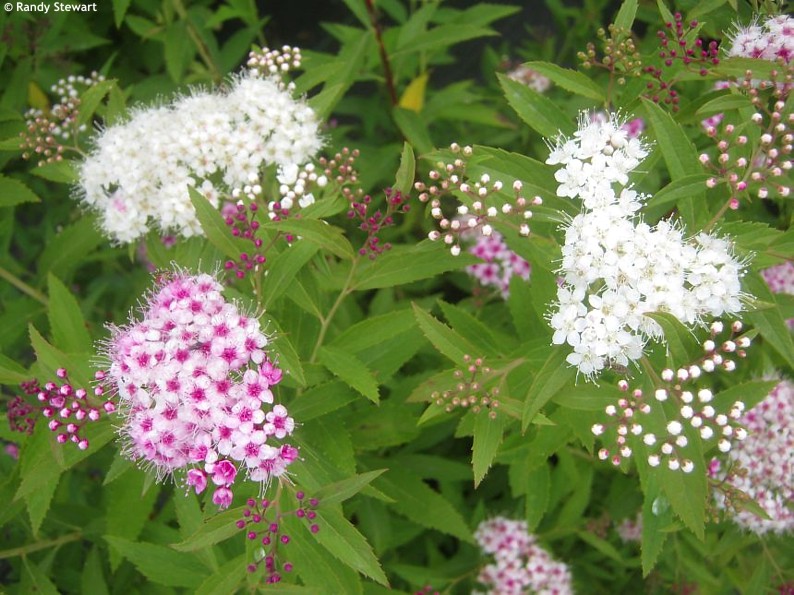
Genpei is a newer preferred name for this variety of Japanese spiraea that is commonly available in the nursery trade as Shirobana. It is truly an interesting piece with bi-coloured flowers. The corymbs come out in either rich pink colour or pure white. Sometimes one corymb may consist of flowers of both the colours and it has nothing to do with flower maturity. The leaves are a little darker green than on the species, more narrowly elliptic, shallowly serrated at margins. If regularly deadhead, at least once a week, the shrub will continue looking pretty and fresh without those ugly and dry seedpods. Moreover, blooming can be extended to early September this way. It naturally forms a low shrub of somewhat prostrate habit if neglected.
Last update 04-02-2014
Japanese spiraea ranks among the most reliable and least demanding ornamental shrubs – we call it simply “foolproof.” It thrives in full sun or partial shade, though the richest flowering and foliage colours occur in sunny sites. It can taky virtually any soil type from ordinary garden soil to much poorer mixtures combining construction leftovers and imported dirt. It tolerates drought as well as short‑term waterlogging, and it will even grow in medium‑heavy clay; high fertility or special preparation is not required. Yet in good soil and with regular watering it will look its best and flower longer and repeatedly. Its root system is compact, making it suitable for container culture. Pruning is best done in spring, since it flowers on new wood; shortening shoots promotes density and abundant bloom, and removing spent corymbs can trigger a second flush in late summer. Feeding is not necessary, though a light spring feed after leaf emergence is possible. The species is resistant to browsing by deer, non‑toxic to domestic and farm animals, and very cold‑hardy, tolerating temperatures down to –34 °C requiring no winter protection (USDA zone 4).

