

































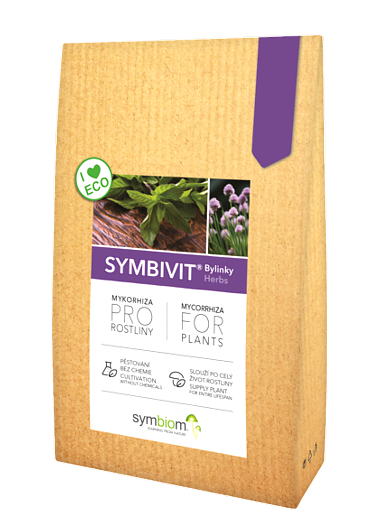
SYMBIVIT® BYLINKY Mycorrhizal fungi
WHAT IS MYCORRHIZA?
In very simple terms, mycorrhiza can be described as a friendly relationship between a plant and certain soil fungi, a system created by nature itself. However, such a simplified explanation is not sufficient for a curious mind, so here is a more detailed description.
Where can we find it?
Many of us go to the forest to collect mushrooms. As we all know, every mushroom grows from an underground network called mycelium, and this is the part that is extremely important for us. Each mycelium consists of a network of tiny fungal filaments. These filaments are the soil mycorrhizal fungi, which are essential because of their ability to connect to plant roots and grow continuously.
Why is this ability so important?
Thanks to this remarkable ability of soil fungi to connect to plant roots, the effective root system of the plant increases many times over. In addition, these microscopic filaments are able to absorb water and nutrients from the surrounding soil much more efficiently. As a result, the plant is significantly better nourished, which leads to improved growth.
The most extraordinary feature of soil fungi is their cooperation with plants and their support throughout the entire life of the plant.
How do we obtain mycorrhiza?
Everything begins in the mycelium. However, if you think that enriching the soil with mycelium alone is sufficient for your plants, we must disappoint you. Although mycelium does contain various soil fungi, they are present in such small quantities that no noticeable effect would occur. This is why we focus on their propagation and processing, so that every grower can benefit from them.
Is there only one type of soil fungi?
On the contrary, there are many different types. Specialists therefore gradually isolate individual fungi from the mycelium, multiply them, and process them so that they meet the specific needs and requirements of growers and customers. Different plant species require different types of mycorrhizal fungi, and this can only be achieved through professional processing.
Is mycorrhiza a fertilizer?
No. Mycorrhizal fungi are living organisms. They are able to support plants throughout their entire life, something no fertilizer can achieve. Fertilizers are important because fungi can also draw nutrients from them for their own growth. However, the best results are achieved when mycorrhizal fungi are combined with natural fertilizers, such as Conavit®.
SYMBIVIT® BYLINKY is a granular product based on the excellent properties of arbuscular mycorrhizal fungi, which form a natural symbiosis with the roots of most aromatic and medicinal herbs. It is easy to use and allows your herbs to draw the best support for healthy growth, rich aroma, and overall vitality. The mycorrhizal fungi contained in Symbivit® Bylinky connect to plant roots, absorb nutrients from the soil, and support the plant throughout its entire life. Thanks to this symbiosis, plants are better able to withstand stressful conditions such as drought, transplanting, or pathogen pressure.
The effect of SYMBIVIT BYLINKY includes:
- improved nutrition, growth, and overall health of herbs
- a higher content of aromatic compounds
- reduced need for watering and fertilization
- increased resistance to stress such as drought or transplanting
- suitability for herbs grown on slopes due to its positive effect on soil stabilization.
The product is suitable for:
- aromatic and medicinal herbs such as mint, lemon balm, sage, thyme, basil, rosemary, lavender, calendula, chamomile, and others
- most flowers and vegetables that form arbuscular mycorrhiza
- herbs grown in containers, window boxes, and garden beds.
This product is NOT suitable for
- plants from the Brassicaceae family such as broccoli, cauliflower, cabbage, kale, kohlrabi, radish, cress, horseradish, and others
- plants from the Chenopodiaceae family such as beetroot and spinach
- plants from the Amaranthaceae family
- other plant families specifically described in the list of recommended use
For ericaceous plants such as rhododendrons, azaleas, and blueberries, use the product RHODOVIT®. For coniferous trees such as pine, spruce, fir, and some deciduous trees such as beech, oak, and birch, use the product ECTOVIT®.

Goods are shipped all over Europe. For Russia and U.K. and for further details please read about SHIPPING OPTIONS HERE.
Are you interested in a serious discount for orders NOV-FEB? Check your options here.
THE PRICES INCLUDE VAT of 15%. For quick conversion you can use 1 CZK = approx. 0.04 EUR
- STANDARD QUALITY - Plants of this group are 1st class quality with number of branches and overall density adequate to their size and age, considering they were container grown.
- DE LUXE QUALITY - This label guarantees a luxurious quality of manually selected plants that, compared to their height and age, are exceptionally dense and beautiful.
- EXTRA - These plants are usually mature and bigger specimens with exceptional overall appearance.
- STANDARD (as described in the plant form) means a tree with a trunk of 190-210 cm and a crown at the top, unless specified differently. The commercial size for trees is their girth measured in the height of 1m from ground.
- HOBBY - These plants are of the same quality as our standard-quality plants but younger and therefore cheaper.
- SHRUB - a woody plant with branches growing bushy from the ground level.
- HALF-STANDARD or MINI-STANDARD - a small tree with shorter trunk, its size is usually specified.
- FEATHERED - These are trees with branches growing already from the base of the trunk and up along the stem.
- GRASSES and PERENNIALS - Sizes given usually read the diameter of the pot or the clump, as specified.
