Veronica longifolia 'MARIETTA'® long-leaved speedwell

 Symbivit Tric (arbuscular)
 Symbivit (arbuscular)
Veronica
The genus Veronica belongs among the most numerous and the most diverse groups of flowering plants of the temperate zone. It includes several hundred species distributed almost worldwide, from alpine meadows and forest understories to dry steppes and coastal rocks. It was described in the 18th century by Carl Linnaeus, who adopted an already established name linked to the legend of Saint Veronica. The legend says that she offered Christ a piece of cloth during his arduous journey to Golgotha, with which he wiped sweat and blood off his face. His image was said to have miraculously imprinted itself on the fabric, the so‑called vera icon, or “true image”. This idea of a faithful, unembellished imprint of reality was symbolically transferred in pre‑modern botany to speedwells, whose small, clearly drawn flowers were perceived as honest and needing no adornment.
Long-leaved speedwell (Veronica longifolia) is a European perennial, first described botanically in 1753. It is a characteristic species of damp meadows and river floodplains across Central and Northern Europe, where it formed a natural part of the traditional agricultural landscape for centuries. In meadow communities it was valued as a stable, long‑lived perennial able to tolerate repeated mowing while continuing to provide forage for pollinators during high summer, when many other meadow species had already finished flowering. Its prominent spike‑like inflorescences are an important nectar source for bumblebees, solitary bees, and butterflies, and the species is still regarded as an indicator of well‑preserved, species‑rich grasslands. It reached North America unintentionally, mainly through seed and hay imported from Europe during the 19th century. Although it has locally naturalised on moist sites in parts of the north‑eastern and midwestern United States, it has never behaved invasively and remains scattered and localised. Owing to its combination of adaptability, ecological value, and non‑invasive behaviour, it has become one of the key parent species in modern breeding, particularly for the development of cultivars with longer inflorescences and an extended flowering period.
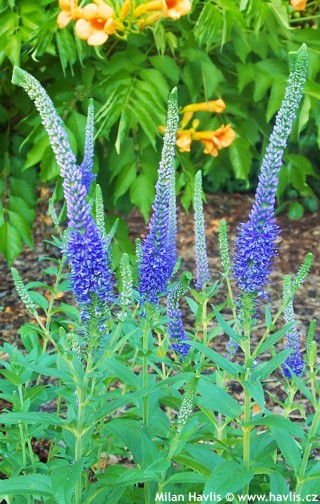
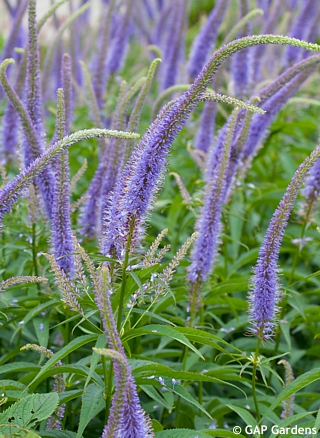
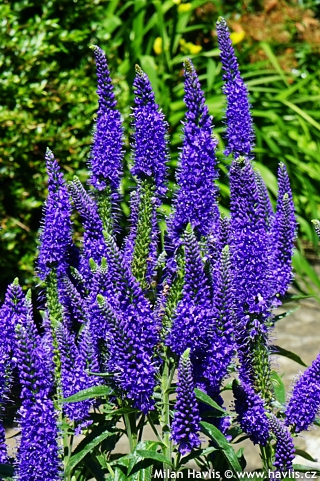
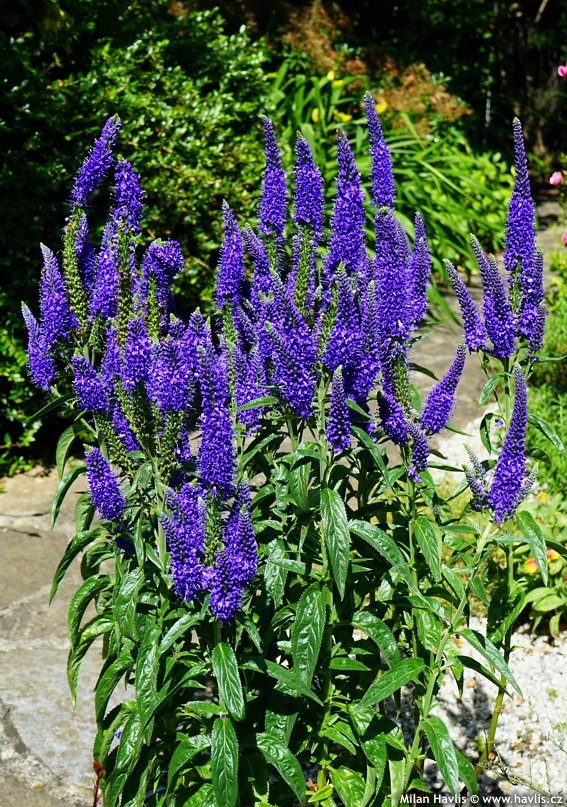
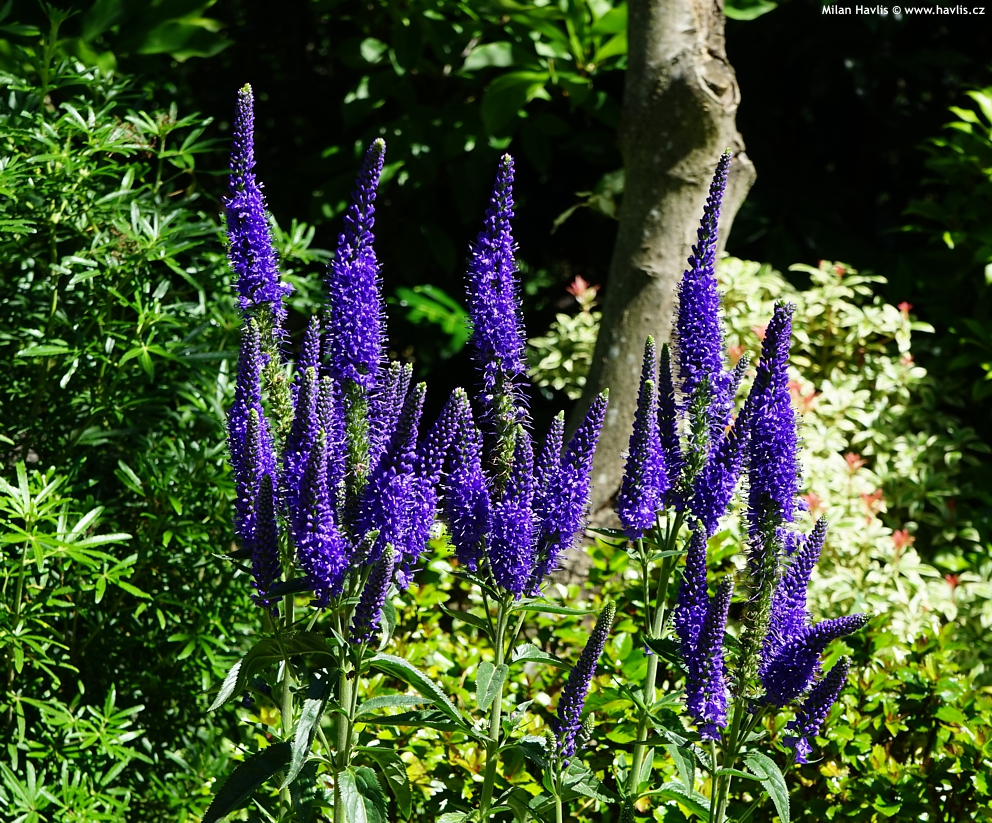
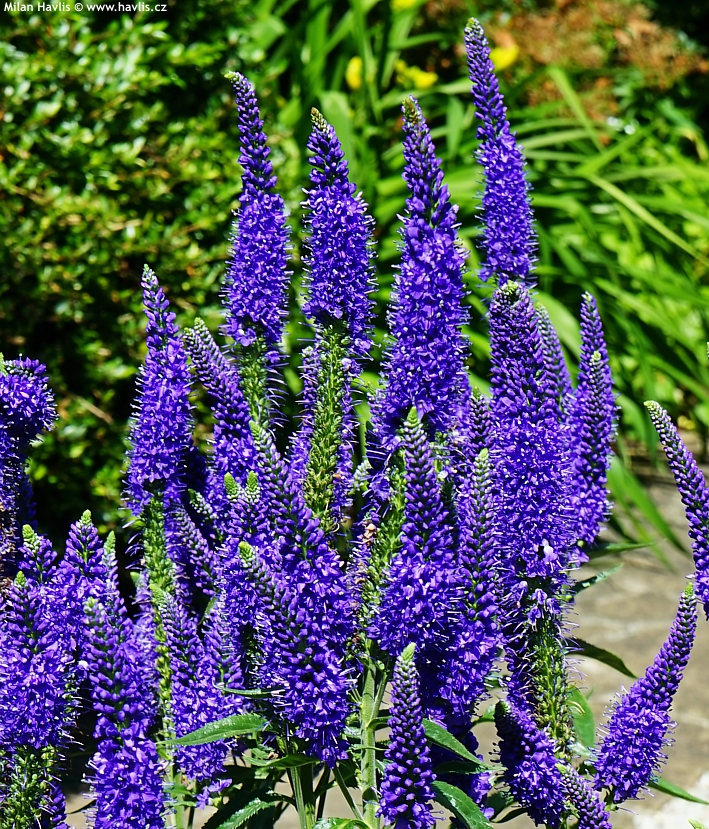
Marietta® is a breathtaking cultivar of long-leaved speedwell, offering perhaps the darkest indigo‑violet shade we have yet seen within this species. Its spike‑like inflorescences measure 13–15 cm in length and appear atop 60–70 cm tall stems from mid‑June, typically flowering for around three weeks. If the spent spikes are removed promptly after the main flush, the plant quickly produces new inflorescences from lower nodes and continues flowering well into September. The leaves are broadly lanceolate, dark green, with finely serrated margins. The cultivar was discovered in 2008 as a natural mutation of the cultivar ‘Allmelanie’ by the Dutch breeder Ruud Klein, who is also responsible for the striking variegated cultivar ‘Charlotte’. The plant was patented in 2015 under patent number PP25248.
Thanks to its deep, velvety dark colouring, Marietta® appears in the border as a bold yet calm vertical brushstroke. Among lighter flowers and perennials of contrasting texture, its spikes sway gently, as if awaiting the arrival of bees, bumblebees, and butterflies of every kind. The tone of the flowers shifts with the light – sometimes cool and restrained, at other times touched by a violet dusk, and under the heat of high summer sun it appears as though drenched in the richest ink. In modern plantings, combined with oxeye daisies, coneflowers, or rudbeckias, it brings depth and presence to the composition, while in more naturalistic gardens it feels entirely at home, like a fresh note among the muted colours of meadow flowers.
Last update 19-07-2020; 27-12-2025
Long‑leaved speedwell is an undemanding and reliable perennial that performs best in full sun to light partial shade, provided the soil retains sufficient moisture. It prefers deeper, humus‑rich soils that remain evenly moist, but will also tolerate ordinary garden conditions as long as the soil does not dry out completely during summer. In drier locations it benefits from occasional watering, especially during the period of bud formation. After the main flush of flowering, spent stems can be cut back to encourage the development of new shoots and often a lighter repeat bloom. The plant is fully frost‑hardy to approximately −34 °C and requires no winter protection; it can remain in the same position for many years without the need for transplanting, although older clumps benefit from rejuvenation by division after several seasons. It is also suitable for year‑round cultivation in outdoor containers, provided regular watering is maintained.

.jpg)