

































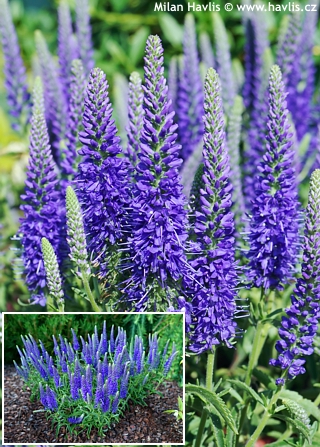
Veronica spicata 'Novaverblu' MOODY BLUES® DARK BLUE spiked speedwell

 Symbivit Tric (arbuscular)
 Symbivit (arbuscular)
Veronica
The genus spikewell – Veronica belongs among the most numerous and the most diverse groups of flowering plants of the temperate zone. It includes several hundred species distributed almost worldwide, from alpine meadows and forest understories to dry steppes and coastal rocks. It was described in the 18th century by Carl Linnaeus, who adopted an already established name linked to the legend of Saint Veronica. The legend says that she offered Christ a piece of cloth during his arduous journey to Golgotha, with which he wiped sweat and blood off his face. His image was said to have miraculously imprinted itself on the fabric, the so‑called vera icon, or “true image”. This idea of a faithful, unembellished imprint of reality was symbolically transferred in pre‑modern botany to speedwells, whose small, clearly drawn flowers were perceived as honest and needing no adornment.
Spiked speedwell is our native European perennial, botanically described as early as the 18th century. In the wild, it grows on dry meadows, steppe slopes, and open hillsides of Europe and western Asia with well‑drained soils, where it forms firm, compact clumps and blooms in upright spikes. It belongs to the group of speedwells adapted to full sun and relatively dry conditions. The inflorescences appear from early summer and give the plant a clear, vertical silhouette which distinguishes it from creeping or ground‑covering species. It is often hybridized with related species (V. longifolia, V. incana) to obtain longer inflorescences, slightly different foliage, or increased drought tolerance. The combination of its simplicity and natural beauty has ensured its long‑standing popularity in cottage and naturalistic gardens, and in England it has even become the official flower of Montgomeryshire in Wales.
The MOODY BLUES® series of speedwells originated in the United States as the result of a targeted experiment with the cultivar ‘Tickled Pink’, whose seeds were irradiated to induce genetic mutation. This intervention produced five colour variants, which first flowered in the summer of 2012 and attracted attention for their exceptionally compact habit and rich, saturated colours. The project was led by breeder Michael S. Dobres, who developed the series for Ball Horticultural Company in West Grove, Pennsylvania; plant patent PP26602 was granted in 2016.
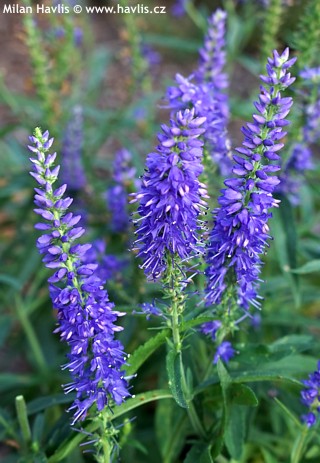
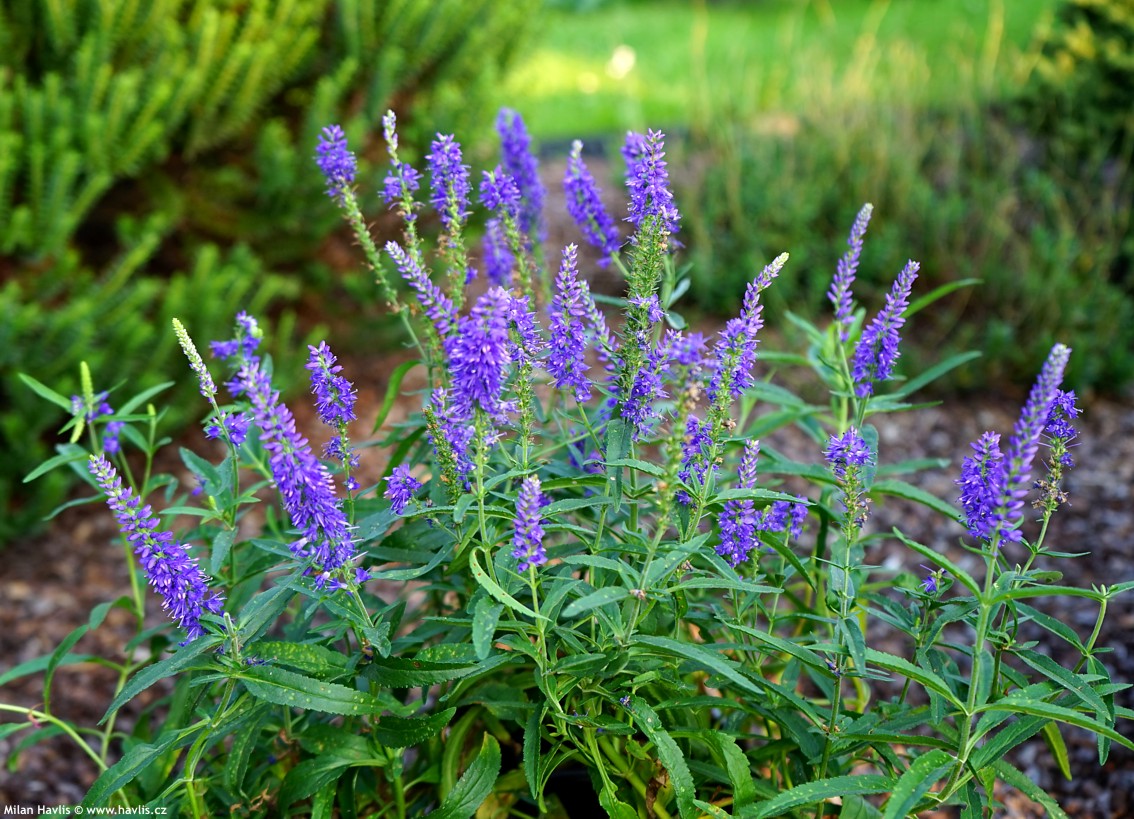
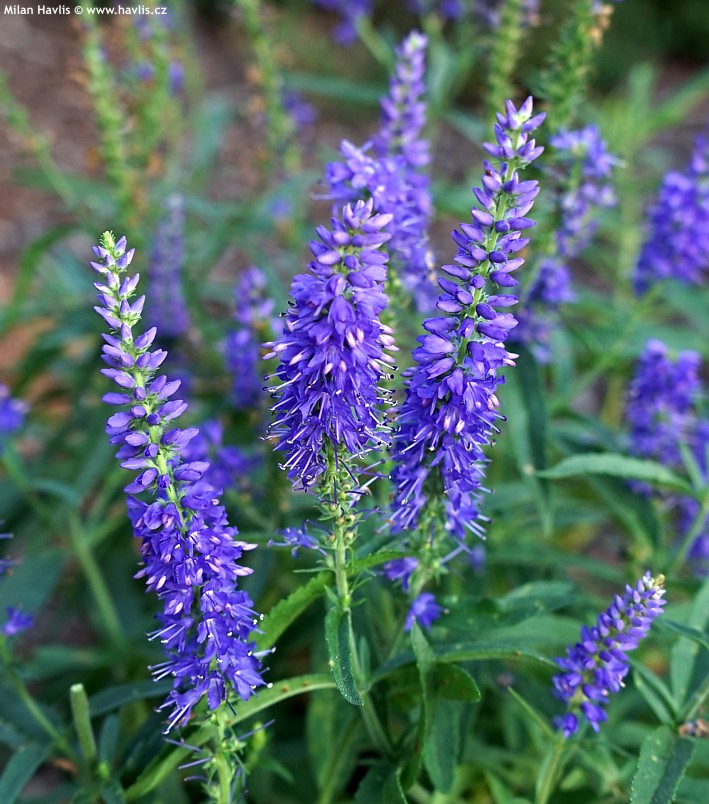
MOODY BLUES® DARK BLUE is arguably the most striking member of the series, bearing deep blue‑violet flowers on sturdy stems reaching 20–30 cm in height. Flowering begins in mid‑May and continues into July; when cut back after the main flush, the plant can flower again in August for a further four to six weeks. Narrowly lanceolate, dark green leaves form dense, low clumps that perform well in rock gardens, containers, and as ground cover in smaller areas. The cultivar is particularly effective when combined with low, light‑coloured ornamental grasses, dwarf lavenders, or compact sages; in more contemporary plantings it stands out alongside silvery foliage such as artemisia or sedum, while in cottage‑style gardens the intensity of its flowers invites playful combinations with perennials in a wide range of other bright colours.
Last update 14-11-2019; 27-12-2025
Spiked speedwell and its hybrids are undemanding, long‑lived perennials that perform best in full sun and in well‑drained, rather dry soils. They do not tolerate waterlogging: during summer, excess moisture may lead to powdery mildew, while winter wet can cause root rot. On the other hand, they cope well with drought and summer heat. Except for cultivars explicitly noted as remontant without cutting, we recommend cutting the stems back to ground level after flowering, which encourages re-growth and often a second, lighter flush of bloom. The plant is fully hardy to abt. −34 °C (USDA zone 4) and requires no special care or winter protection. It can also be grown year‑round in outdoor containers, provided excellent drainage is ensured as well as occasional light watering.

.jpg)
