











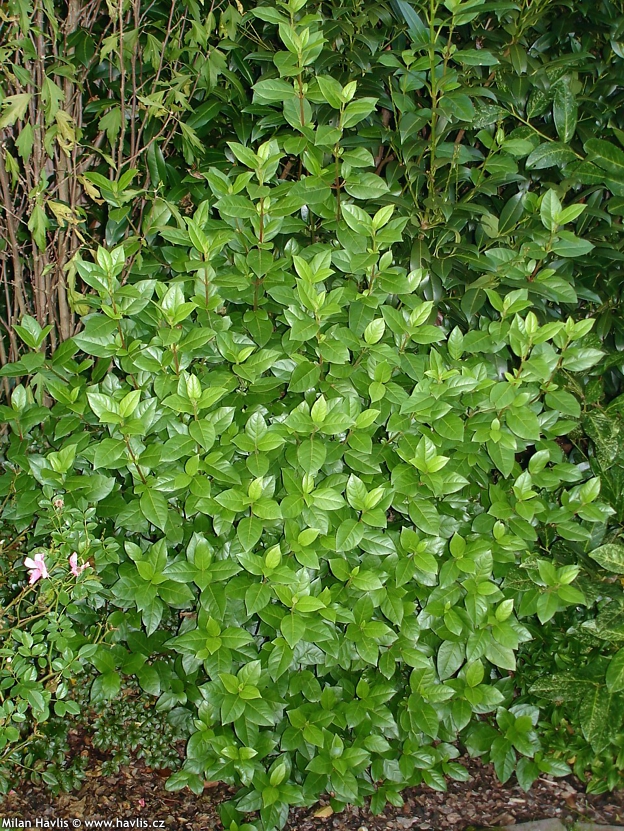
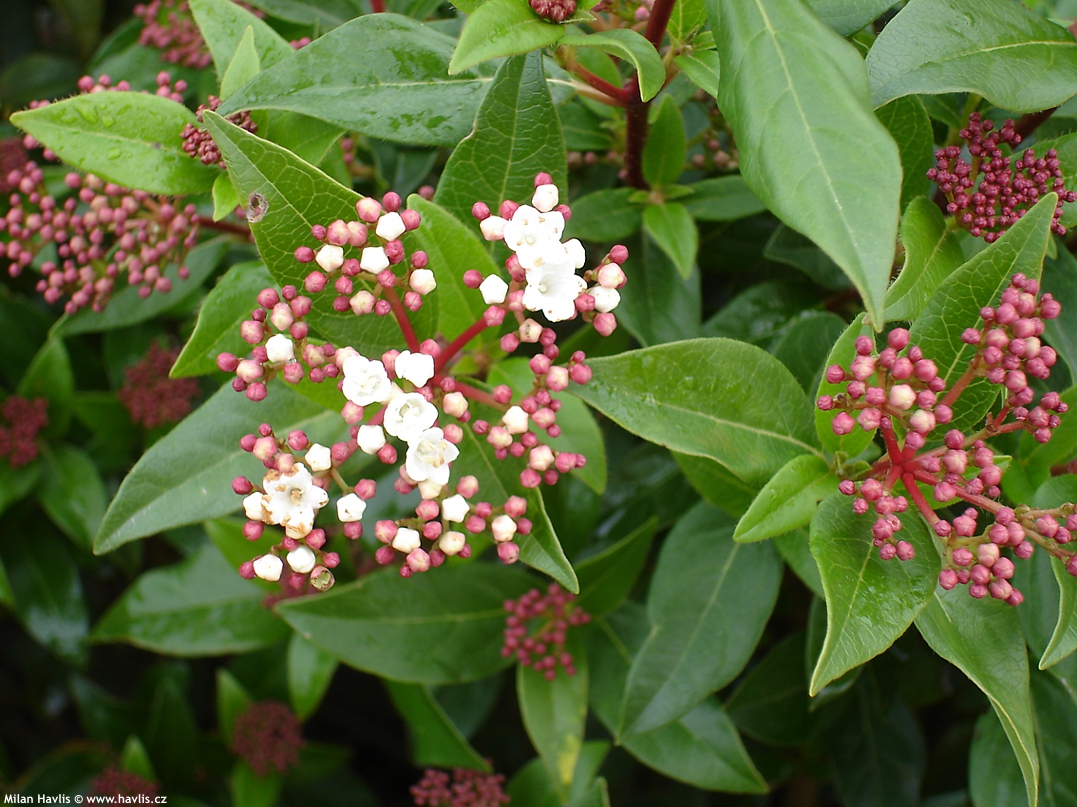
Viburnum tinus 'EVE PRICE' laurustinus

 Symbivit Tric (arbuscular)
 Symbivit (arbuscular)
Viburnum
The genus Viburnum includes around 150 species distributed across the temperate regions of the Northern Hemisphere, from eastern Asia through the Caucasus and Europe to North and South America. Botanically, it is an exceptionally diverse group: it comprises both deciduous and evergreen shrubs, species with strongly fragrant flowers as well as those with only a faint scent or none at all, and others grown primarily for their (inedible) fruit. This diversity is reflected in common horticultural practice and several informal groups – the fragrant winter viburnums (V. farreri and V. × bodnantense), the fruiting viburnums (V. opulus, V. trilobum), the evergreen Asian viburnums (V. davidii, V. tinus, V. cinnamomifolium), the large-leaved ornamental viburnums (V. plicatum, V. japonicum), and many more, including hybrids that combine traits from several groups. The genus has been known since antiquity, and its Latin name Viburnum appears in the works of Roman authors around the turn of the era, such as Virgil and Pliny the Elder.
Laurustinus, Viburnum tinus, originates from the Mediterranean, both from its Eurasian coastline stretching from the Pyrenees to Turkey and from the northern parts of Africa, where it grows in Morocco, Algeria, Tunisia and Libya. It is also native to the nearby islands, from the Canary Islands to the Balearics. It is admired for its striking metallic blue fruits, which are a botanical curiosity. Their colour is not produced by pigment but by structural colouration, created by light refracting on microscopic lipid globules. The species name tinus comes directly from antiquity, where it was used exclusively for this evergreen shrub. Pliny the Elder mentions it in his Naturalis Historia as a plant commonly grown near dwellings, making it one of the oldest documented ornamental shrubs of the Mediterranean. Carl Linnaeus (1707–1778) formally described the species in 1753, although its cultural and botanical history is far older. In the wild it is most often found in maquis, the evergreen shrublands of the Mediterranean with poor soils, arid summers and intense heat, as well as on the moister lower slopes of hills. In these habitats it combines two seemingly contradictory traits: resilience to summer drought and a need for winter moisture. Unlike many other plants typical of such locations, it is neither spiny nor defensive in any other way and brings a sense of freshness even where little else survives.
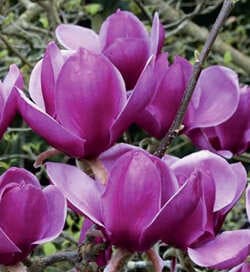
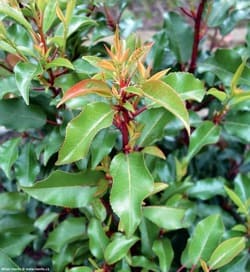
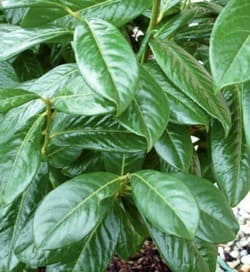
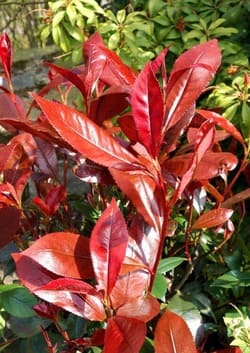
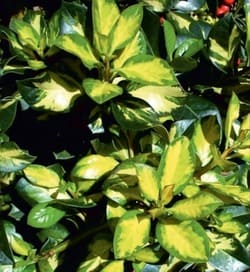
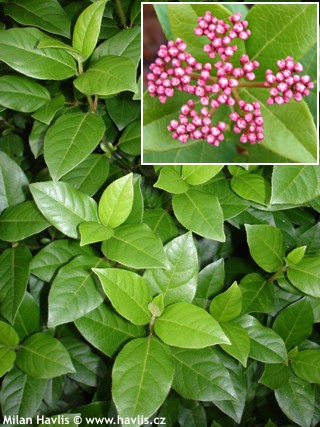
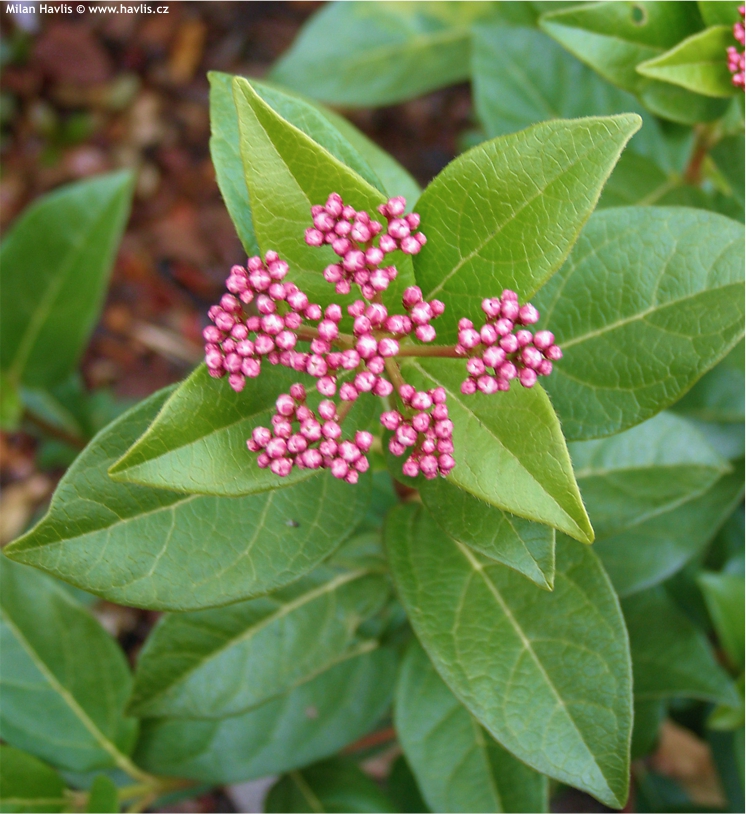
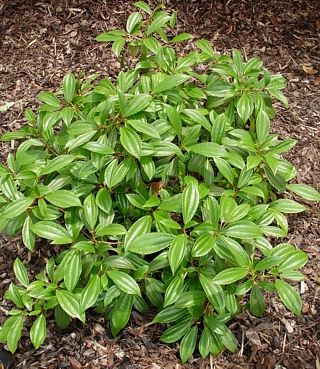
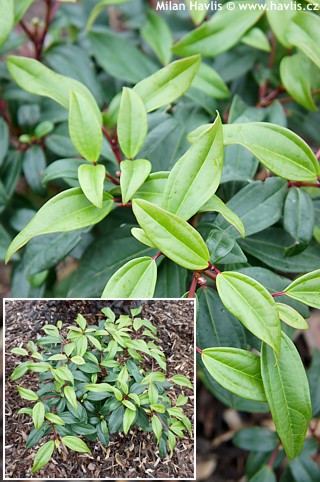
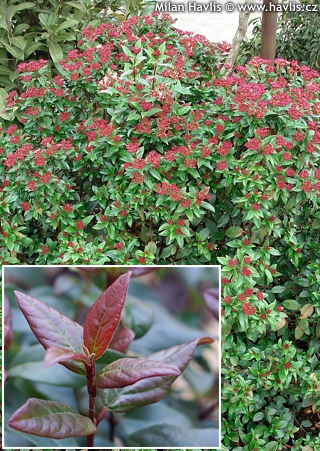
Eve Price laurustinus is truly a classic today. Its evergreen leaves are up to 8 cm long, ovate, leathery but thinner than most evergreens, medium to dark green, and with conspicuous venation. In autumn it produces a profusion of highly attractive terminal cymes composed of rosy pink flower buds which open into tiny, white, fragrant flowers in December in mild winters of zones 7 and higher. In colder areas they open in late winter or early spring and are followed by small, inedible but not poisonous, blue berries. Laurustinus is cultivated especially for its lush foliage and compact habit. It forms upright growing, dense shrubs and is often used in hedges in warmer zones. Stems turn purple red in autumn and winter.
This variety was discovered by Dr. Chris Clennet at Wakehurst Place (West Essex, about 75 km south of London) in 1960 who worked for the Royal Botanic Gardens at Kew for 30 years until 2017. He showed the plant to the owner of the manor, Sir Henry Philip Price (1877-1963) who was a keen, amateur botanist. Sir Price made his money as a businessman and started as a tailor who in early 20th century made suit available to men who had not been able to afford it before. A part of his wealth was devoted to promotion of botany and he left the manor to Royal Botanic Gardens at Kew after is death in 1963. Two years before his death he named this laurustinus after his second wife Eve Mary Dickson, and in the same year (1961) the plant received AGM award by the Royal Horticultural Society of England (RHS).
Now, let’s explore its hardiness. In Central Europe, Viburnum tinus has a reputation for being a tender Mediterranean shrub yet experience from growing it since 2004 shows the opposite. It survived the extreme winter of 2006/2007, when temperatures dropped to around minus 27 °C, freezing back to the ground but reliably resprouting from its undamaged base. The leaves are sensitive to severe frost below minus 17 °C only when combined with direct winter sun, so the safest option is to plant it in a position sheltered from early morning light or among other shrubs that provide natural protection. Even without this, the worst that can happen is damage to the upper parts of the branches, which can simply be removed in spring. The root system is hardy to approximately minus 27 °C, meaning that in colder regions it can be grown almost like a perennial, resprouting from the base and forming low, very dense shrubs whenever the upper growth is damaged.
Last update 24-10-2009; 30-01-2021
Viburnum tinus is remarkably healthy in temperate climates and is not usually troubled by pests or diseases. It grows best in fertile, humus-rich and well-drained soil but tolerates much poorer sites as long as they are not waterlogged. It is not demanding regarding pH, although slightly acidic soil enhances the colour of the foliage. It thrives in full sun or partial shade, with full sun giving the best results, and once established it is highly tolerant of prolonged summer drought. In dry winters it benefits from a single deep watering once a month.
It does not require shaping, as it naturally maintains a compact habit, but it tolerates any form of pruning. The best time is spring after flowering, when the shape can be refined or spent flower heads shortened, though this will remove the autumn fruit display. Mulching in winter helps protect the roots from temperature fluctuations, and young plants can be sheltered with evergreen boughs. In regions with long periods of frost, winter shade prevents the leaves from being scorched by early morning sun. Fully (stem) hardy to -17 °C (zone 7), and root-hardy down to even -27 °C (USDA zone 5b) on a protected site.
Goods are shipped all over Europe. For Russia and U.K. and for further details please read about SHIPPING OPTIONS HERE.
Are you interested in a serious discount for orders NOV-FEB? Check your options here.
THE PRICES INCLUDE VAT of 15%. For quick conversion you can use 1 CZK = approx. 0.04 EUR
- STANDARD QUALITY - Plants of this group are 1st class quality with number of branches and overall density adequate to their size and age, considering they were container grown.
- DE LUXE QUALITY - This label guarantees a luxurious quality of manually selected plants that, compared to their height and age, are exceptionally dense and beautiful.
- EXTRA - These plants are usually mature and bigger specimens with exceptional overall appearance.
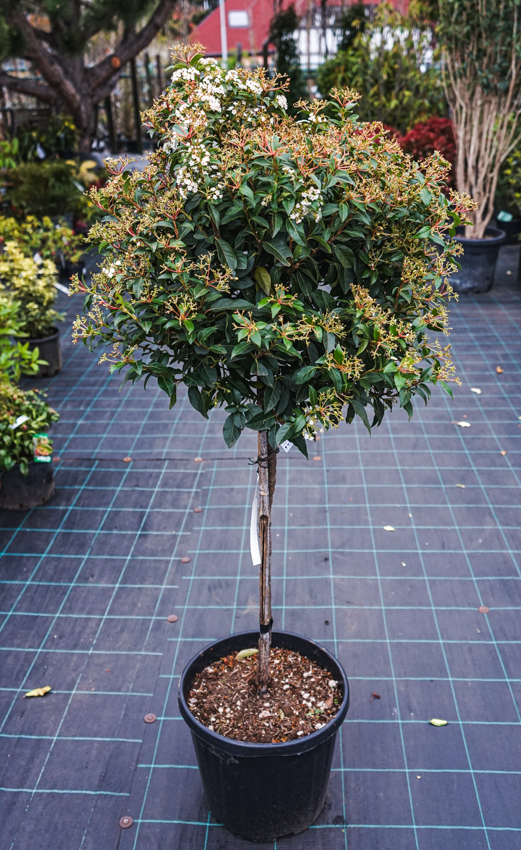
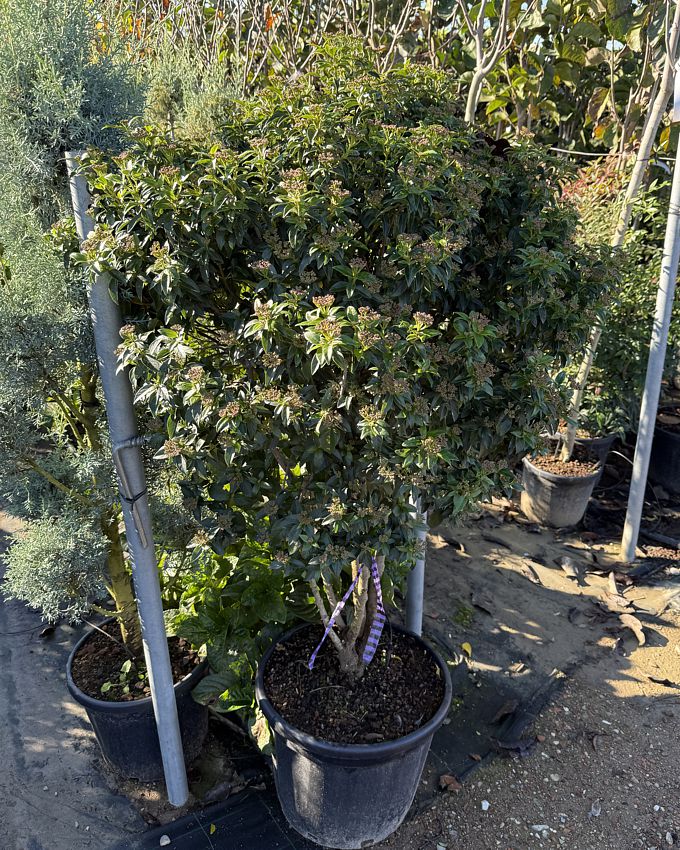
- STANDARD (as described in the plant form) means a tree with a trunk of 190-210 cm and a crown at the top, unless specified differently. The commercial size for trees is their girth measured in the height of 1m from ground.
- HOBBY - These plants are of the same quality as our standard-quality plants but younger and therefore cheaper.
- SHRUB - a woody plant with branches growing bushy from the ground level.
- HALF-STANDARD or MINI-STANDARD - a small tree with shorter trunk, its size is usually specified.
- FEATHERED - These are trees with branches growing already from the base of the trunk and up along the stem.
- GRASSES and PERENNIALS - Sizes given usually read the diameter of the pot or the clump, as specified.
