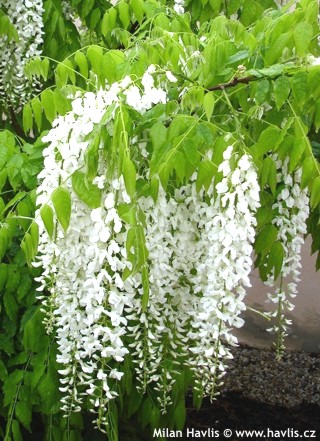
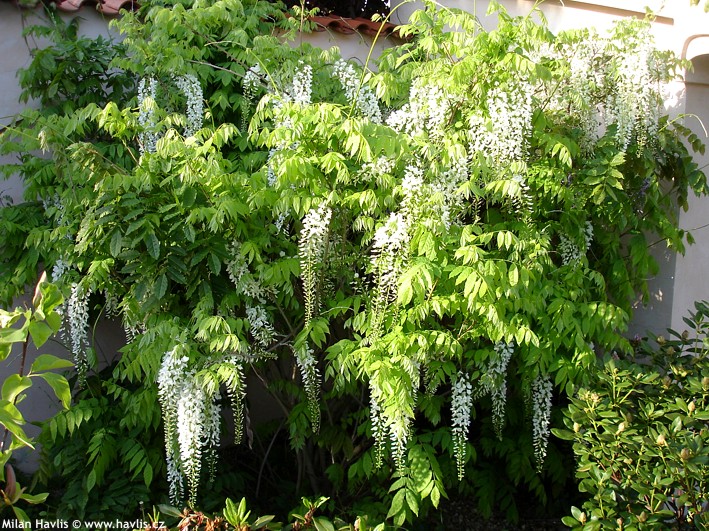
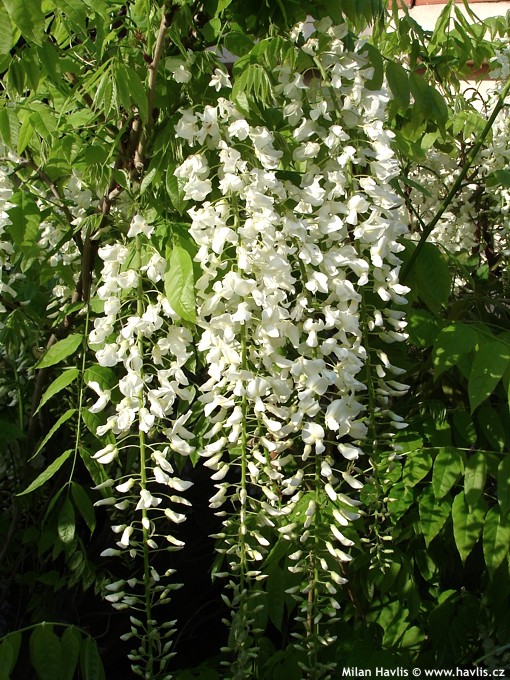
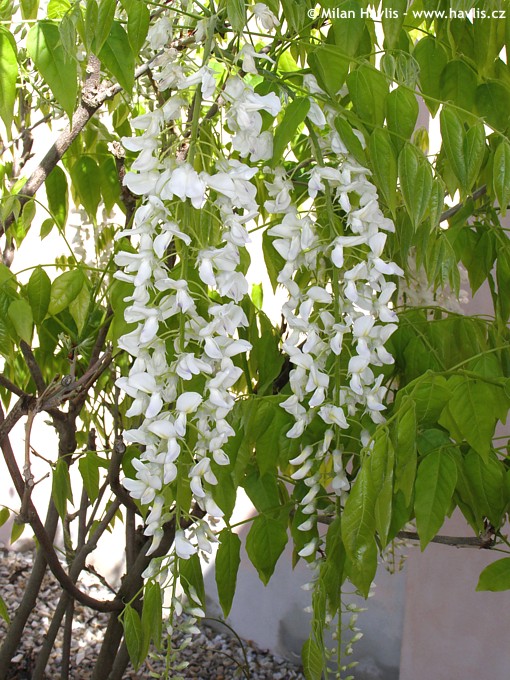
Wisteria floribunda 'ALBA' japanese wisteria

 Symbivit Tric (arbuscular)
 Symbivit (arbuscular)
Wisteria
Genus Wisteria belongs to the pea family and comprises around six species of climbing woody vines native to East Asia and the eastern parts of North America. It is a genus with a surprisingly ancient history: botanists consider it a remnant of a once more widespread flora that survived the climatic shifts of the last few million years. The first European references to wisterias date from the late 18th century, when dried specimens of Japanese plants reached herbarium collections. The genus was described by the American botanist Thomas Nuttall (1786–1859), who named it after his friend, the anatomist Caspar Wistar (1761–1818). Nuttall, however, misspelled the name as Wisteria instead of Wistaria, and under the rules of botanical nomenclature the error has been preserved ever since. The journey of wisterias to the West began in 1816, when agents of the East India Company sent the first cuttings to England, and within a few decades the plant had transformed pergolas, arbours and urban courtyards across the continent.
It is hardly surprising, because few plants in temperate gardens can stop a passer-by as reliably as a wisteria in full bloom. When its flowers unfold in spring, it feels like a coloured waterfall. Long racemes hang from pergolas and old walls like curtains of purple, white or pink, swaying gently in the wind, their scent mingling with the first warm days. Wisteria has an exceptionally long cultural footprint: in China it was grown for centuries as a symbol of friendship, devotion and spring renewal, while in Europe it became one of the defining features of 19th‑century romantic gardens. In Japan it has been cultivated for generations and woven into poetry, painting and garden design. In Europe its thick, woody vines still shape the appearance of many historic estates that were among the first to import this once exotic novelty from the East. The genus is botanically interesting in that its species differ in the direction of twining: some coil clockwise, others anticlockwise, which is one of the most reliable diagnostic features, and several species are capable of producing a second flush of flowers in summer.
Wisteria floribunda, the Japanese wisteria, known in Japanese as 藤 (fuji), is one of the most revered climbing plants of Japan and its cultural presence runs even deeper than that of the Chinese wisteria. It appears in Japanese literature as early as the 11th century in The Tale of Genji, where fuji symbolises grace, feminine beauty and the fleeting nature of spring. The name is also borne by the powerful Fujiwara clan, which shows how deeply this plant is rooted in Japanese culture. The species is native to Japan, growing along woodland edges, in valleys and on slopes from Honshu to Kyushu, and it is here that most of the historic forms with exceptionally long racemes originated. It reached Europe shortly after the Chinese wisteria: it was brought by the physician and naturalist Philipp Franz von Siebold (1796–1866), who obtained it during his stay in Japan, described it botanically and had it meticulously illustrated by the Japanese artist Kawahara Keiga in his work Flora Japonica. While the Chinese wisteria captivated Europe with its strength and reliability, the Japanese species won admiration for the length and elegance of its racemes. Japan is home to famous ancient specimens, the best known being the plant at Ushijima, said by tradition to be over a thousand years old and bearing extraordinarily long, narrow, tapering inflorescences. These commonly reach 40–90 cm, and in some cultivars even exceed one metre. This aesthetic – long, cascading racemes, a finer overall habit and the elegant acropetal opening of the flowers (from the base upwards) – made Wisteria floribunda a symbol of Japanese elegance in Europe and America, and it quickly found its way into the romantic gardens of the 19th century.
Alba is a classic white form of the Japanese wisteria, valued for its pure, delicate expression and reliable flowering. Its racemes are slender, elegantly pendulous and usually reach 40–60 cm in length, shorter than the extremely long‑flowered forms of the longissima group, yet still striking enough to appear festive and light. The flowers open at the turn of April and May, mostly together with the new leaves, acropetally, from the base of the raceme upwards, creating the smooth, gradual unfolding typical of the Japanese wisteria. The colour is pure white, sometimes with a very slight creamy tint as the flowers open, and the individual blooms carry a light, sweet fragrance that is most noticeable on warm spring days.
The deciduous leaves have an exotic look; they are fresh green, about 30 cm long, pinnate, composed of 13–19 leaflets, and during flowering they form a soft backdrop against which the white racemes stand out clearly. The habit is strong, long‑lived and typically twining, with shoots winding clockwise, a characteristic feature of the Japanese wisteria that reliably distinguishes it from the Chinese species, just as the fact that Japanese wisterias do not flower a second time in summer. Thanks to its pure colour, medium‑length racemes and balanced growth, ‘Alba’ ranks among the most versatile white cultivars of the Japanese wisteria, suitable for pergolas, arbours and representative entrances, where it appears elegant without being overly dominant. Its strength becomes apparent with age – it can twist a thin beam or wooden trellis that once served as its support, and if allowed to creep under roof tiles, it can lift them and create an entry point for uninvited visitors.
Last update 01-01-2007; 26-04-2026
The Japanese wisteria requires full sun and deep, well‑drained, slightly acidic to neutral soil; in heavy clay it grows only if drainage is good. After planting it needs watering during the first half‑year, and once established it is fairly tolerant of drought, though less so than the Chinese wisteria. Fertilising is not advisable, as excess nitrogen suppresses flowering. Pruning is often considered essential, but in reality it only changes the distribution of the flowers: with summer shortening of the long shoots and winter pruning to two or three buds, the flowers concentrate on a smaller area and appear more abundant, while a freely growing plant carries them along the full length of its branches. Each plant produces as many flowers as its age and health allow, regardless of pruning. It needs strong support and is not suitable for long‑term container cultivation. All parts of the plant are poisonous. Well‑established specimens tolerate frosts of around –29 °C (USDA zone 5)