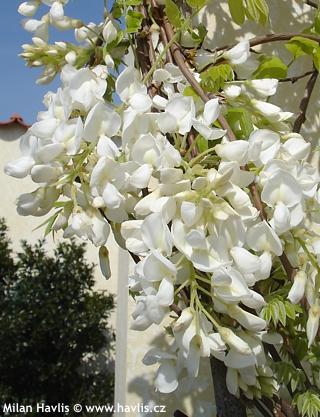











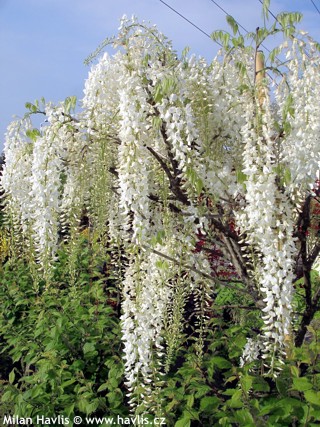
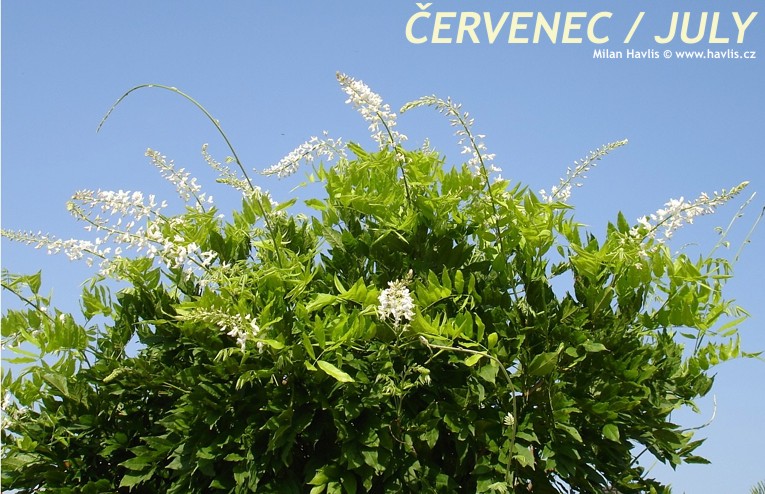
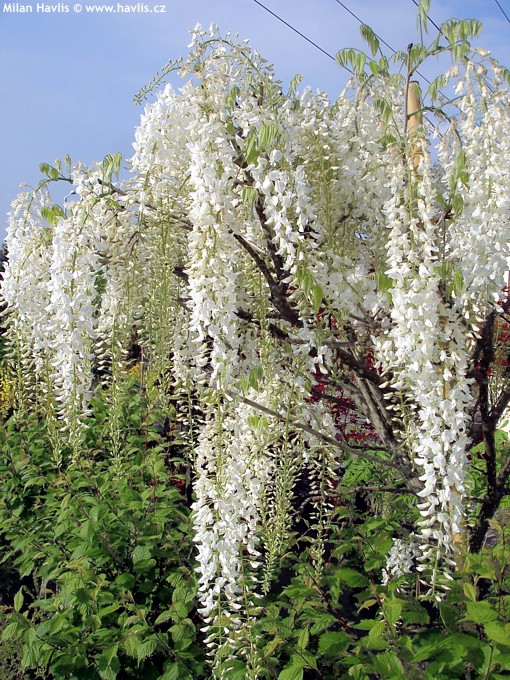
Wisteria sinensis 'ALBA' Chinese wisteria


 Symbivit Tric (arbuscular)
 Symbivit (arbuscular)
Wisteria
Genus Wisteria belongs to the pea family and comprises around six species of climbing woody vines native to East Asia and the eastern parts of North America. It is a genus with a surprisingly ancient history: botanists consider it a remnant of a once more widespread flora that survived the climatic shifts of the last few million years. The first European references to wisterias date from the late 18th century, when dried specimens of Japanese plants reached herbarium collections. The genus was described by the American botanist Thomas Nuttall (1786–1859), who named it after his friend, the anatomist Caspar Wistar (1761–1818). Nuttall, however, misspelled the name as Wisteria instead of Wistaria, and under the rules of botanical nomenclature the error has been preserved ever since. The journey of wisterias to the West began in 1816, when agents of the East India Company sent the first cuttings to England, and within a few decades the plant had transformed pergolas, arbours and urban courtyards across the continent.
It is hardly surprising, because few plants in temperate gardens can stop a passer-by as reliably as a wisteria in full bloom. When its flowers unfold in spring, it feels like a coloured waterfall. Long racemes hang from pergolas and old walls like curtains of purple, white or pink, swaying gently in the wind, their scent mingling with the first warm days. Wisteria has an exceptionally long cultural footprint: in China it was grown for centuries as a symbol of friendship, devotion and spring renewal, while in Europe it became one of the defining features of 19th‑century romantic gardens. In Japan it has been cultivated for generations and woven into poetry, painting and garden design. In Europe its thick, woody vines still shape the appearance of many historic estates that were among the first to import this once exotic novelty from the East. The genus is botanically interesting in that its species differ in the direction of twining: some coil clockwise, others anticlockwise, which is one of the most reliable diagnostic features, and several species are capable of producing a second flush of flowers in summer.
Wisteria sinensis, the Chinese wisteria (紫藤 ), originates from central China, where it grows in valleys and along woodland edges in the provinces of Guangxi, Guizhou, Hebei, Henan, Hubei, Shaanxi and Yunnan. It was cultivated for centuries around homes, temples and garden pavilions, its shoots often trained over wooden structures as a symbol of friendship as enduring as the plant itself, or as a sign of spring’s arrival. Its introduction to Europe is unusually well-documented: it was brought by John Reeves (1774–1856), inspector of the East India Company in Canton, who obtained two plants from the merchant Conseequa, who had received them from his nephew Tinqy. Reeves propagated them by layering and sent them on two ships to England, the first arriving on 4 May 1816 and the second a week later. The first plant, grown by Charles Hampden Turner, later became the lectotype of the species. The botanical description followed in 1819, when John Sims published John Curtis’s illustration in Curtis’s Botanical Magazine and named the species Glycine sinensis before it was transferred to the genus Wisteria.
Chinese wisteria is no doubt the queen of flowering climbers. Alba variety bears clusters of very fragrant, pure white flowers that are 25-35 cm long and appear on bare wood earlier than on other wisterias, usually in April. Rather exotic looking pinnate leaves are mid green and densely cover the plant and its support. It usually offers second blooming in early summer when in full leaf.
Wisteria flowers are mainly on short spurs so cut back unwanted side branches to 2-3 buds to encourage formation of flowering spurs.
Last update 26-01-2009; 19-01-2013
Chinese wisteria requires full sun and deep, well-drained, slightly acidic to neutral soil; in heavy clay it grows only if drainage is good. After planting it needs watering for the first six months, but once established it is highly tolerant of drought. Fertilising is not recommended, as excess nitrogen suppresses flowering. Pruning is often considered essential, but in reality it only alters the distribution of flowers: summer shortening of long shoots and winter pruning to two or three buds concentrates the flowers into a smaller area and makes the display appear richer, while an unpruned plant carries the same number of flowers spread along the full length of its shoots. Each plant produces as many flowers as its age and vigour allow, regardless of pruning. It needs strong support and is not suitable for long-term container cultivation. All parts of the plant are poisonous. Well‑established specimens tolerate temperatures down to around –29 °C (USDA zone 5)