Wisteria sinensis Chinese wisteria

 Symbivit Tric (arbuscular)
 Symbivit (arbuscular)
Wisteria
Genus Wisteria belongs to the pea family and comprises around six species of climbing woody vines native to East Asia and the eastern parts of North America. It is a genus with a surprisingly ancient history: botanists consider it a remnant of a once more widespread flora that survived the climatic shifts of the last few million years. The first European references to wisterias date from the late 18th century, when dried specimens of Japanese plants reached herbarium collections. The genus was described by the American botanist Thomas Nuttall (1786–1859), who named it after his friend, the anatomist Caspar Wistar (1761–1818). Nuttall, however, misspelled the name as Wisteria instead of Wistaria, and under the rules of botanical nomenclature the error has been preserved ever since. The journey of wisterias to the West began in 1816, when agents of the East India Company sent the first cuttings to England, and within a few decades the plant had transformed pergolas, arbours and urban courtyards across the continent.
It is hardly surprising, because few plants in temperate gardens can stop a passer-by as reliably as a wisteria in full bloom. When its flowers unfold in spring, it feels like a coloured waterfall. Long racemes hang from pergolas and old walls like curtains of purple, white or pink, swaying gently in the wind, their scent mingling with the first warm days. Wisteria has an exceptionally long cultural footprint: in China it was grown for centuries as a symbol of friendship, devotion and spring renewal, while in Europe it became one of the defining features of 19th‑century romantic gardens. In Japan it has been cultivated for generations and woven into poetry, painting and garden design. In Europe its thick, woody vines still shape the appearance of many historic estates that were among the first to import this once exotic novelty from the East. The genus is botanically interesting in that its species differ in the direction of twining: some coil clockwise, others anticlockwise, which is one of the most reliable diagnostic features, and several species are capable of producing a second flush of flowers in summer.
Wisteria sinensis, the Chinese wisteria (紫藤 ), originates from central China, where it grows in valleys and along woodland edges in the provinces of Guangxi, Guizhou, Hebei, Henan, Hubei, Shaanxi and Yunnan. It was cultivated for centuries around homes, temples and garden pavilions, its shoots often trained over wooden structures as a symbol of friendship as enduring as the plant itself, or as a sign of spring’s arrival. Its introduction to Europe is unusually well-documented: it was brought by John Reeves (1774–1856), inspector of the East India Company in Canton, who obtained two plants from the merchant Conseequa, who had received them from his nephew Tinqy. Reeves propagated them by layering and sent them on two ships to England, the first arriving on 4 May 1816 and the second a week later. The first plant, grown by Charles Hampden Turner, later became the lectotype of the species. The botanical description followed in 1819, when John Sims published John Curtis’s illustration in Curtis’s Botanical Magazine and named the species Glycine sinensis before it was transferred to the genus Wisteria.
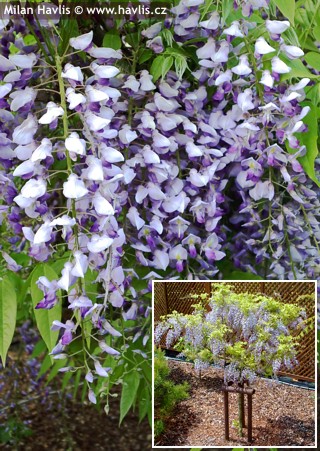
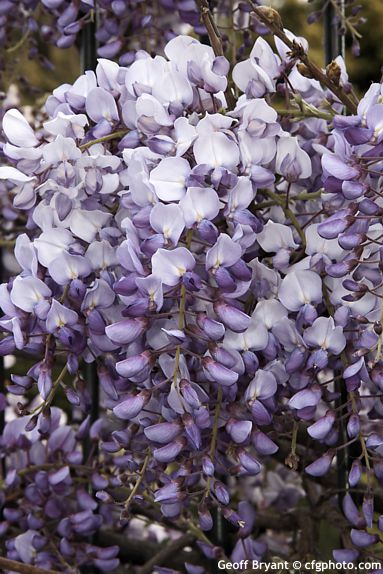
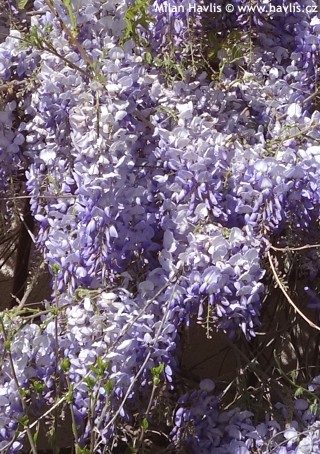
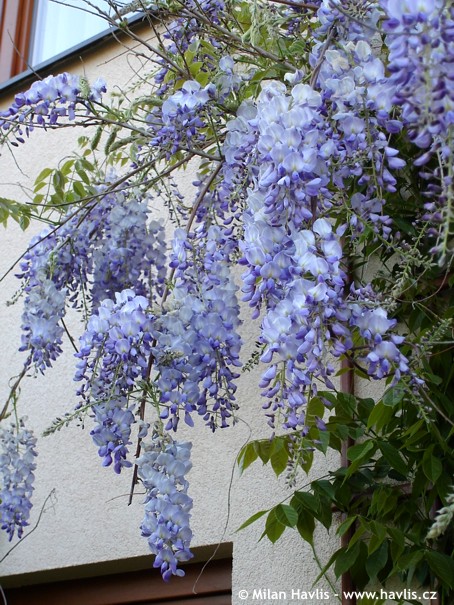
Chinese wisteria is a striking climbing woody plant with long, fragrant flowers. They appear early in spring, usually in April, and typically open before the leaves, almost simultaneously, creating a continuous, unified veil. The colour ranges from pale lilac to violet, and the flowers are arranged in pendulous racemes 20–30 cm long, shorter than those of Japanese wisteria but produced in greater numbers, giving a more compact effect. Each flower has the characteristic papilionaceous structure with a broad standard and a strong, sweet, grapelike scent that is most pronounced on warm spring days. After the main spring display, Chinese wisteria can re-bloom in summer, most often from July, producing thinner, scattered racemes on new shoots against the backdrop of dense foliage, though never with the intensity of the first flush. After flowering, velvety brown pods develop and ripen in summer; once mature, they split explosively and eject their seeds several metres away, the cracking of the woody pods being surprisingly loud in a quiet garden. In cultivation the species is propagated mainly by layering or cuttings, as seedlings flower late and unreliably.
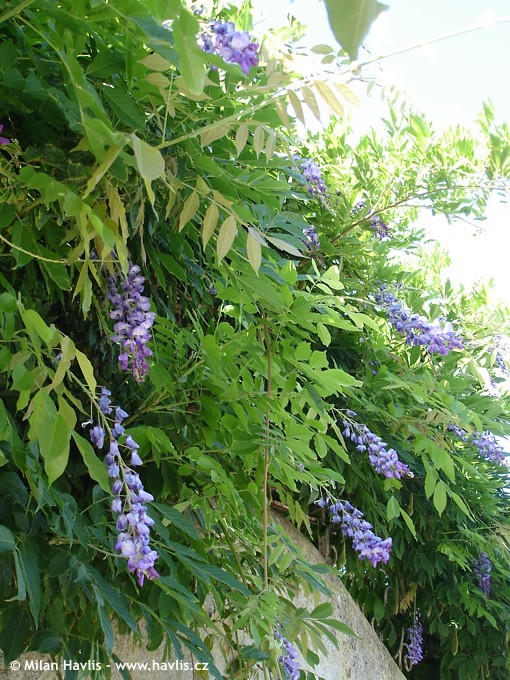
Its exotic-looking leaves are deciduous, pinnate, 20–30 cm long, composed of 9–13 leaflets that emerge in soft bronze tones before turning rich green. The leaflets are elongated and soft to the touch, forming a dense, slightly drooping canopy in midsummer that effectively covers the structure beneath. Autumn colour is modest, usually yellow‑green, and the leaves fall relatively late, so the plant remains visually present well into the season.
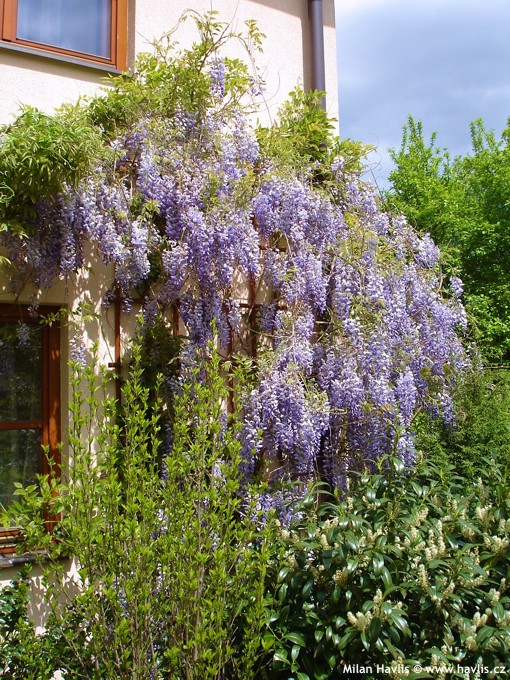
It forms strong, woody vines that need support when young and thicken with age into twisted trunks reminiscent of old bonsai. It anchors firmly to pergolas, walls and mature trees, and its shoots twine anticlockwise, a feature that reliably distinguishes it from Japanese wisteria and helps gardeners train it along a structure. In its native range it can reach twenty metres, while in European gardens it usually grows to 8–12 metres depending on support and pruning. Its strength becomes evident with age: it can twist thin beams or wooden trellises that once supported it, and if allowed to creep under roof tiles, it can lift them and create entry points for unwelcome visitors.
Chinese wisteria is one of the few climbers capable of transforming an ordinary building into a spring landmark within a few years, and its use extends far beyond pergolas. The best-known historic specimen grows at Griffin’s Brewery in Chiswick, London, where records show it has been cultivated since 1816. Its trunks are as thick as those of a small tree, demonstrating how massive the species can become when given space and solid support. Equally impressive plants can be found in Oxford, where old wisterias climb the façades of college buildings and create an annual spring spectacle that has become part of local tradition. These examples show that Chinese wisteria is not merely decorative but a long-term architectural element that becomes part of the building itself.
Last update 01-01-2007; 26-04-2026
Chinese wisteria requires full sun and deep, well-drained, slightly acidic to neutral soil; in heavy clay it grows only if drainage is good. After planting it needs watering for the first six months, but once established it is highly tolerant of drought. Fertilising is not recommended, as excess nitrogen suppresses flowering. Pruning is often considered essential, but in reality it only alters the distribution of flowers: summer shortening of long shoots and winter pruning to two or three buds concentrates the flowers into a smaller area and makes the display appear richer, while an unpruned plant carries the same number of flowers spread along the full length of its shoots. Each plant produces as many flowers as its age and vigour allow, regardless of pruning. It needs strong support and is not suitable for long-term container cultivation. All parts of the plant are poisonous. Well‑established specimens tolerate temperatures down to around –29 °C (USDA zone 5)