

































Veronica × media 'CHRISTA'® speedwell

 Symbivit Tric (arbuscular)
 Symbivit (arbuscular)
Veronica
The genus Veronica belongs among the most numerous and the most diverse groups of flowering plants of the temperate zone. It includes several hundred species distributed almost worldwide, from alpine meadows and forest understories to dry steppes and coastal rocks. It was described in the 18th century by Carl Linnaeus, who adopted an already established name linked to the legend of Saint Veronica. The legend says that she offered Christ a piece of cloth during his arduous journey to Golgotha, with which he wiped sweat and blood off his face. His image was said to have miraculously imprinted itself on the fabric, the so‑called vera icon, or “true image”. This idea of a faithful, unembellished imprint of reality was symbolically transferred in pre‑modern botany to speedwells, whose small, clearly drawn flowers were perceived as honest and needing no adornment.
Veronica × media is a natural interspecific hybrid arising from the crossing of spiked speedwell (V. spicata) and long-leaved speedwell (V. longifolia) wherever the two species meet in the wild. The botanical name was introduced by the German botanist Carl Ernst August Weihe (1779–1834), who was the first to describe this recurring natural phenomenon. While V. spicata comes from dry meadows and forms lower, more compact clumps, V. longifolia grows in moister habitats and is taller, with longer and more abundant flower spikes. The hybrid group Veronica × media takes the best from both the parents: medium height, a firm, upright habit, a clear vertical presence in the border and a long flowering season, which has made it a valued part of European gardens since the 19th century.
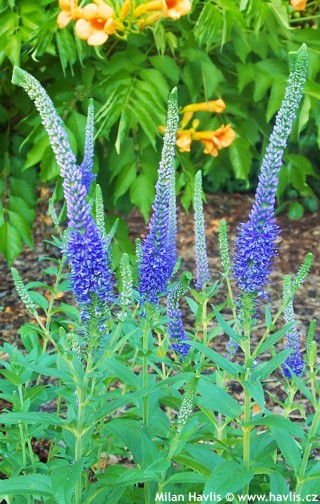
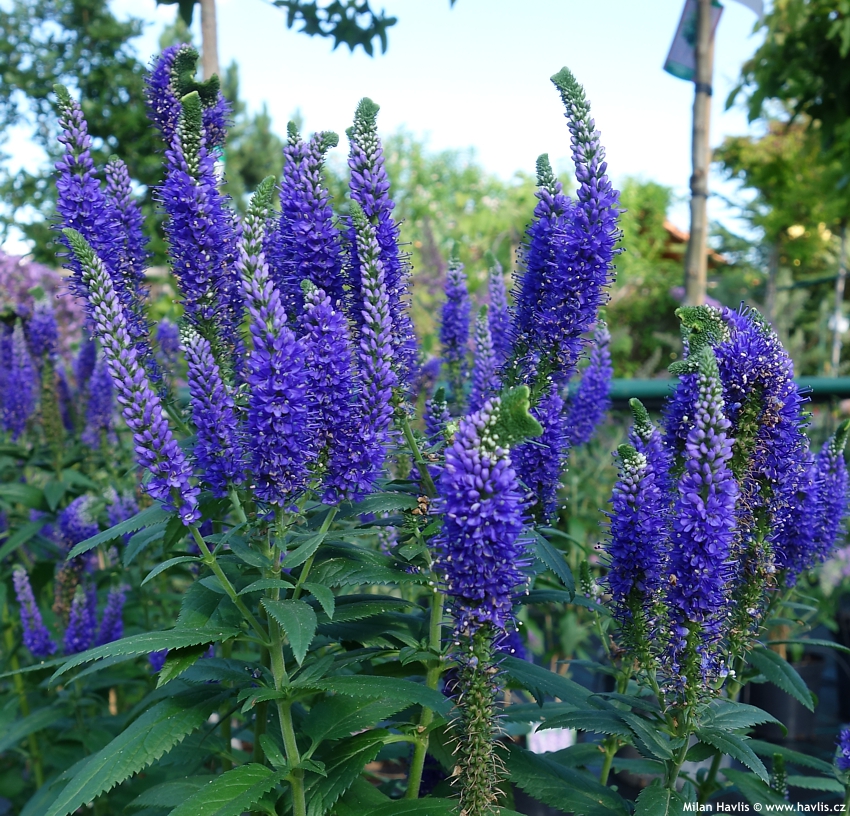
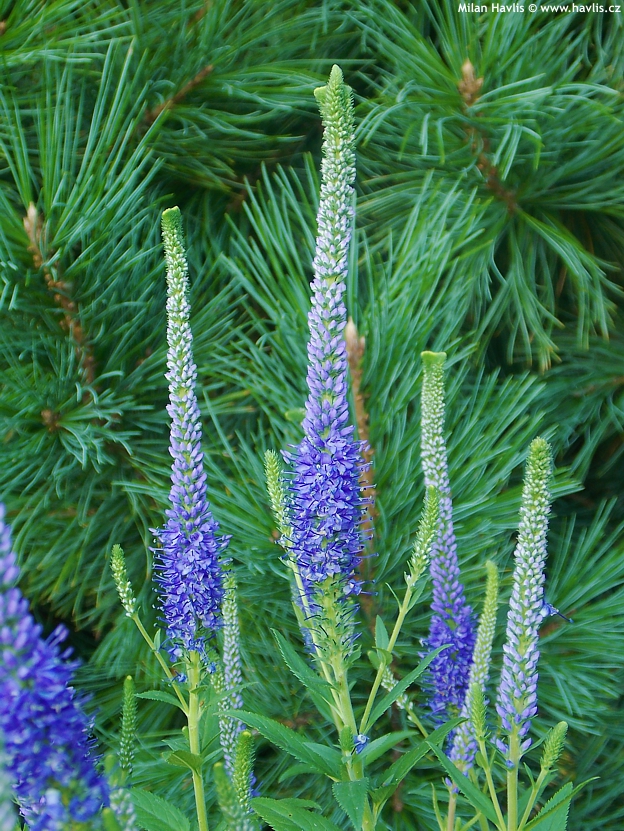
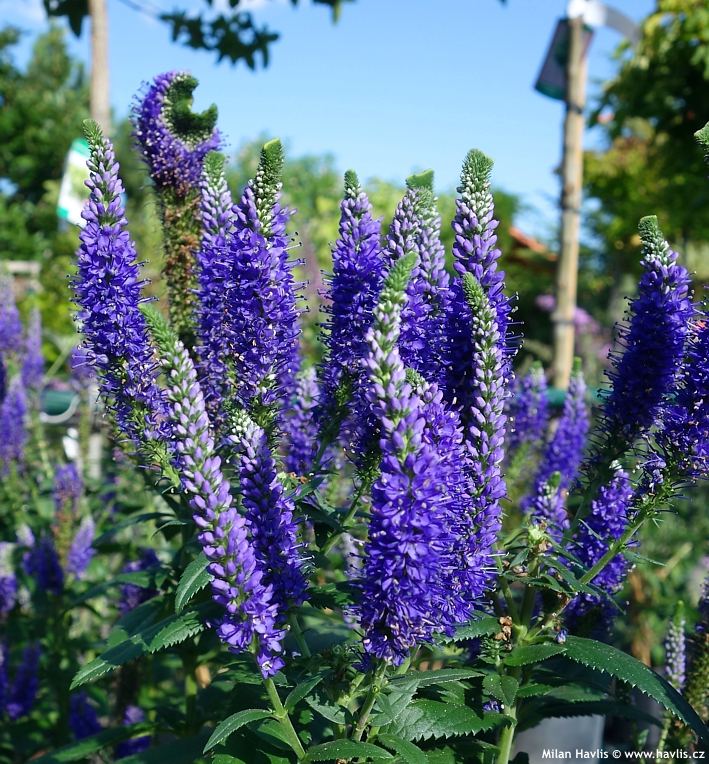
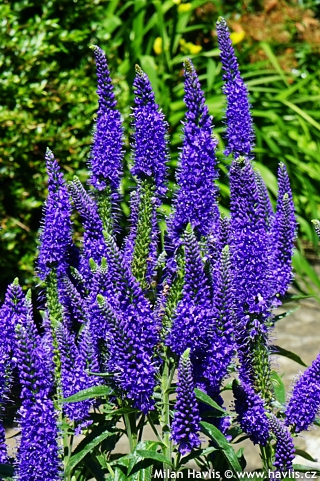
Christa is a modern Dutch cultivar of hybrid speedwell introduced in 2005. In summer it produces an abundance of slender flower spikes in the shade of blue as deep as the sky before a storm. The tips of the inflorescences are typically flattened – so‑called cristate, broadened into a small crest – giving them the look of a tiny comb by which the plant is instantly recognisable. Similar fasciated growths can be found in some veronicastrums, and you may also know the popular Japanese conifer Cryptomeria japonica ‘Cristata’, which shows the same crested tips on its young shoots. It flowers reliably from early July to late August, especially if the spent spikes are removed in time. The plant forms compact clumps with firm stems up to 60 cm tall, which, together with the long-lasting blooms, makes it an excellent choice for cutting.
The leaves are deciduous, narrowly lanceolate, distinctly tapered towards the margins, mid‑green and matte. They grow densely along the entire stem right up to the flowers, giving the clump a full appearance. The cultivar was bred by the Dutch breeder Jaap Fokker and brought to market by Green Works International (EU patent 20439 from 2007, valid until 2019). Although the patent lists it under the botanical name of its primary parent, Veronica longifolia, its habit, branching pattern and inflorescence structure clearly correspond to an interspecific hybrid, Veronica × media.
Last update 08-08-2013; 29-12-2025
Veronica × media ranks among the most reliable summer perennials of temperate climates and require no special care. It grows best in full sun but will tolerate light partial shade if they receive at least half a day of light. It prefers well‑drained, moderately moist soil that does not dry out completely in summer, and it appreciates a thin layer of compost in spring. After the first flowering it is advisable to remove the spent spikes, which encourages a second flush and keeps the clump compact. It can be grown in containers only for short periods, as they quickly exhaust the space and are more sensitive to drying out. Wind does not trouble it; the stems are firm and remain upright. The plant is neither poisonous nor allergenic and overwinters reliably in temperate climates without any protection. Hardiness may vary slightly between cultivars, but the hybrid group tolerates winter lows of around –34 °C (USDA zone 4).

.jpg)
