


































.jpg)
.jpg)
Sciadopitys verticillata Japanese umbrella pine

 Symbivit Tric (arbuscular)
 Symbivit (arbuscular)
Sciadopitys
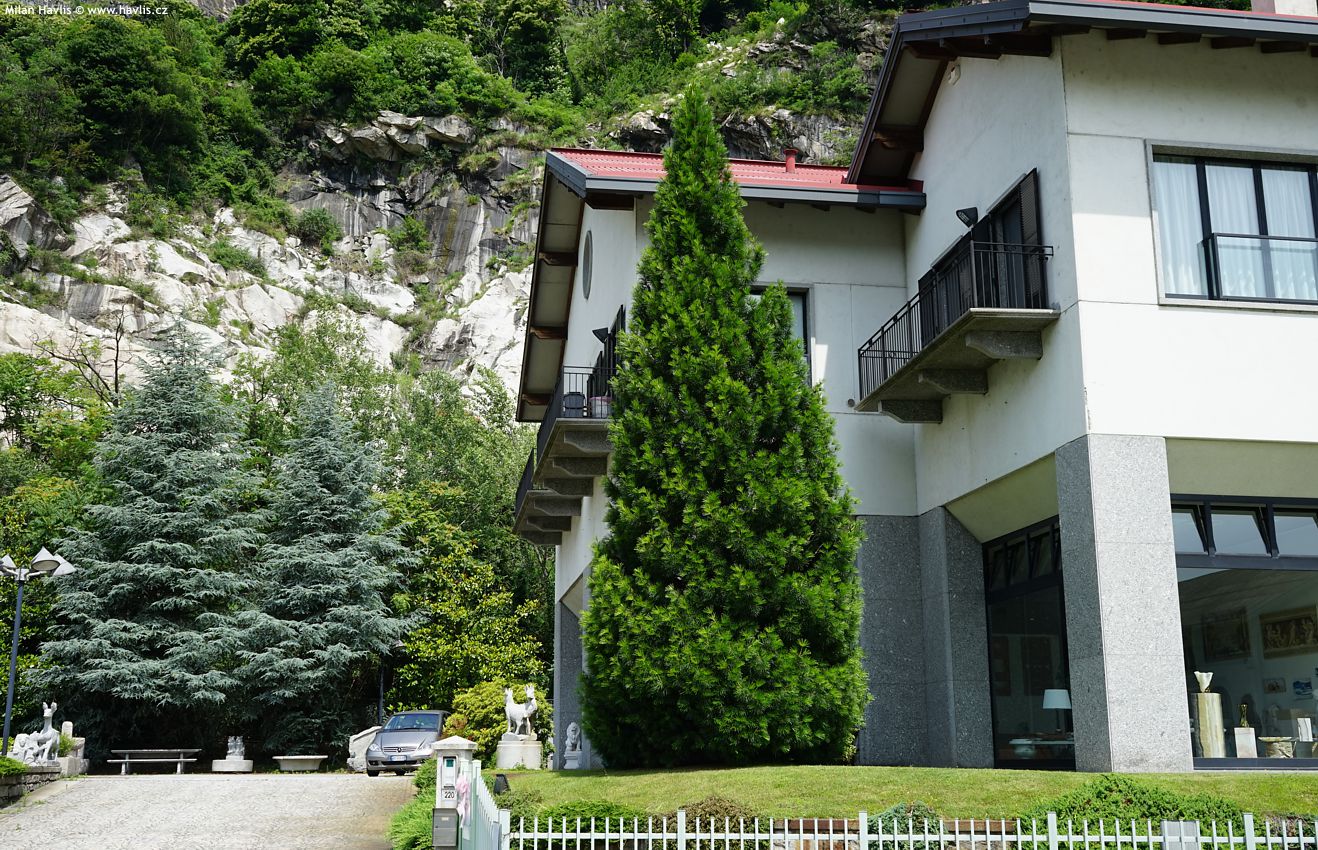
The Japanese umbrella pine (Sciadopitys verticillata) ranks among the oldest surviving conifer species and represents a remnant of vegetation that was already widespread during the Tertiary period. From a botanical perspective, it is an extraordinary tree: the sole living species of the genus Sciadopitys and the only representative of the entire family Sciadopityaceae, with no close relatives among modern conifers. This isolated position makes it a true evolutionary relic that has survived virtually unchanged for millions of years. It continues to attract attention primarily because of the structure of its needles. Although they may resemble those of a thick‑needled pine at first glance, they are in fact much closer to the foliage of long‑extinct horsetails. In its native land, the tree is valued not only for its unique appearance but also for its longevity, stability, and ability to endure changing conditions. In Japanese culture, it has a long tradition as a sacred tree, often planted near Shinto shrines and Buddhist temples.
In the wild, the Japanese umbrella pine grows exclusively in Japan, specifically in the mountain forests of the islands of Honshu and Shikoku. Its main natural habitats lie on Mount Kōya and in the Kiso River valley in Wakayama Prefecture, where it forms part of moist, shaded woodland with acidic soils. European botanists were introduced to the species in 1842, when it was formally described by Philipp Franz von Siebold and Joseph Gerhard Zuccarini based on material brought from Japan. The first living plant was sent to England by the botanist Thomas Lobb in 1853, although it did not survive. During the 1860s, seeds were repeatedly imported into Europe, enabling the species to spread more widely in cultivation.
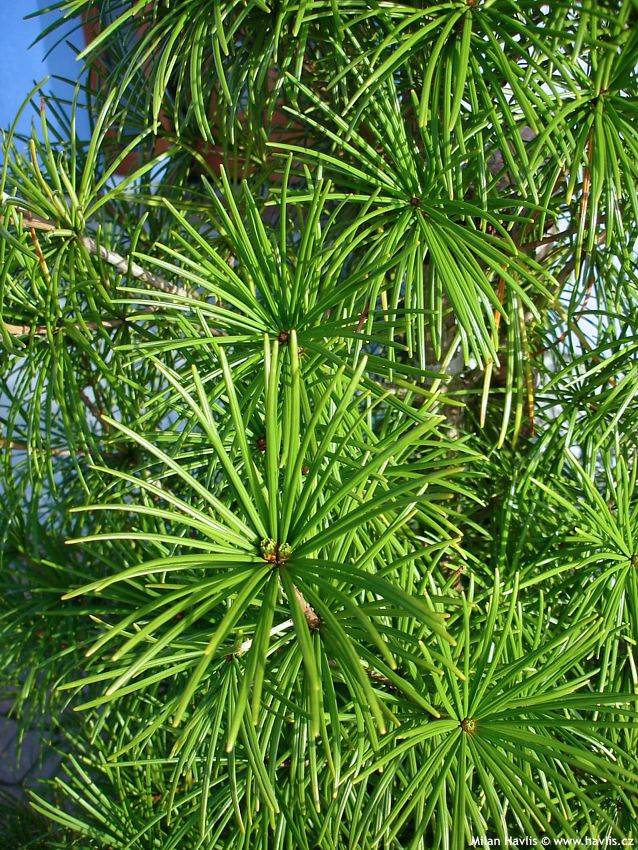
The needles of Japanese umbrella pine are distinctive: soft, almost fleshy, flexible, 5–12 cm long, deep green, and strikingly glossy. Botanically, they are not true needles, but unusual leaf‑like structures formed by the fusion of two needles, a fact confirmed by their internal anatomy. They are arranged in regular whorls at the ends of the shoots and spread out like the ribs of an open umbrella – hence the English name umbrella pine. This arrangement gives the tree a strongly graphic, almost architectural appearance that remains unchanged with age. Rather than maintaining a single permanent trunk, the tree gradually develops several terminal leaders, creating multiple crown tips, while one typically remains dominant.
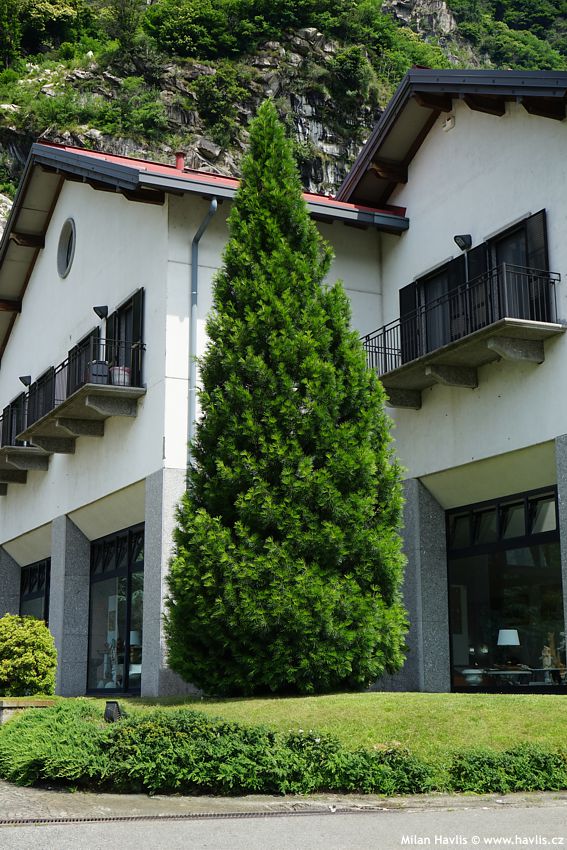
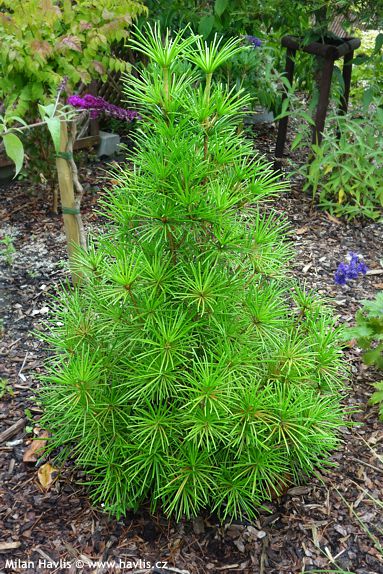
Growth is generally described as very slow, but this deserves a more nuanced explanation. In its early years, the Japanese umbrella pine does indeed grow slowly. After several years in the ground, however, it gains strength, and a plant 1–1.5 m tall may produce a shoot 40–50 cm long in a single season. In subsequent years, it often adds little height, instead concentrating on thickening the lower tiers of the crown so that it does not become sparse. This happens naturally, without the need for pruning, allowing the tree to maintain a balanced and regular form. While in Japan it can reach heights of 20–30 m under ideal conditions, occasionally even more, it remains much smaller in European gardens. In Central Europe, it typically grows to 3–6 m even after several decades. The habit is naturally symmetrical and conical, with a pronounced leader; with age, the base gradually broadens, rarely exceeding 3–4 m in width.
Last update 13-04-2008; 20-01-2026
Despite its exotic appearance, the Japanese umbrella pine is far from delicate. With a well‑chosen site, it requires little care beyond watering during the first year after planting. The key is an acidic, humus‑rich, well‑drained soil with even moisture, avoiding both prolonged waterlogging and drought; permanent mulching is ideal. It thrives best in a sunny position, and, in moist soil, it even tolerates midday scorching sun. It can also be grown in shade, where it tends to stretch toward the light and becomes slimmer and thinner. Exposed, windy sites are unsuitable: not only do the soft branches bend with the wind, but needle drop often occurs. Fertilization is not essential, though it can be beneficial. Pruning is unnecessary but possible on late winter; careful nurseries often use it to produce compact, dense plants at saleable sizes. Older literature frequently describes the species as poorly hardy, but this no longer reflects current experience or modern sources. Practical experience shows that it can withstand several days of frost down to −27 °C without damage, and some modern databases even place it in USDA hardiness zones 4b to 5 (down to −32 °C). The Japanese umbrella pine is also exceptionally long‑lived, capable of surviving for several centuries while retaining its stable form and vitality. It is not a tree for quick results, but a calm, enduring presence in the garden – one whose value increases with time.

.jpg)
