

































.png)
 The myth itself is a classic Greek tragedy, a story passed down since antiquity. Philyra was a beautiful sea nymph, with whom the god Cronus fell hopelessly in love. He desired her deeply, yet he was already married to another. Can you see how the torment of divided love has plagued not only humans since the dawn of time, but even the gods themselves? Unable to restrain his passion, Cronus devised a plan. So that neither Philyra nor his own wife would recognise him, he transformed himself into an impressive stud and, in that form, galloped to the nymph and seduced her. But even in Greek myths, everything comes at a price. From their union a child was born. When the beautiful Philyra gave birth, she was devastated – the child was half man and half horse, a centaur. Not just any centaur, but Chiron, who would one day accomplish great deeds and become the mentor of Achilles himself – though she could not have known that at the time. Overcome with shame at the sight of him, she begged the gods to rid her of her human form. The gods granted her wish and, because she was truly beautiful, transformed her into a beautiful tree – the phillyrea.
Back to our own century. Around 2005, I visited a nursery in England that specialised in exotic-looking shrubs with large, attractively shaped leaves suited to the local climate. To put things into context – England lies within an oceanic climate on the boundary between the temperate zone and the cooler subtropics, so it was clear that not everything grown there could be relied upon in our conditions. Still, every tip is worth exploring, and I wanted to see for myself. It was an exciting challenge to discover so many beautiful woody plants and begin testing them one by one back home.
I was accompanied by two people – the older owner, a tough, weathered character, visibly proud of his life’s work, perhaps at times a little too much so, and already weary of worldly bustle. And a young man, fresh out of school by the look of him, who seized every moment when the owner was not preening himself to enthusiastically explain what grew where and how it was doing. At one point I stopped by an interesting composition featuring a large-leaved Fatsia japonica, nearly two metres tall, and right beside it an equally impressive Eriobotrya japonica, clipped into an elegant multi-stem form, about three metres high, crowned with a dense canopy of enormous, leathery leaves. It was obvious that these beauties were not meant for me – at first glance they radiated the message: we are not frost-hardy.
 Surprisingly, this time it did not bother me. What caught my attention was the shrub growing between them. Small-leaved, dense, and at first glance remarkably healthy and vigorous. I dared to ask what it was, as there was no label, and the owner scorched me with a look that seemed to say, “Don’t you know this, you dilettante?” Aloud, however, he merely said, “That’s just filler – we have them everywhere, they grow on their own.” As soon as he stepped a few paces away, the younger guide, eyes wide with excitement, began telling me that these were phillyreas, how much he loved them, where they came from, how they grew – everything. It was clear he was passionate about them, and I could not blame him. We let the owner disappear into his office, and the young gardener led me through the entire nursery to show me each specimen in turn. I was delighted.
.jpg) The reason the boss had taken offence was probably the fact that, in the regions where phillyrea grows naturally, it is regarded more as a filler shrub or even scrub, as it can grow almost anywhere without care. As a result, in the wild it often looks rather… forlorn. Yet the moment a human hand touches it, it becomes a splendid evergreen shrub, attractive for its airy structure, rich branching, and small leaves with a pale underside reminiscent of the olive tree.
The reason the boss had taken offence was probably the fact that, in the regions where phillyrea grows naturally, it is regarded more as a filler shrub or even scrub, as it can grow almost anywhere without care. As a result, in the wild it often looks rather… forlorn. Yet the moment a human hand touches it, it becomes a splendid evergreen shrub, attractive for its airy structure, rich branching, and small leaves with a pale underside reminiscent of the olive tree.
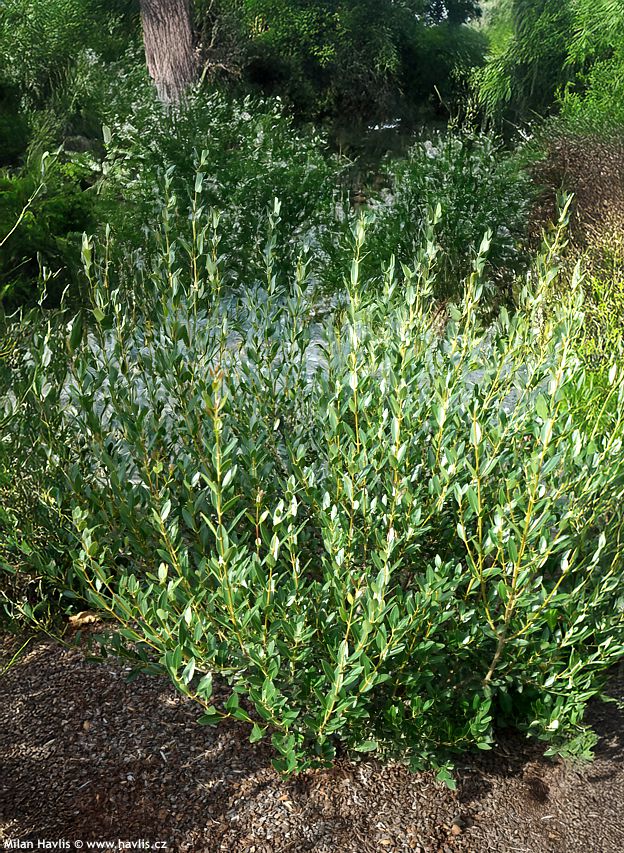
 In horticultural practice, we mainly encounter two botanical species: Phillyrea angustifolia, the narrow-leaved phillyrea, and Phillyrea latifolia, the broad-leaved phillyrea. There is also a natural hybrid of the two, known as Phillyrea × media, the intermediate phillyrea. It is sometimes classified as a subspecies of the broad-leaved form, though botanists are not entirely certain. The narrow-leaved species grows quickly and vigorously, with a light, airy appearance. It is used not only as filler in hedges and green walls, but is also often clipped in a manner similar to boxwood. Since my English expedition, I too have enjoyed using it as a contrasting element in compositions with large-leaved shrubs and trees, where both textures can truly shine.
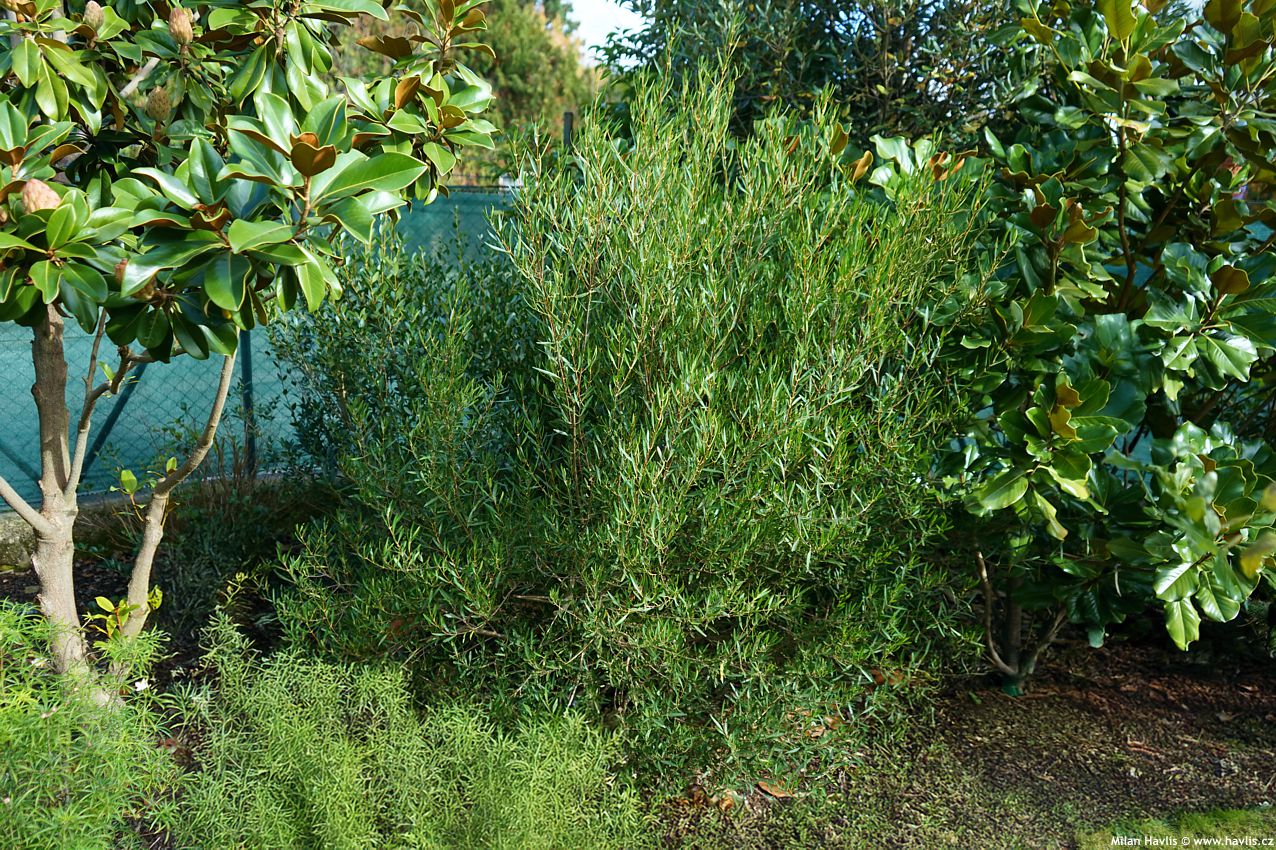 Because the narrow-leaved phillyrea is variable, several selected cultivars exist, differing in leaf shape and size, habit, and overall stature. One of the newest is the cultivar ‘Green Up’, offering more compact shrubs with smaller leaves. The cultivar ‘Rosmarinifolia’ has exceptionally narrow leaves, truly evoking the lightness of rosemary foliage. The intermediate form, Phillyrea × media, stands halfway between the two species: its leaves are shorter and broader, yet its growth remains relatively fast and vigorous.
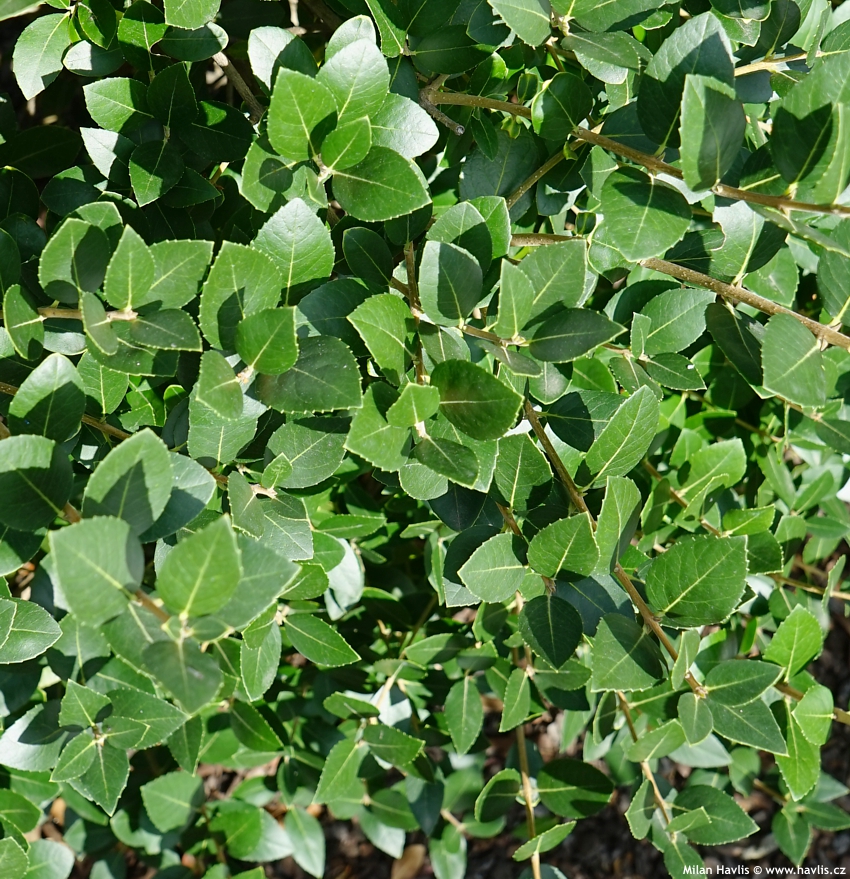
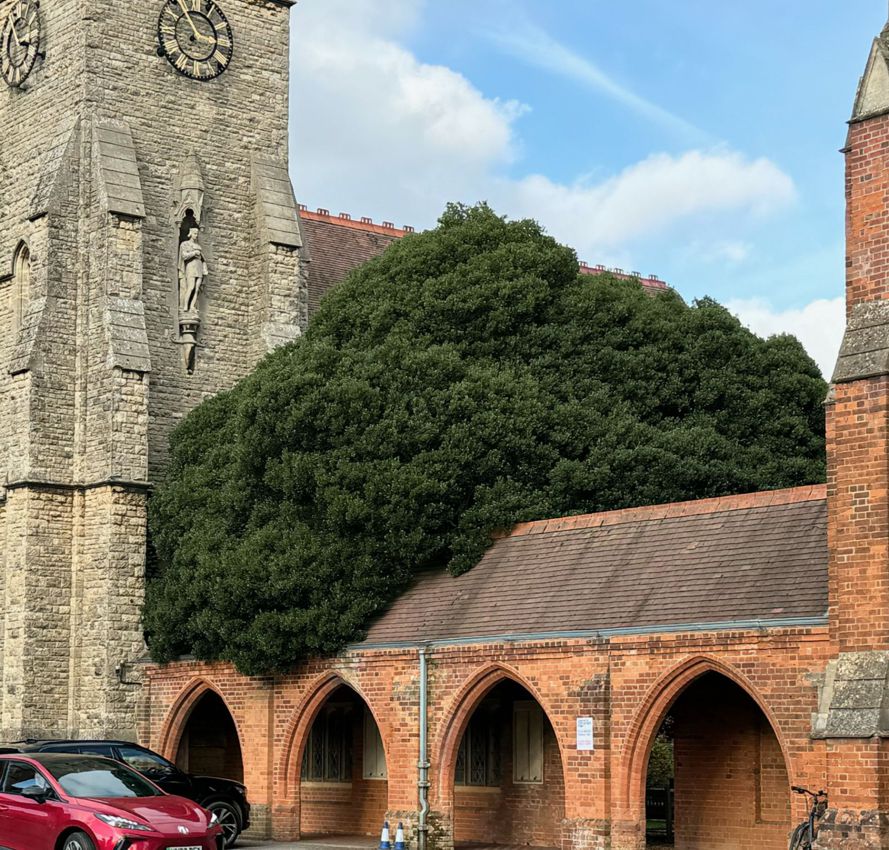 The broad-leaved phillyrea is something else entirely. It grows slowly, forming stiff, strictly upright branches, and its leaves are darker green, highly glossy, and distinctly toothed along the margins. A characteristic feature of its growth is the dense, almost congested crown, which over time develops into an attractive shape that has earned it the English nickname the broccoli tree. Can you imagine a giant broccoli? Yes – that’s the one.
.jpg) Another English name is green olive. In cooler regions, phillyreas are used as a visually similar alternative to the true olive, whose tolerance threshold is much lower, even though both belong to the olive family. They do not, however, produce olives. They do bear fruit, but it has nothing in common with olives and is not edible.
Another English name is green olive. In cooler regions, phillyreas are used as a visually similar alternative to the true olive, whose tolerance threshold is much lower, even though both belong to the olive family. They do not, however, produce olives. They do bear fruit, but it has nothing in common with olives and is not edible.
.jpg) Phillyrea originates from the Mediterranean macchia – harsh plains and rocky landscapes with minimal rainfall, poor soils, often lashed by strong winds outside the growing season and, in hot summers, occasionally ravaged by fire. And do you know what phillyrea can do? It can resprout even from a charred stump. Such is its resilience. Perhaps that is why Italians say that phillyrea grows where even hope no longer does. That says it all. It is content with any well-drained soil and minimal watering – an ideal woody plant for an era of ever-diminishing water reserves in the ground. Thanks to more than twenty years of cultivation, we now know that it is highly frost-hardy and has withstood temperatures down to around –27 °C without damage. So, will you give phillyrea a try as well, and finally stop battling with a lack of water?
Phillyrea originates from the Mediterranean macchia – harsh plains and rocky landscapes with minimal rainfall, poor soils, often lashed by strong winds outside the growing season and, in hot summers, occasionally ravaged by fire. And do you know what phillyrea can do? It can resprout even from a charred stump. Such is its resilience. Perhaps that is why Italians say that phillyrea grows where even hope no longer does. That says it all. It is content with any well-drained soil and minimal watering – an ideal woody plant for an era of ever-diminishing water reserves in the ground. Thanks to more than twenty years of cultivation, we now know that it is highly frost-hardy and has withstood temperatures down to around –27 °C without damage. So, will you give phillyrea a try as well, and finally stop battling with a lack of water?
