












.jpg)
.jpg)
Arbutus unedo 'QUERCIFOLIA' strawberry tree


 Rhodovit (arbutoid type)
Arbutus
The strawberry tree is a Mediterranean woody plant that you may easily miss passing by local rocks and plains, because there it is just as naturalized, ubiquitous, and often oddly shaped as, for example, the common elder is in Central European countryside. Somewhat surprisingly, the genus Arbutus belongs to the heath family (Ericaceae) and includes several species of evergreen shrubs and small trees distributed throughout the Mediterranean region along its entire perimeter, European, African, and Near Eastern, as well as in adjacent parts of western Europe. It belongs among ancient woody plants that were already growing here around 20 million years ago, at a time when the local climate and the character of Mediterranean vegetation were only beginning to take on their present form. Under the typically harsh conditions of the maquis, strawberry trees survived cooling periods, recurring droughts, fires, and other repeated disturbances of the landscape. It is therefore no surprise that this combination of evergreen elegance, long-term drought tolerance, and the ability to regenerate after stress has rapidly brought the strawberry tree to the forefront of growers’ interest at the beginning of the new millennium. It is a prime candidate for the changing climate of today’s Central Europe, where rainfall and soil moisture are declining.
The common strawberry tree (Arbutus unedo) is the most widespread representative of the genus and is abundant in Mediterranean landscapes. It naturally forms the lower and middle layers of woodland. It was first scientifically described by Carl Linnaeus in 1753 in his work Species Plantarum. The species name unedo originates from the Latin phrase unum edo: “I eat only one” traditionally attributed to Pliny the Elder (23–79 AD, Roman Italy). This refers to fruits, which are edible and sometimes quite sweet, but rather bland in flavour. This brief remark, whether meant seriously or with irony, reminds us that the strawberry tree was observed and named long before the emergence of modern botany. For centuries it remained a symbol of southern regions, where its adaptability to summer drought and its striking appearance made it popular in gardens and urban greenery, while more northerly areas were long considered beyond its reach. That has now changed.
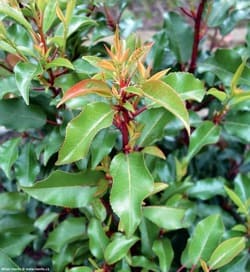
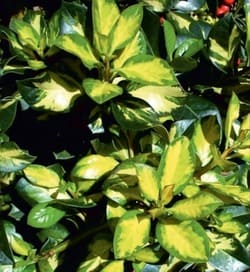
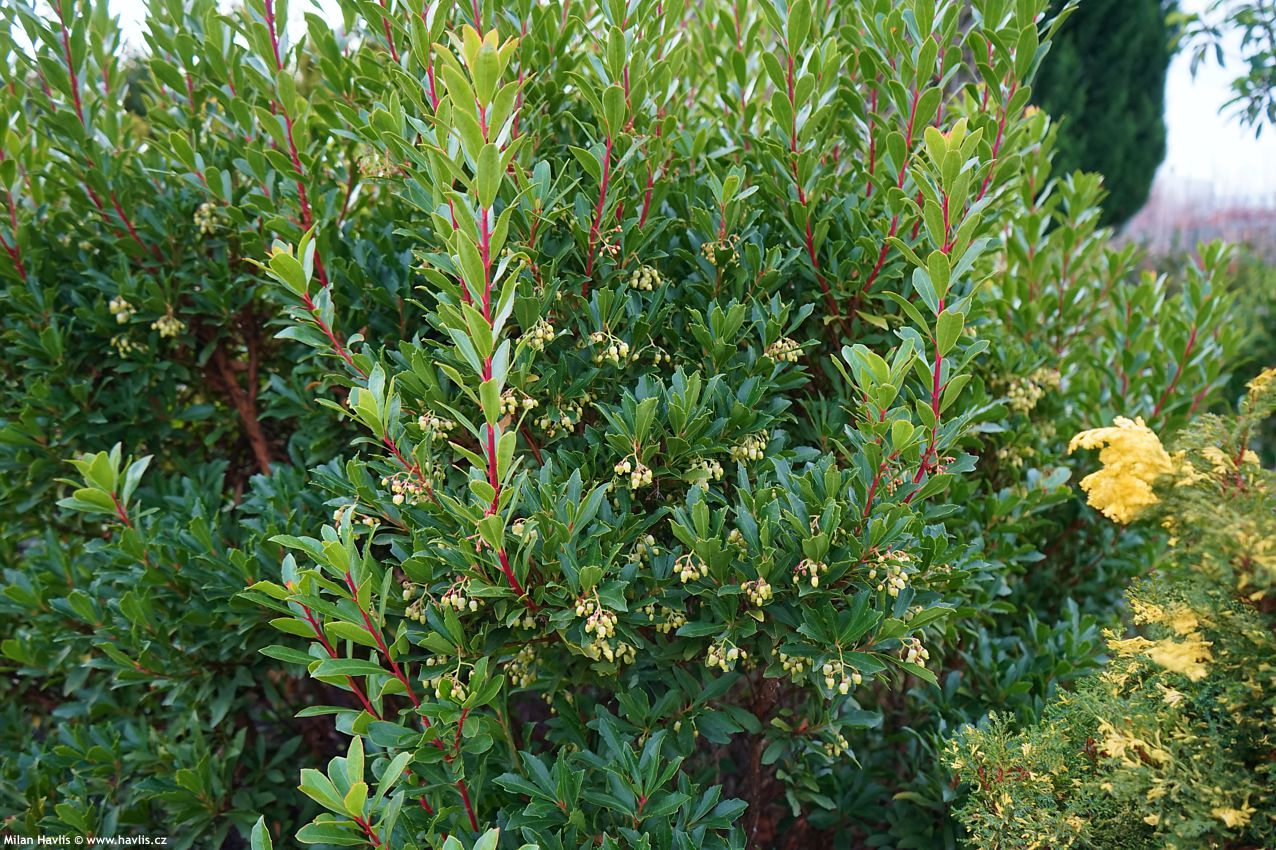
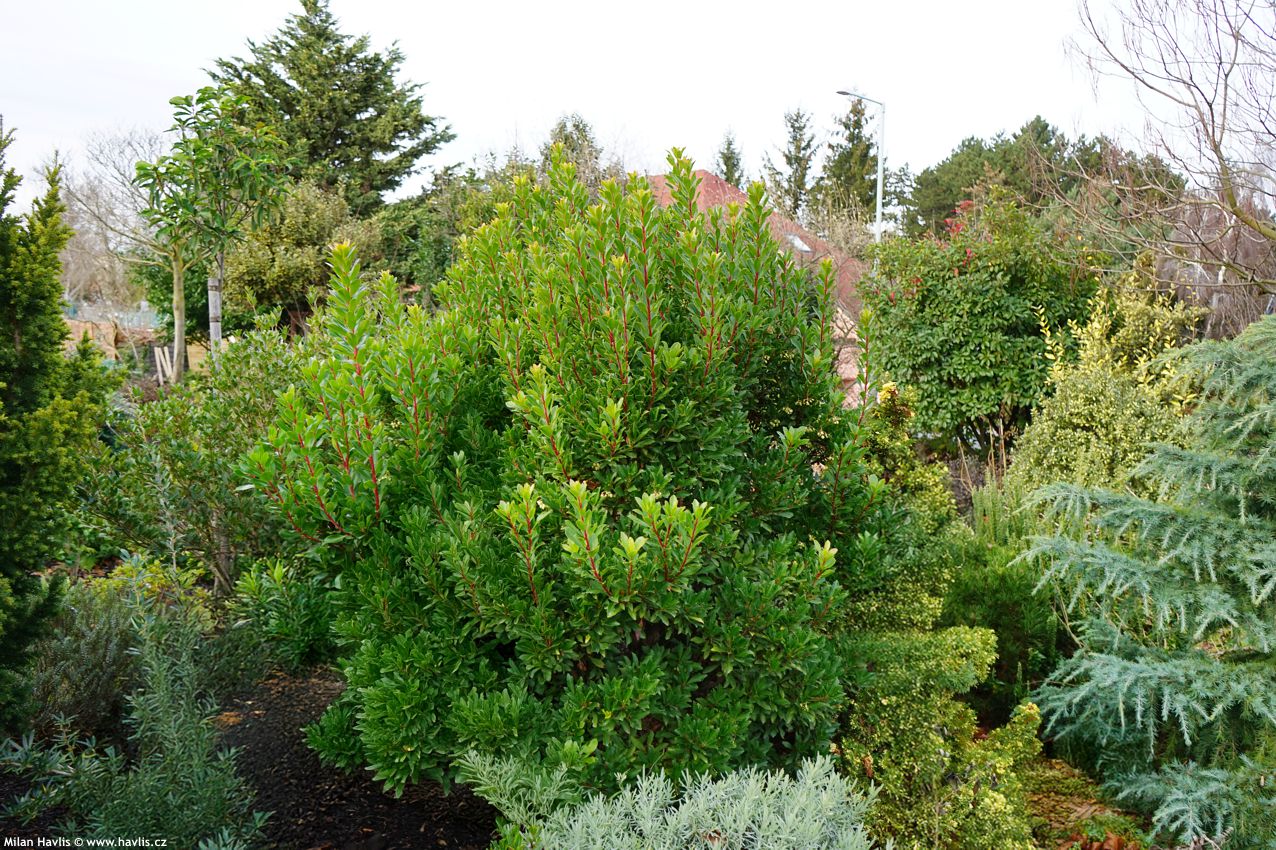
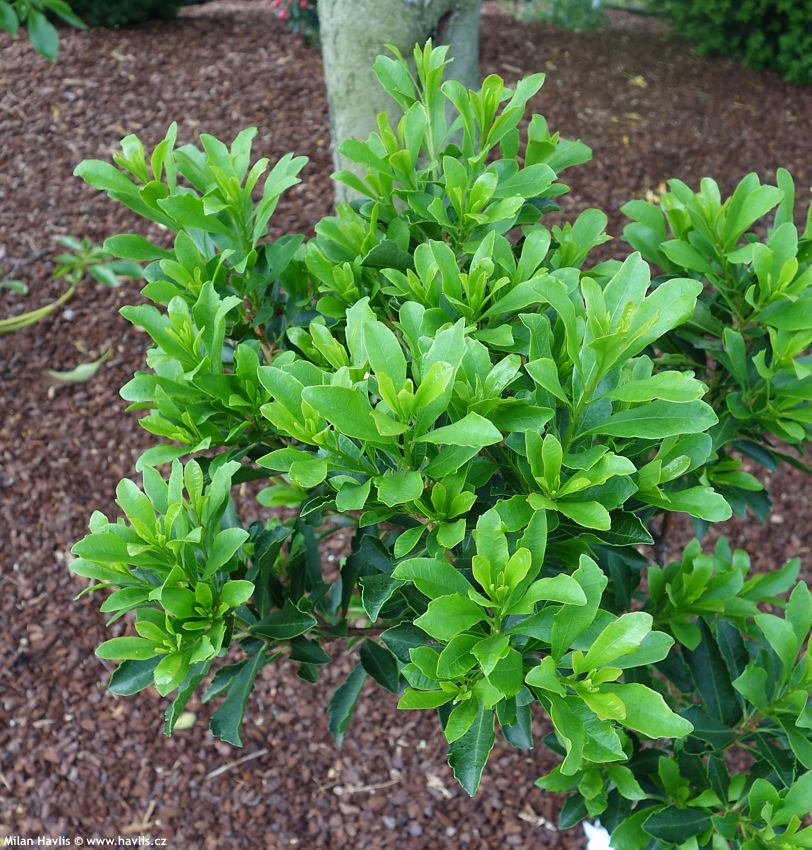
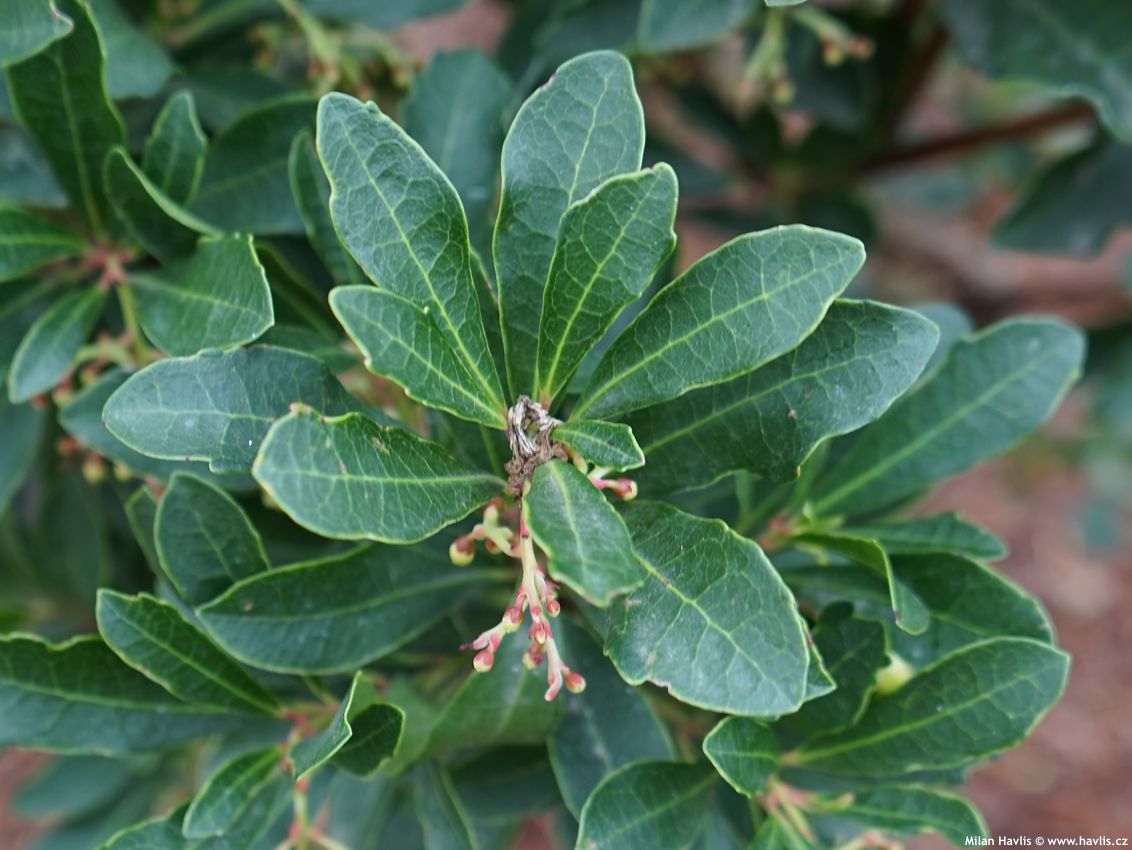
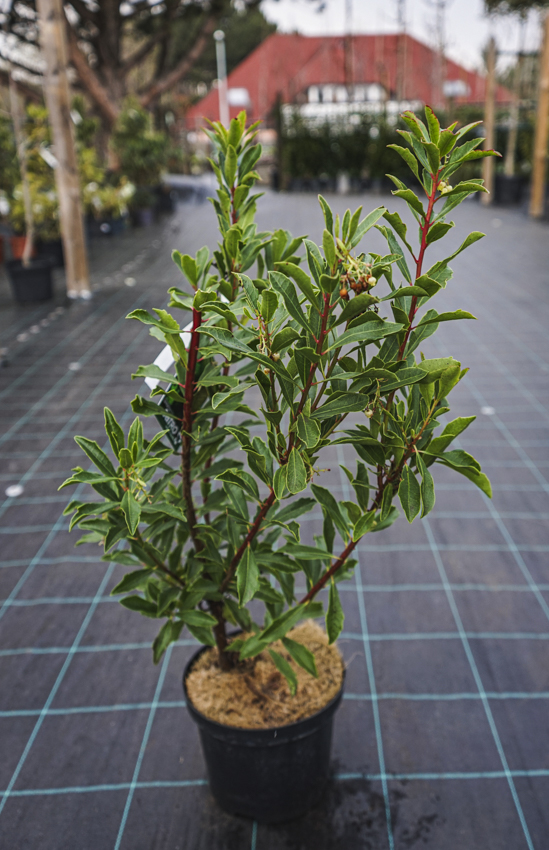
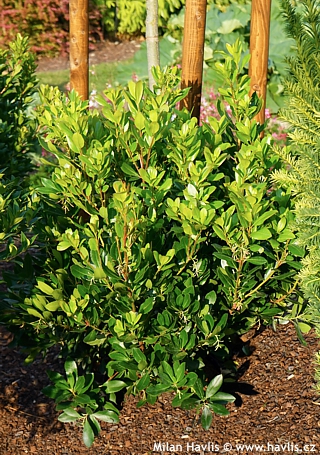
Quercifolia is a rare, collector’s selection of strawberry tree that differs from the species in both leaf shape and growth habit. The epithet Quercifolia is common in botanical usage and means “oak‑leaved”; also here it refers to the unusual leaf form, which bears several shallow notches toward the tip so that – with a little imagination (or a lot) – the leaves can resemble those of an oak. They are evergreen, leathery and dark green, densely covering the stout twigs, which take on an attractive deep magenta colour in autumn and winter. And it's only fair to add that the leaf shape can vary considerably from one leaf to another, even on the same plant. Though, it still has charisma and charm which make it irresistible. The plant grows upright, very densely and more slowly than most cultivars, forming chubby, almost impenetrable shrubs that remain smaller for a long time than many other varieties.
The origin of the selection is not precisely documented and it probably dates from the 19th century: it does not appear in the records of Kew Gardens, whose collections were carefully documented by William Aiton in Hortus Kewensis, but botanists H. J. Elwes and A. Henry list it there about a century later in The Trees of Great Britain & Ireland (1912). Although Quercifolia is compact and slow‑growing when young, in favourable conditions it can eventually reach the size of the species, as evidenced by a specimen measured at 7.8 m in Glasnevin National Botanic Garden, Dublin, in 1974. Nevertheless, I believe that in Central European conditions such a height is unlikely.
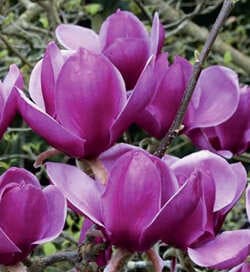
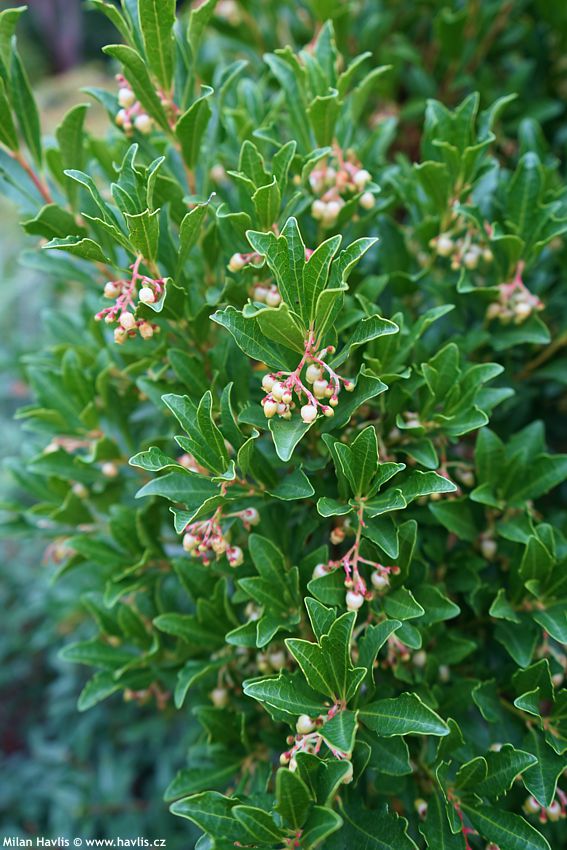
The small flowers clearly reveal their membership in the heath family, like blueberries. They are grouped in short clusters and appear from autumn through spring. They are lily-of-the-valley–shaped, creamy white, and ripen into edible fruits – about 2 cm wide spheres that are initially light green, then yellowish, and finally strawberry red when ripe, which gave the tree its common name. They contain up to 20% sugar, but their raw flavour is not very pronounced, so they are mainly used for jams, liqueurs, and further processing. Because they ripen very slowly and are produced in abundance, it often happens that unharvested fruits overripe and spontaneously ferment in the sun without spoiling. As a result, southern drivers must be cautious when consuming them, as they already contain alcohol. In nature, some animals deliberately seek them out for this reason, much as birds in our region “get drunk” on fermented rowan berries. In the Mediterranean, strawberry trees ripen from autumn to late winter. If autumn flowers are damaged by frost in our climate, the plant produces a replacement set of flowers in spring, and if the summer is sufficiently hot and sunny, it may (or may not) bear fruit in autumn.
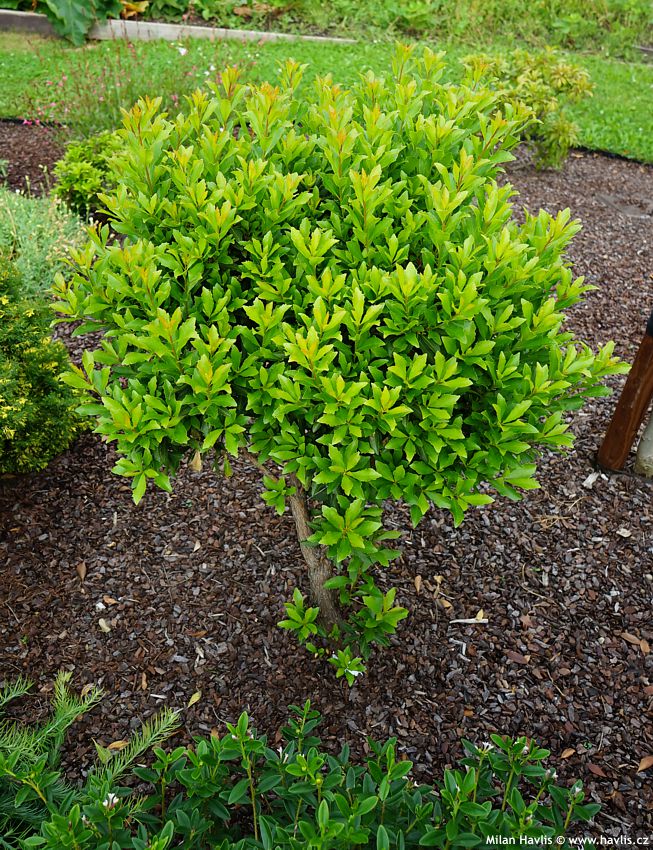
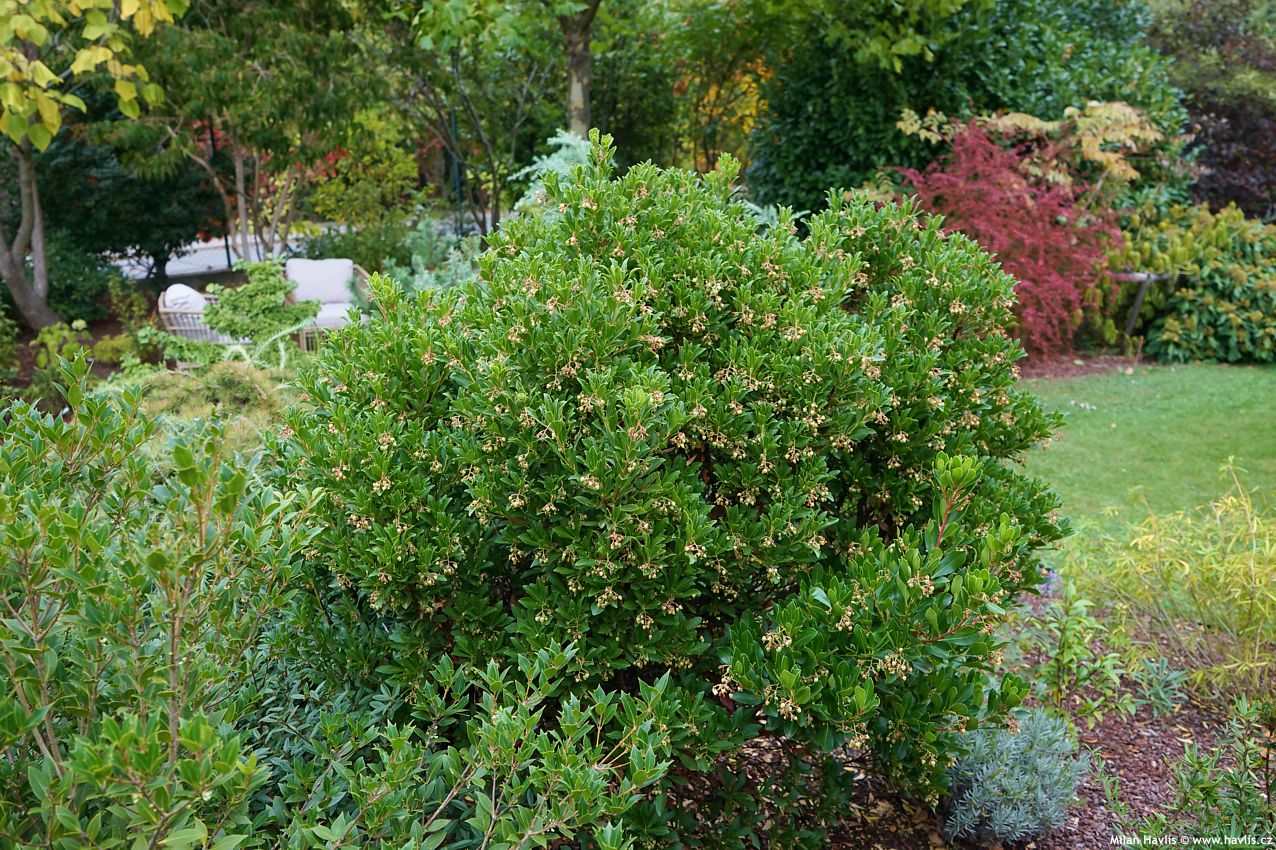
The strawberry tree grows densely into a spherical to dome-shaped habit with ascending branches. In spring, after frosts, pruning can encourage denser branching. It is often shaped and sheared in midsummer. Multi-stemmed forms look particularly beautiful, where several strong, upright branches are retained as the framework, the others removed, and a mushroom-shaped crown is formed by summer pruning. This highlights its beautiful reddish-brown branches. In the Mediterranean it can grow into a tree up to eight meters tall and wide; in our conditions, roughly half that size.
Last update 13-03-2026
It requires good, fertile, and excellently drained soil, especially to prevent root rot in winter. However, it can cope with clay subsoil at greater depth. After planting, keep the soil evenly moist for a couple of months, but once established, reduce or completely stop watering – it is accustomed to surviving the entire summer on natural rainfall alone. Grow it in full sun or light partial shade, preferably in a sheltered location. When planting, use soil fungi, and here is one peculiarity: although it is a heathland shrub, it does not require ericoid mycorrhiza and functions very well with universal arbuscular mycorrhiza (Symbivit, Tric). It is recommended to plant stronger specimens with mature wood so that young twigs are not damaged during the first winter. So far, we have not been able to test it in the most severe frosts; to date it has withstood −17 °C here, but North American growers plant it in zone 6, with winter temperatures dropping to as low as −23 °C (USDA zone 6). It does not suffer from diseases, and among pests it may occasionally be sampled by vine weevils, but they do not find it particularly palatable.
.jpg)
Goods are shipped all over Europe. For Russia and U.K. and for further details please read about SHIPPING OPTIONS HERE.
Are you interested in a serious discount for orders NOV-FEB? Check your options here.
THE PRICES INCLUDE VAT of 15%. For quick conversion you can use 1 CZK = approx. 0.04 EUR
- STANDARD QUALITY - Plants of this group are 1st class quality with number of branches and overall density adequate to their size and age, considering they were container grown.
- DE LUXE QUALITY - This label guarantees a luxurious quality of manually selected plants that, compared to their height and age, are exceptionally dense and beautiful.
- EXTRA - These plants are usually mature and bigger specimens with exceptional overall appearance.
- STANDARD (as described in the plant form) means a tree with a trunk of 190-210 cm and a crown at the top, unless specified differently. The commercial size for trees is their girth measured in the height of 1m from ground.
- HOBBY - These plants are of the same quality as our standard-quality plants but younger and therefore cheaper.
- SHRUB - a woody plant with branches growing bushy from the ground level.
- HALF-STANDARD or MINI-STANDARD - a small tree with shorter trunk, its size is usually specified.
- FEATHERED - These are trees with branches growing already from the base of the trunk and up along the stem.
- GRASSES and PERENNIALS - Sizes given usually read the diameter of the pot or the clump, as specified.
