












.jpg)
Baptisia 'PINK TRUFFLES' false indigo

 Symbivit Tric (arbuscular)
 Symbivit (arbuscular)
Baptisia
Baptisia is an old North American genus with roughly 30 species, ranging from dry prairies to bright woodland edges in the eastern and south‑eastern United States. It was formally established by Étienne Pierre Ventenat (1757–1808) in 1808, although its history is more tangled: earlier authors alternated between placing it in Podalyria, Sophora or Ripasia, reflecting the uncertainties within the Fabaceae family at the time and its similarity to other papilionaceous plants. These are robust perennials with deep root systems that anchor them even in extreme drought, while their peculiar chemical trait – the blackening of tissues when injured – recalls their former use in dyeing and folk medicine. This is also reflected in their scientific name, since the Greek bapto means to dip; several species were used as substitutes for true indigo, hence its American common name False indigo. The natural species differ in flower colour and ecology, but all share a firm, almost shrub‑like habit and the ability to form substantial clumps that act as surprising anchors of vegetation in dry prairie landscapes.
Hybridisation in Baptisia began quietly: in nature, blue‑flowered species such as B. australis occasionally crossed with yellow ones like B. sphaerocarpa and B. tinctoria, showing that the combination of anthocyanins and carotenoids can produce new shades. Modern breeding relies mainly on several species that appear in the literature as parents of described hybrids: B. australis for its strong habit and blue pigments, B. tinctoria and B. sphaerocarpa for yellow tones and resilience, B. alba as a stabilising element with pure white flowers, and B. minor for compact habit, lower growth and rich blue pigment. A real breakthrough came in the United States at the turn of the twentieth and twenty‑first centuries, when Hans Hansen (born 1963) began, reportedly at first just for fun, collecting seed in Texas and Oklahoma and crossing the plants. The results surprised him so much that he started breeding Baptisia systematically, crossing species across the sections of the genus and creating the Prairieblues™ and later the Decadence® series, which defined the modern form of Baptisia with strong stems, large inflorescences, new colour combinations and improved garden performance. At the same time Tony Avent (born 1956) of Plant Delights Nursery in North Carolina gathered natural forms, especially B. arachnifera with its silvery foliage, and his selection work broadened the genetic base from which today’s breeders draw. His collection now includes at least twenty‑five cultivars that he has tested over many years in different climatic conditions. Hybrids develop slowly because Baptisia plants take several years to grow and flower, but once established they form long‑lived clumps that act as stable, almost maintenance‑free dominants in the garden.
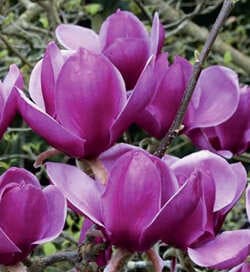
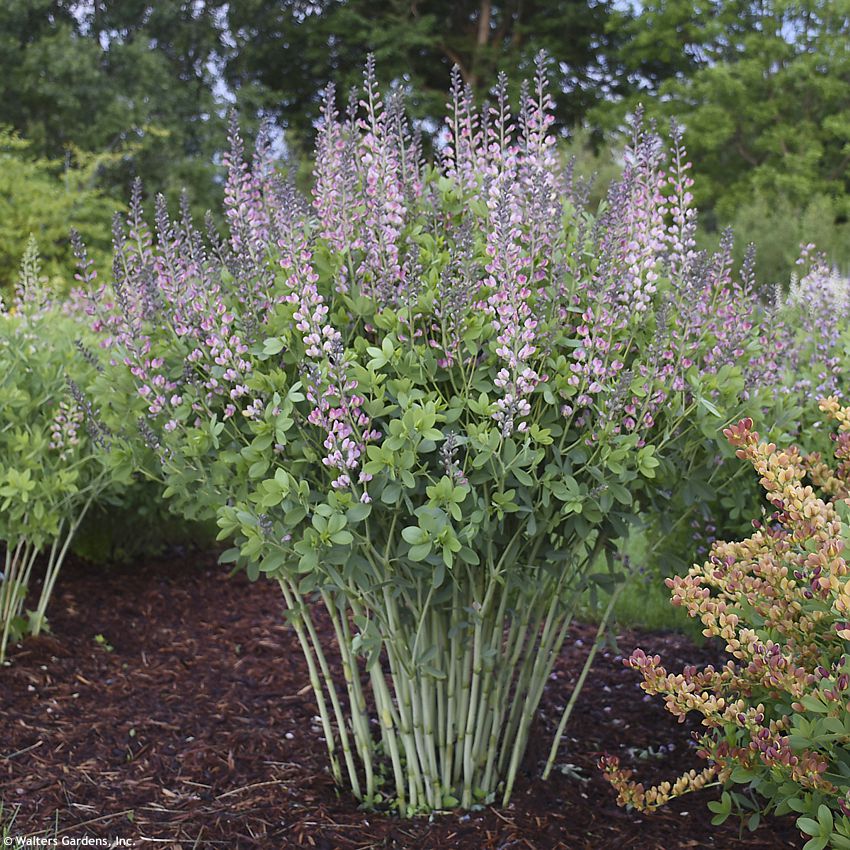
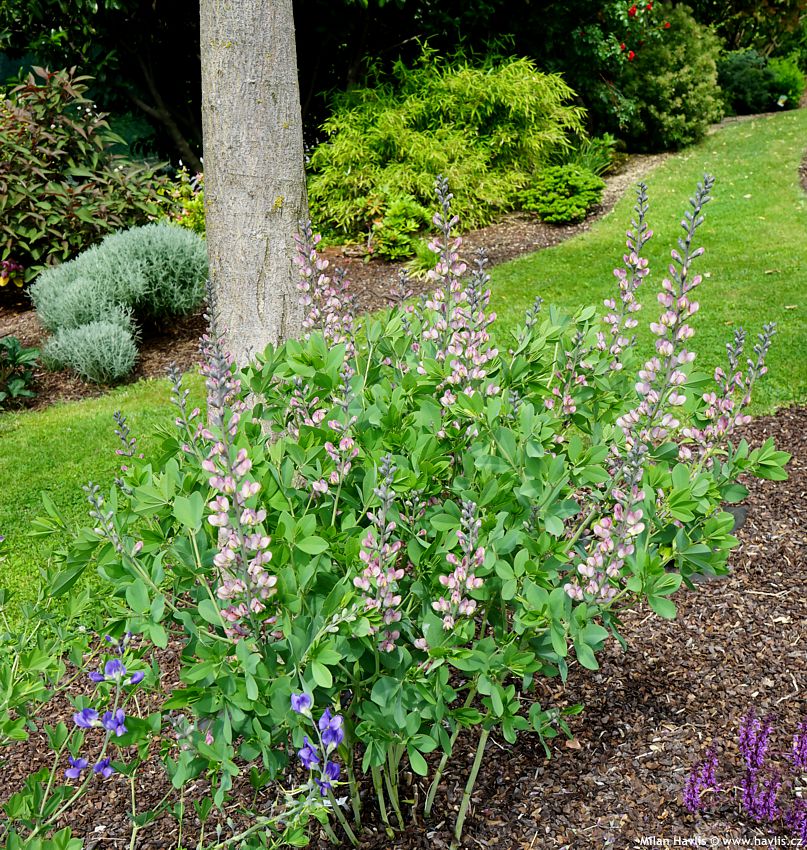
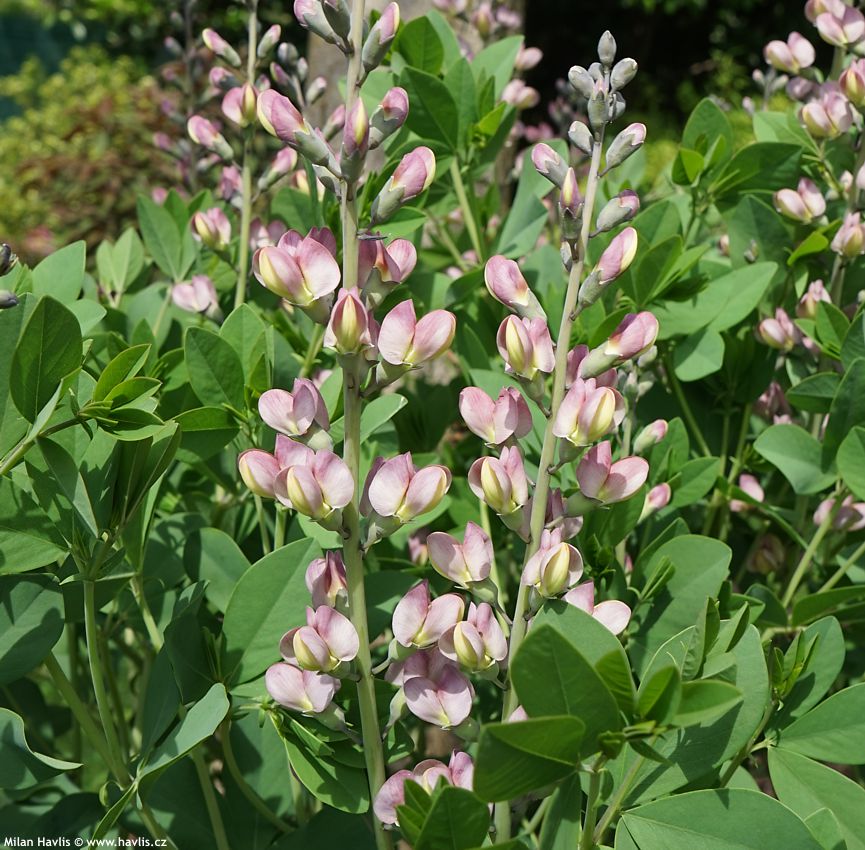
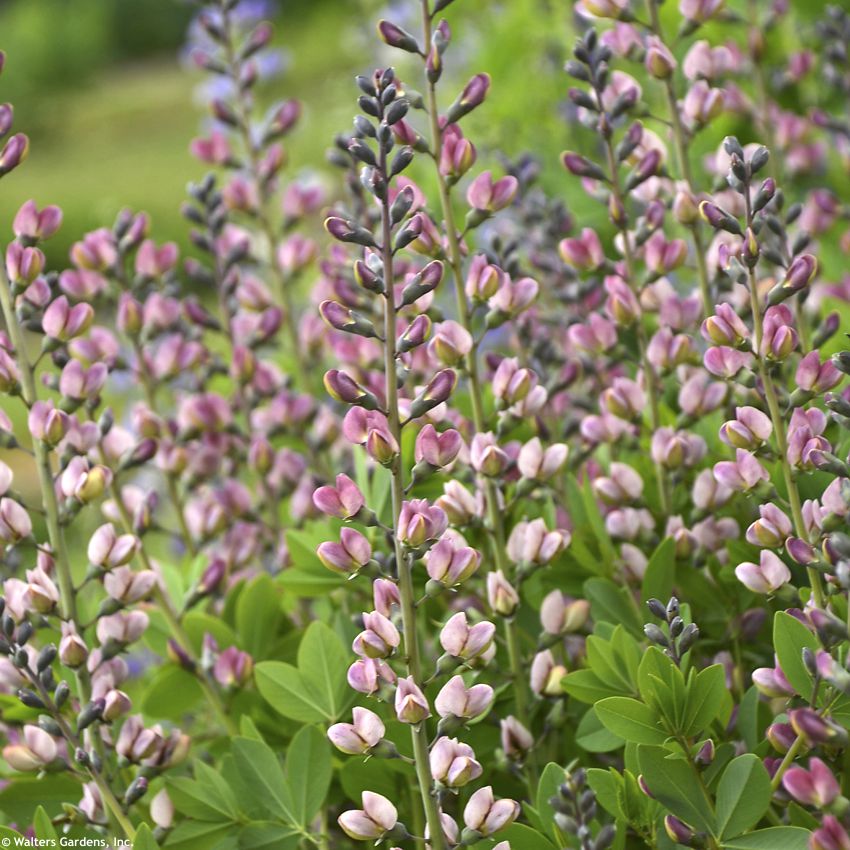
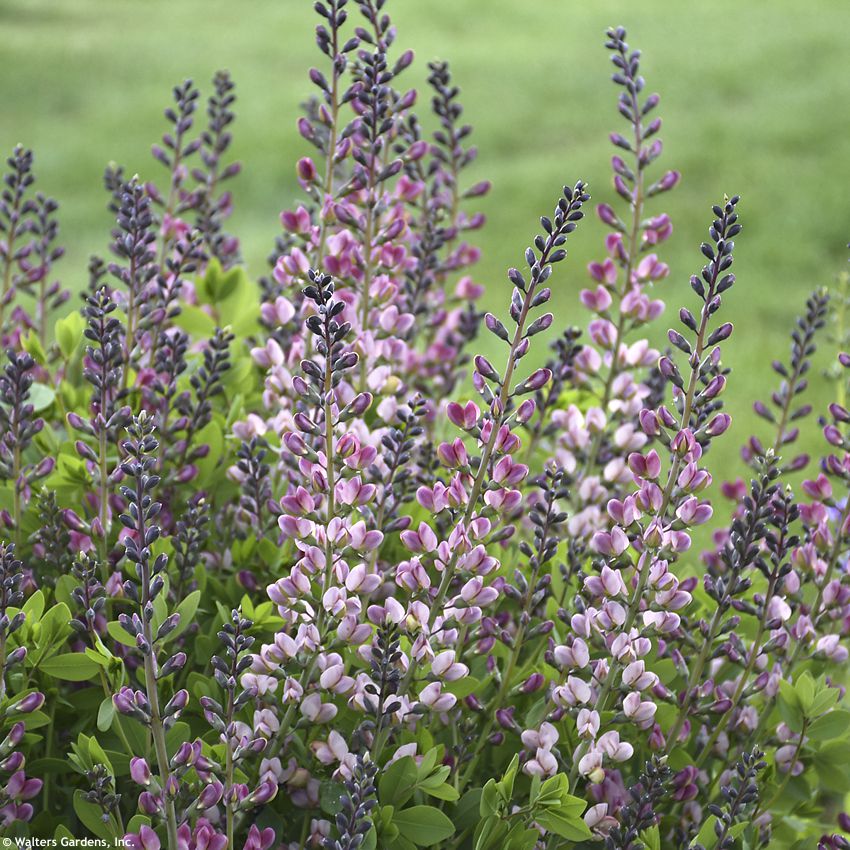
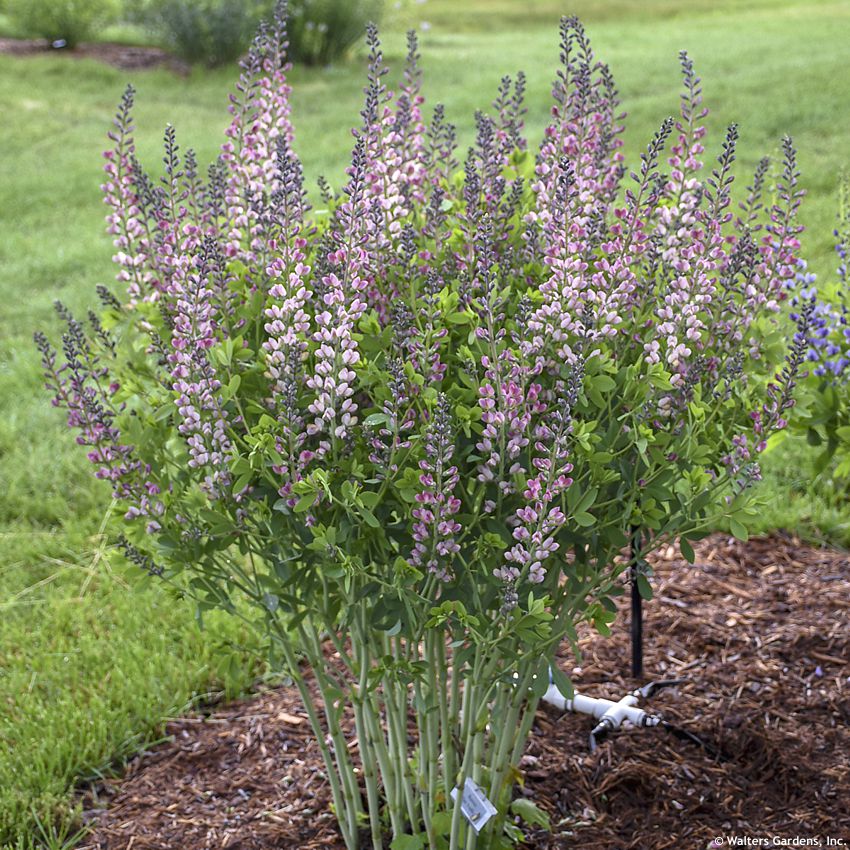
Pink Truffles baptisia is a member of the Decadence® series bred by the American hybridiser Hans Hansen. It offers surprisingly long inflorescences, twenty‑five to thirty‑five centimetres in length, composed of pea‑like flowers that open from lilac‑pink buds as vivid as over‑applied rouge and then unfold into a soft powdery pink reminiscent of a young girl’s cheeks. A light yellow‑green flush on the lower part brings a touch of life to its dreamy appearance. Because the flowers sit close together, they create the impression of a single pastel pink candle. Pink Truffles flowers in May and early June, slightly earlier than B. australis, and the flowers last for a long time, often up to three weeks. After flowering it produces conspicuous pods whose ripe seeds rattle like a child’s toy, giving rise to its American folk name rattleweed. The plant forms a firm, almost shrub‑like habit around 1.1 to 1.3 metres tall and slightly less wide, creating a compact and well‑balanced clump. The leaves have the classic Baptisia shape of an oversized clover: trifoliate, broadly elliptic to obovate, with a matte, bluish‑green surface that in morning light resembles a thin film of dust on old glass. Compared with the species it is more compact, more delicately coloured and has stronger stems that do not collapse even after heavy rain. The cultivar is protected by US patent PP26588 from 2016.
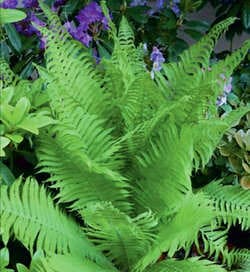
‘Pink Truffles’ baptisia has a slightly mysterious presence in the garden. Although its buds offer a saturated colour before flowering, the open blooms are gentle and invite two distinct planting styles. You can choose a tone‑on‑tone combination with perennials in similar lilac and pink shades that flower at the same time, such as meadow clary, pink forms of woodland sage, later forms of steppe sage, cranesbills, scabious, knautia, fleabane, early asters or even red valerian. Or you can try a more enigmatic planting with attractively shaped perennials and shrubs that flower sparsely or unobtrusively; when the pink spires of this Baptisia suddenly rise among them, the effect is a quiet surprise rather than a shout. For such a composition you might include large‑leaved hostas in green and bluish tones that tolerate sun, pale pink or even green‑flowered forms of taller coneflowers, low evergreen Hebe or Daphne in the foreground, Mexican mock orange with palmately divided leaves beside or behind, and certainly some taller sun‑tolerant ferns such as ostrich fern or male fern.
Last update 12-07-2026
Baptisia requires patience: during the first two or three years after planting it grows slowly because it invests energy in its deep root system. This slow start is also the reason why its retail price is often higher than that of common perennials; it simply takes longer to produce a plant strong enough for planting. Once established, however, Baptisia becomes an exceptionally stable and long‑lived perennial that forms increasingly substantial clumps resembling small shrubs, which is why it was chosen as the Perennial of the Year 2019 by the Czech Perennial Growers’ Association. It needs full sun, well‑drained and rather poor soil, and it dislikes waterlogging; it responds very well to heat and drought. Watering is required only in the first year after planting, and later it is almost maintenance‑free. Fertilising is unnecessary and on overly rich soils it may even grow weaker. Pruning is done in spring when the dry stems are removed; for a cleaner appearance though you can cut it back by about half after flowering so that it does not waste energy on seed production and forms a smaller but freshly leafy clump. Baptisia does not tolerate transplanting and often stagnates for several years afterwards. Pests rarely attack it and diseases appear only occasionally. Thanks to its firm structure and deep roots it withstands wind and summer heat well and is fully hardy to at least -34 °C (USDA zone 4).

Goods are shipped all over Europe. For Russia and U.K. and for further details please read about SHIPPING OPTIONS HERE.
Are you interested in a serious discount for orders NOV-FEB? Check your options here.
THE PRICES INCLUDE VAT of 15%. For quick conversion you can use 1 CZK = approx. 0.04 EUR
- STANDARD QUALITY - Plants of this group are 1st class quality with number of branches and overall density adequate to their size and age, considering they were container grown.
- DE LUXE QUALITY - This label guarantees a luxurious quality of manually selected plants that, compared to their height and age, are exceptionally dense and beautiful.
- EXTRA - These plants are usually mature and bigger specimens with exceptional overall appearance.
- STANDARD (as described in the plant form) means a tree with a trunk of 190-210 cm and a crown at the top, unless specified differently. The commercial size for trees is their girth measured in the height of 1m from ground.
- HOBBY - These plants are of the same quality as our standard-quality plants but younger and therefore cheaper.
- SHRUB - a woody plant with branches growing bushy from the ground level.
- HALF-STANDARD or MINI-STANDARD - a small tree with shorter trunk, its size is usually specified.
- FEATHERED - These are trees with branches growing already from the base of the trunk and up along the stem.
- GRASSES and PERENNIALS - Sizes given usually read the diameter of the pot or the clump, as specified.
