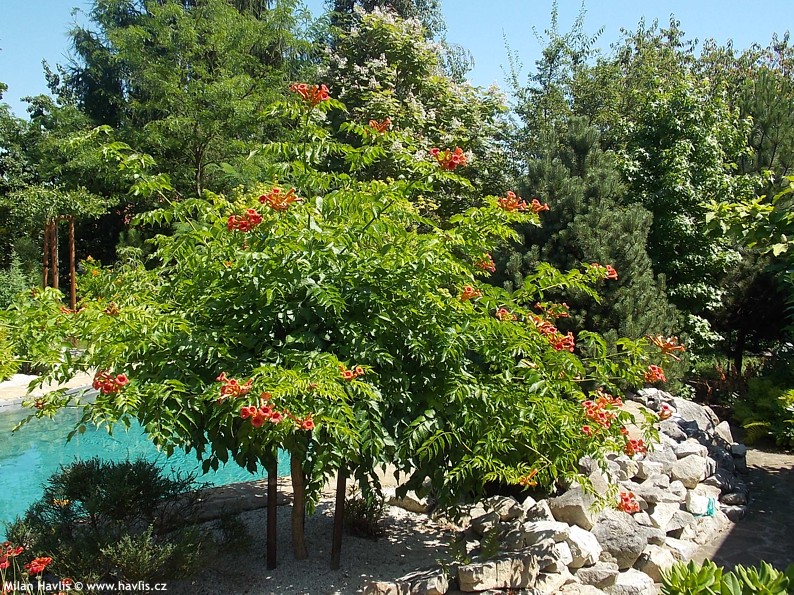
Campsis radicans 'SERENA' trumpet vine, trumper creeper - climbing

 Symbivit Tric (arbuscular)
 Symbivit (arbuscular)
Campsis
The genus Campsis consists of only two species and they both carry the energy of subtropical climbers that, over the course of evolution, learned to ascend using small aerial rootlets and to brace themselves against tree bark as if it were a natural ladder. They belong to the family Bignoniaceae, a group known for its trumpet flowers and often woody climbing habit. C. radicans originates from North America, whereas C. grandiflora comes from East Asia, an intriguing geographical split that suggests a much earlier distribution of the genus’s ancestors across the warmer regions of the Northern Hemisphere. The genus was described by João de Loureiro (1717–1791), a Portuguese missionary and botanist working in Southeast Asia, who defined it on the basis of its characteristically curved stamens, reflected in the Greek kampein, meaning “to bend”. The nomenclatural history is, however, tangled: European gardens of the 17th century were unsure where to place the plant, and it appeared under the names Bignonia, Tecoma and even Apocynum, until the 19th century finally settled the genus in its present form. In the wild it is a climber of bright woodland edges, well‑drained riverbanks and disturbed habitats, where its rapid growth and ability to root along the stems allow it to occupy space before slower woody plants can take hold.
Campsis radicans, trumpet vine, is one of the most striking North American climbers, admired by Europeans as early as the colonial period for its softly red, trumpet‑shaped flowers. The species was described by Carl Linnaeus (1707–1778) in 1753 as Bignonia radicans and was later transferred to the genus Campsis by Édouard Bureau (1830–1918). Its native range stretches from Iowa and New Jersey down to Florida and Texas, where it inhabits river floodplains, woodland margins and abandoned pastures. In the pre‑Columbian landscape it was tied mainly to moist valley bottoms, but with the spread of agriculture and the disturbance of natural habitats it became a successful coloniser of fences, hedgerows and neglected plots. It reached Europe in the 17th century, first appearing in England, and quickly established itself in gardens thanks to its vivid colour and generous flowering at a time when most native woody plants have long finished blooming. It is valued for its toughness and indestructibility as well – it can envelop pergolas, walls and old trees, forming dense green screens. However, this feature demands respect: the species’ root suckers and its ability to root along the stems make it a plant that can easily get out of hand unless given clearly defined boundaries. Culturally it is associated with the American South, where it has become an almost iconic feature of rural gardens, and its folk name “cow‑itch vine” recalls the fact that contact with the foliage may cause skin irritation in sensitive individuals.
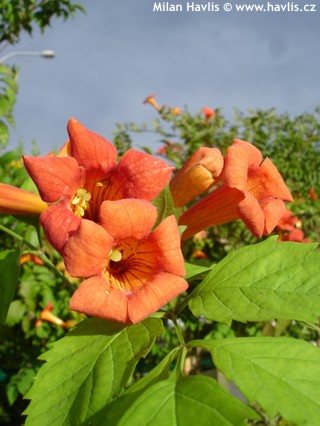
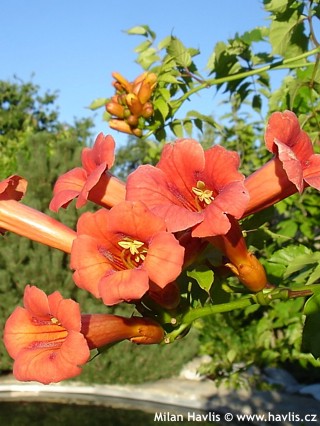
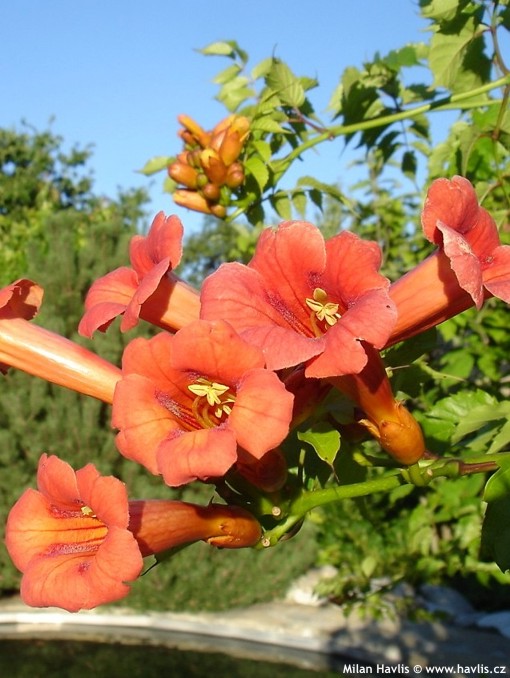
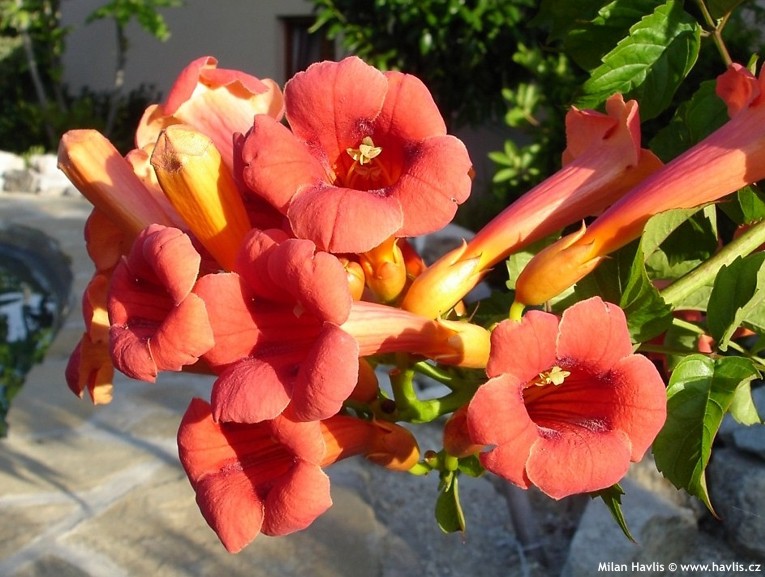
Serena is our own selection of trumpet vine, originating from the botanical species C. radicans. It bears softly apricot‑red, tubular flowers with a golden‑yellow throat, which sometimes pushes a yellow “tongue” onto the reflexed edge of the corolla. From the inside of the throat outward run prominent wine‑red veins that are clearly visible. The flower is firm and very symmetrical, with margins shaped into a neat, regular “little flower”. Trumpet vines have no scent. The buds are orange and appear from mid‑July until the first frosts. The deciduous leaves are large, pinnate, deep green and glossy. Serena produces strong, fairly long one‑year shoots (1 metre or more per season) and is suitable for growing as a vigorous climber, a robust shrub, or even a small tree with an irregular crown. Growth is very vigorous and reliable once the plant has properly rooted.
AS A CLIMBER
If you grow it as a climber, avoid heavy pruning of the shoots during the first few years; instead, tie them to the support throughout the season so that they keep growing upwards and quickly reach the height you want to cover. Only once it reaches the desired height should you begin, each spring after the frosts, to cut back horizontal and arching branches to 2–3 pairs of buds on the previous year’s wood. The plant will thicken and flower more abundantly.
AS A SHRUB
If you grow it as a shrub, decide on the height you want for the basic framework (we recommend around 60–80 cm) and bear in mind that during the season it will exceed this height by roughly one metre both upwards and sideways. After the first winter following planting, cut it back to the height you have chosen for the future framework, and in subsequent years prune all last year’s branches each spring after the frosts to 2–3 pairs of buds on the previous year’s wood. This form does not require a support, and the plant can stand anywhere in the garden.
AS A STANDARD (TREE FORM)
If you grow this trumpet vine as a standard, be sure to secure it to a firm support (a tripod stake works well) at planting and keep this support for its entire life. Each spring after the frosts, prune all last year’s branches to 2–3 pairs of buds on the previous year’s wood. This form does not rely on a vertical support such as a wall or pergola and can therefore stand freely anywhere in the garden.
Last update 14-11-2012; 18-06-2026
Trumpet vine needs above all full sun, warmth for abundant and long flowering, and well‑drained soil. Against a south‑facing wall it behaves like a vigorous climber capable of producing several‑metre shoots in a single season, attaching itself by means of aerial rootlets that cling to surfaces without damaging them and can even grip smooth glass. In heavy clay or in places where water remains for more than a few hours after rain, it suffers from root rot and growth stagnation. Moisture is not a problem as long as the soil is free‑draining; what it cannot tolerate is prolonged waterlogging, because its roots require oxygen. During the first year after planting, it is best to maintain even soil moisture, but once established it copes well with longer dry spells, especially in deeper, fertile soil: its root system reaches down far enough that after two years it can find water on its own without irrigation. Feeding is unnecessary, though an annual layer of compost or well‑rotted manure will support growth and flowering; nitrogen‑rich fertilisers, on the other hand, encourage lush foliage at the expense of blooms.
Pruning is important for lush appearance and profuse flowering, though not essential for the plant’s survival. If you shorten the previous year’s shoots to two or three pairs of buds after the last frosts and remove weak or poorly placed branches, the plant will reward you with a balanced, dense framework of new shoots and a profusion of flowers. In colder regions it is advisable to protect the root collar with a light mulch, though the top growth is usually hardy enough; young plants may suffer some winter dieback, but they reshoot reliably. The plant is not poisonous, though reference works note that its sap may irritate sensitive skin, so gloves are recommended (though we have not recorded a single case so far). It tolerates windy sites well if given firm support, though sudden gusts can break long shoots. Its frost hardiness is the highest within the genus, at least –29 °C (USDA zone 5), which is sufficient for most temperate gardens. It is not suitable for outdoor containers.