Cornus kousa 'Schmred' HEART THROB® Japanese dogwood

 Symbivit Tric (arbuscular)
 Symbivit (arbuscular)
Cornus
Cornus is a genus that botanists rightly regard as true aristocracy among woody plants. It comprises approximately 50–60 species of trees and shrubs distributed mainly across the temperate regions of the Northern Hemisphere, with centres of diversity in East Asia and North America. Fossil records confirm its presence as early as the Tertiary period, and the first scientific description of the genus was published by Carl Linnaeus (1707–1778) in 1753 in his Species Plantarum. For centuries, dogwoods have accompanied human culture not only as ornamental plants, but also as sources of exceptionally hard timber, medicinal substances and symbolic meaning in folk traditions, where they often represent strength, order and longevity.
Japanese dogwood (Cornus kousa) originates from East Asia, where it occurs naturally in Japan, Korea, and parts of China. It was scientifically described in the 19th century based on Asian plant material examined by Henry Fletcher Hance (1827–1886), who published it under the name Cornus kousa. The species was introduced into European and North American botanical collections, and later into nursery production, during the wave of botanical exploration and plant exchange at the turn of the 19th and 20th centuries. It was valued primarily for its pronounced seasonal interest, offering ornamental appeal from spring through autumn, and for its edible fruits. Japanese and Chinese botanists studied its variability in the wild and, in the past, described local forms that were treated as two subspecies, ssp. kousa and ssp. chinensis. While some authors regarded ssp. chinensis as a more vigorous, loosely flowering form with larger inflorescences and considered it worthy of formal recognition, modern taxonomy generally prefers to treat the species simply as Cornus kousa, without further infraspecific distinction.
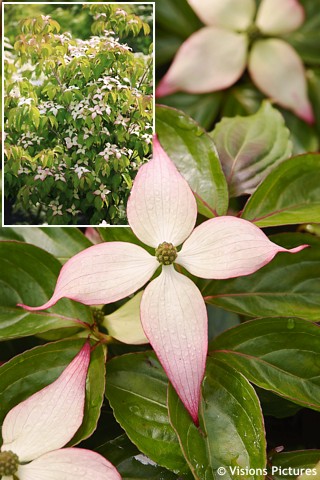
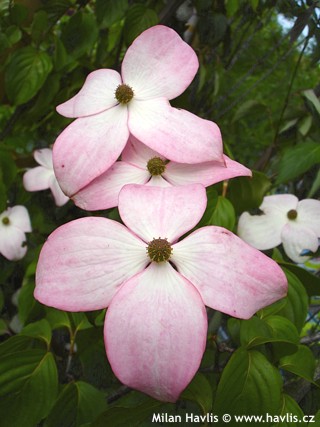
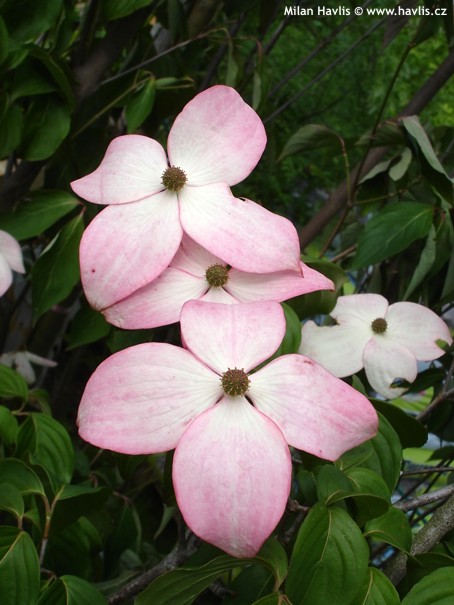
In 1995 James Schmidt from Oregon, USA, patented his version of Japanese dogwood named HEART THROB® with bright pink flowers. Botanically, they are flowers bracts, while flowers are inconspicuous, very small and form a tiny sphere in the middle of the four bracts. Since the flower bracts are in fact leaves the “flowering” in this case begins at the end of spring when the plant is fully leaved and lasts for as long as 8 weeks before the bracts fade away.
The bracts colour is light pink to bright rosy-pink. It depends on how well the plant is established (how long in a location), the soil quality, and if exposed to full sun. Older plants bear more colourful “flowers” than freshly transplanted specimens.
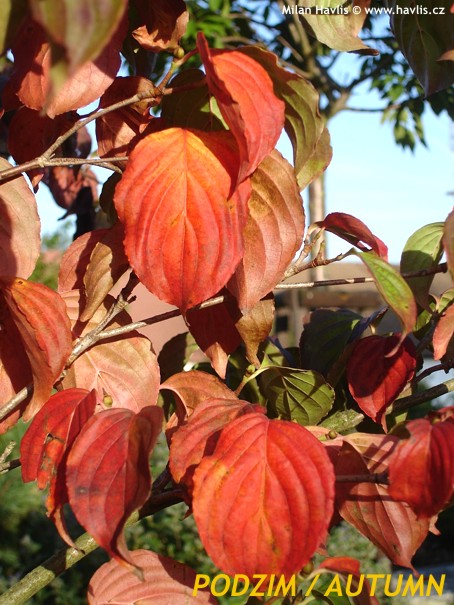
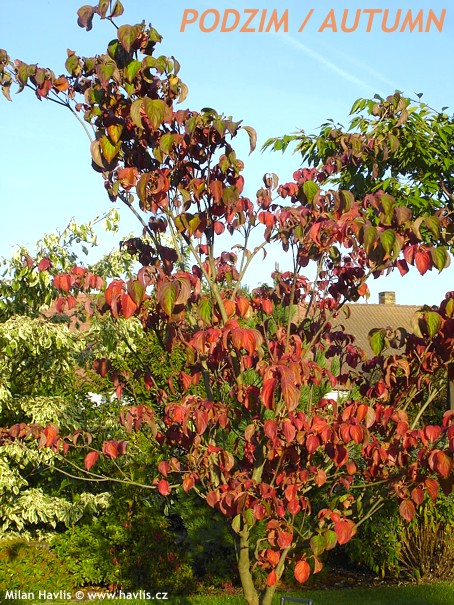
Pointed leaves are deciduous, ovate, dark green and slightly drooping. The best show begins in early autumn when they turn to deep orange and bright red and purple.
Last update 29-09-2009
Every dogwood likes acidic soil, rich in organic material, and always moist but well-drained soil. Some gardeners advise planting it in semi-shade to reduce summer sunlight, but we do not recommend that. Plant it in full sun and mulch the roots well. In dry spells provide extra watering and thus you can be sure your dogwood will flower profusely and will be richer and healthier. Use of selective fertilizers supporting flowering and leaf colour is advised. Fully hardy to about -29 °C (USDA zone 5).