

































Frangula alnus (syn. Rhamnus frangula) 'Ron Williams' FINE LINE® Alder buckthorn

 Symbivit Tric (arbuscular)
 Symbivit (arbuscular)
Frangula
The genus Frangula belongs to the buckthorn family and includes several species distributed mainly across Europe and western Asia, with smaller representations in eastern Asia and North America. Its naming, however, went through a minor upheaval in the eighteenth century. Carl Linnaeus (1707–1778), regarded as the father of modern botany, described alder buckthorn in 1753 under the name Rhamnus frangula, as at that time even thornless species were included within the genus Rhamnus. It was only later that the English botanist Philip Miller (1691–1771), long‑serving head gardener of the Chelsea Physic Garden and almost a generation older than Linnaeus, recognised that buckthorns of this type were fundamentally different. Unlike the more warmth‑loving Rhamnus species, Frangulas lack thorns, have entire leaves and their fruits ripen gradually. Miller therefore separated them as the distinct genus Frangula, grouping together the so‑called true buckthorns with soft leaves that are typical in our region. Fossil evidence supports this distinction, showing that buckthorns were already common components of the European landscape during the Tertiary period, occupying mainly moist habitats along river floodplains, springs, woodland edges and open alluvial forests, environments they continue to favour today.
Alder buckthorn is among the most widespread species of the genus and has been known at least since 1753, when it first appeared in Species Plantarum. It occurs naturally across almost the whole of Europe, extending into western Asia and North Africa, and for centuries has lived near human settlement, often where soils are damp and the landscape slightly untidy. At first glance it may resemble common alders or chokeberries, but it offers no edible fruit, perhaps one reason why it long remained outside the focus of ornamental horticulture. Instead, it was valued for a range of practical uses. Its wood has a reddish‑orange heartwood and was considered one of the finest raw materials for producing high‑quality charcoal, including that used for gunpowder. Its almost poisonous bark has long been processed pharmaceutically into effective laxatives, and the fruits were used as a source of dye. Only from the nineteenth century onwards are there records of naturally occurring mutations, twigs bearing thinner, finely divided leaves that appeared unexpectedly elegant. These were selected and gradually developed into several cultivars that remain successful to this day. Combined with their low cultivation demands and resistance to many external influences, alder buckthorns have become valued trees for parks and private gardens, while in the wider landscape they remain unobtrusive yet persistent shrubs of woodland margins, wetlands and alluvial forests, providing shelter and food for a wide range of wildlife.
Fine Line® buckthorn is a gorgeous shrub which in its few years on the market has managed to gain attention of many gardeners as well as landscape architects. It is a result of cross-pollination carried out by Ronald Williams in 1989, but only in 1999 he selected plants showing stable characteristics. He had the plant patented under PP 14,791.
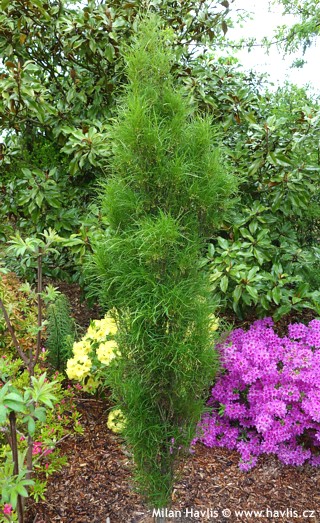
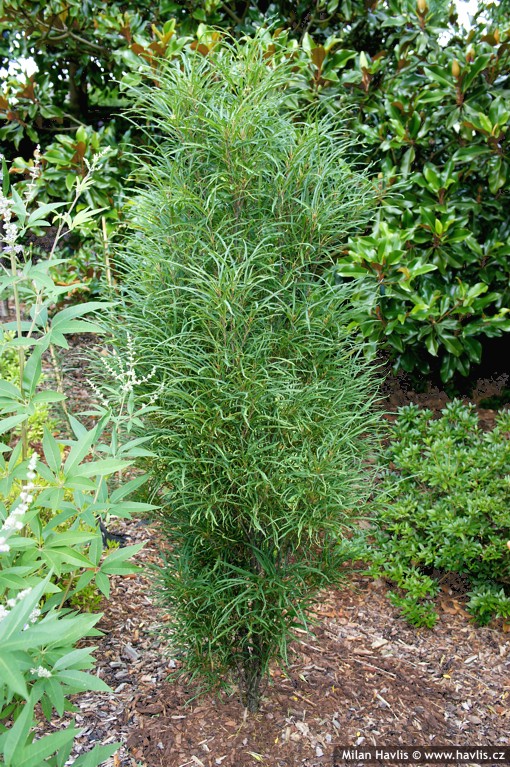
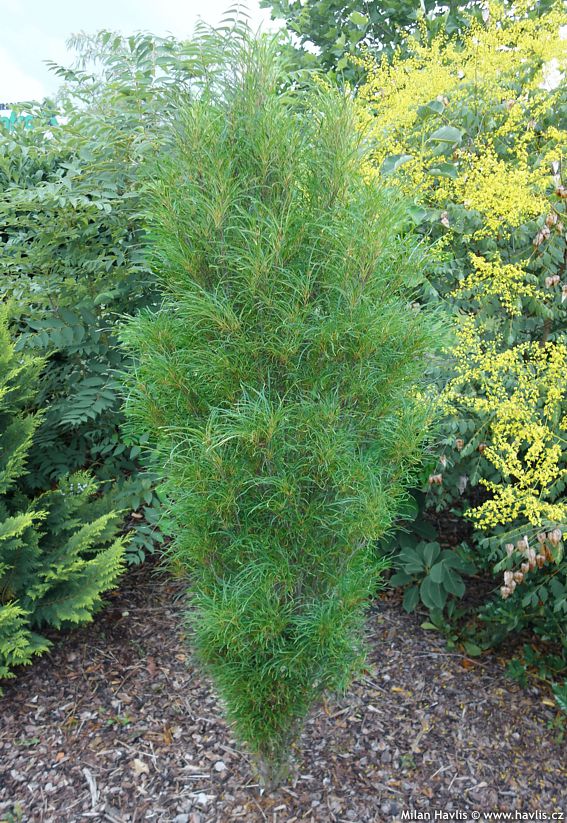
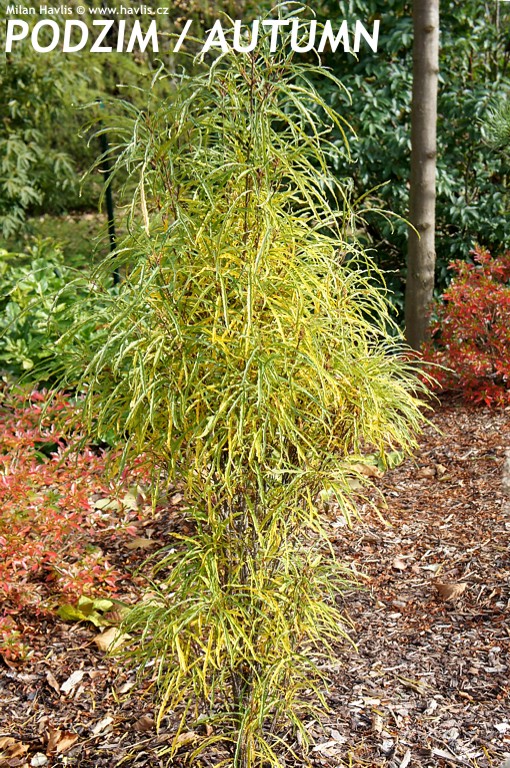
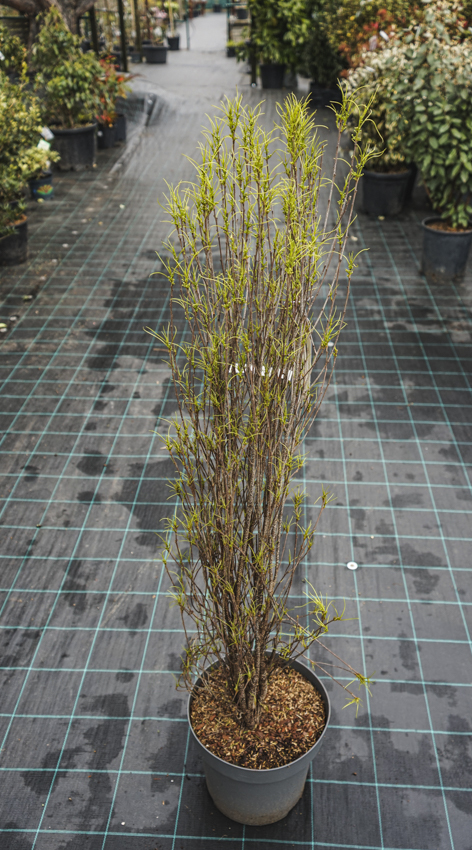
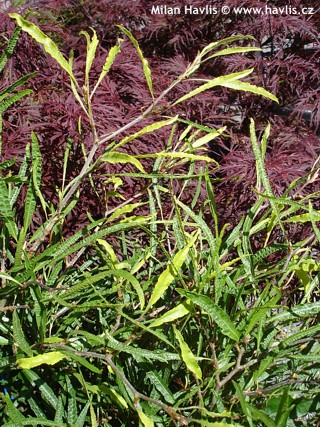
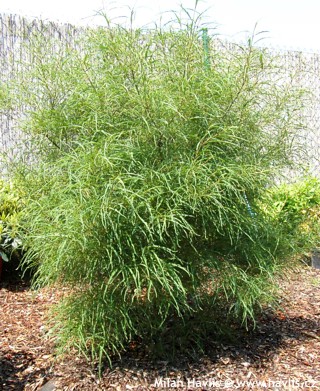
Fine Line® buckthorn has identical leaves to one of its parents – a href="http://www.havlis.cz/karta_en.php?kytkaid=451">Aspleniifolia variety. They are deciduous, very narrow, fern-like, linear, 10-12 cm long and soft green changing to bright yellow in autumn. They are finely serrated at margins. The overall appearance is fluffy and feathered but still quite compact since thanks to its other parent – Columnaris variety – it has narrow, columnar habit.
It is a very versatile plant that will do almost any job you can possibly think of. It looks great planted as a small specimen with a vertical accent, or as a part of a Japanese style garden. It can be mixed with conifers, or placed in a Mediterranean style garden planted in gravel and sand. There are reports that it was used as an unusual informal hedge. Unlike the species its seeds are not viable so it will not weed around.
It withstands any sort of pruning, shaping or clipping but in my opinion it looks best in its natural habit. It is somewhat slow growing and for the fastest growth we suggest planting it into moist, humus rich, slightly acidic soil, in either full sun or part shade. It is so hardy it can be grown as a pot plant outdoors on a patio or balcony. Fully hardy to USDA zone 3: approx. -40°C.
Last update 29-12-2010
Goods are shipped all over Europe. For Russia and U.K. and for further details please read about SHIPPING OPTIONS HERE.
Are you interested in a serious discount for orders NOV-FEB? Check your options here.
THE PRICES INCLUDE VAT of 15%. For quick conversion you can use 1 CZK = approx. 0.04 EUR
- STANDARD QUALITY - Plants of this group are 1st class quality with number of branches and overall density adequate to their size and age, considering they were container grown.
- DE LUXE QUALITY - This label guarantees a luxurious quality of manually selected plants that, compared to their height and age, are exceptionally dense and beautiful.
- EXTRA - These plants are usually mature and bigger specimens with exceptional overall appearance.
- STANDARD (as described in the plant form) means a tree with a trunk of 190-210 cm and a crown at the top, unless specified differently. The commercial size for trees is their girth measured in the height of 1m from ground.
- HOBBY - These plants are of the same quality as our standard-quality plants but younger and therefore cheaper.
- SHRUB - a woody plant with branches growing bushy from the ground level.
- HALF-STANDARD or MINI-STANDARD - a small tree with shorter trunk, its size is usually specified.
- FEATHERED - These are trees with branches growing already from the base of the trunk and up along the stem.
- GRASSES and PERENNIALS - Sizes given usually read the diameter of the pot or the clump, as specified.
