Gaillardia 'ORANGES AND LEMONS'® blanket flower

 Symbivit Tric (arbuscular)
 Symbivit (arbuscular)
Gaillardia
The genus Gaillardia belongs to the daisy family and comprises roughly a dozen species distributed from Canada to northern Mexico, landscapes where scorching summers alternate with cool nights and where plants have had to learn to survive wind, drought and fire. The first botanical descriptions date back to 18th and the genus is named after the French patron of botany Antoine René Gaillard de Charentonneau (1720–1799), who supported Parisian naturalists at a time when North America was becoming a new botanical Eldorado. Blanket flowers reached European gardens quickly thanks to their tireless willingness to bloom and their colours, which during the Victorian fascination with exotic plants looked like small suns carried from the fires of the prairie. Interestingly, some late Pleistocene fossil finds suggest that the ancestors of today’s blanket flowers also grew in cooler regions, which helps explain their surprising hardiness despite their warm looking appearance. Within the genus there is a degree of nomenclatural confusion between G. aristata and G. pulchella, as they hybridise readily and form transitional populations in the wild that botanists have renamed several times. Yet this very variability underpins the richness of today’s cultivars, which differ in colour, height and flowering period.
Hybrids within the genus Gaillardia arise most often from crosses between G. aristata and G. pulchella, the former contributing resilience, firm stems and cool‑tolerant traits, while the latter adds vivid colours, long flowering and a lighter, more open habit. This combination has produced the broad group of garden forms known as Gaillardia × grandiflora, which vary in colour, height and growth rate. Most hybrids reach 30 to 60 cm and show natural variability, as they readily revert to characteristics of both parents. A mild degree of heterosis means that in their first year after planting they tend to be particularly vigorous and floriferous, while in subsequent seasons their growth naturally settles. The history of these hybrids reaches back to the nineteenth century, when the first garden forms appeared in Europe, and modern breeding continues in the United States and Europe, especially in programmes focused on compact habit, early flowering and striking bicolour combinations. This natural variability and long breeding tradition underpin the diversity of today’s hybrid blanket flowers, which rank among the most rewarding summer perennials for sunny gardens.
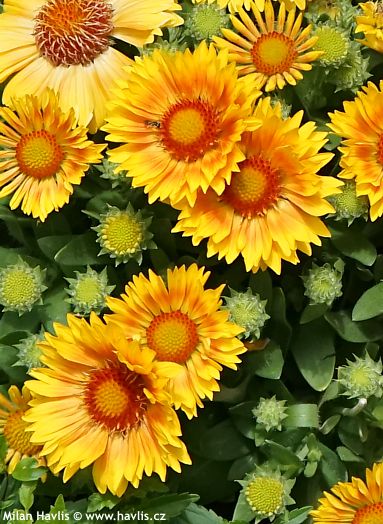
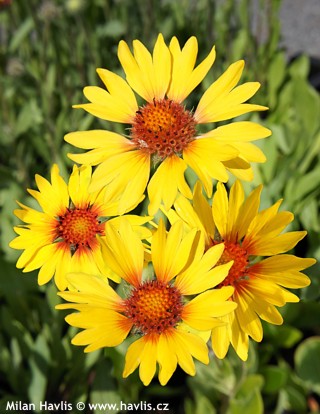
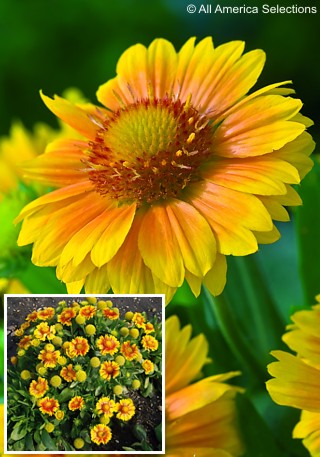
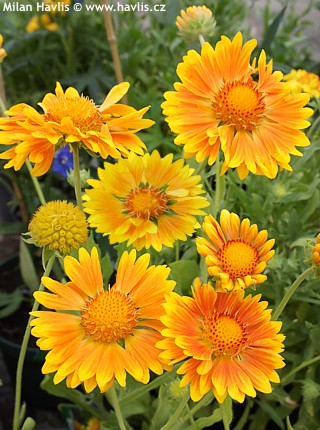
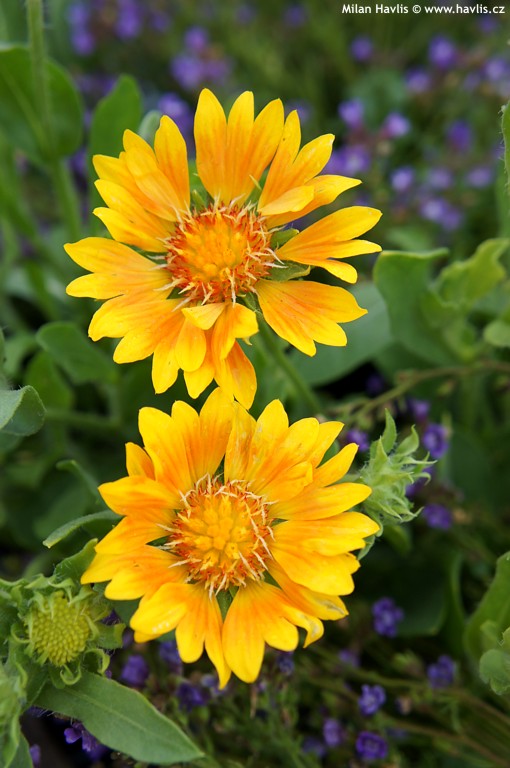
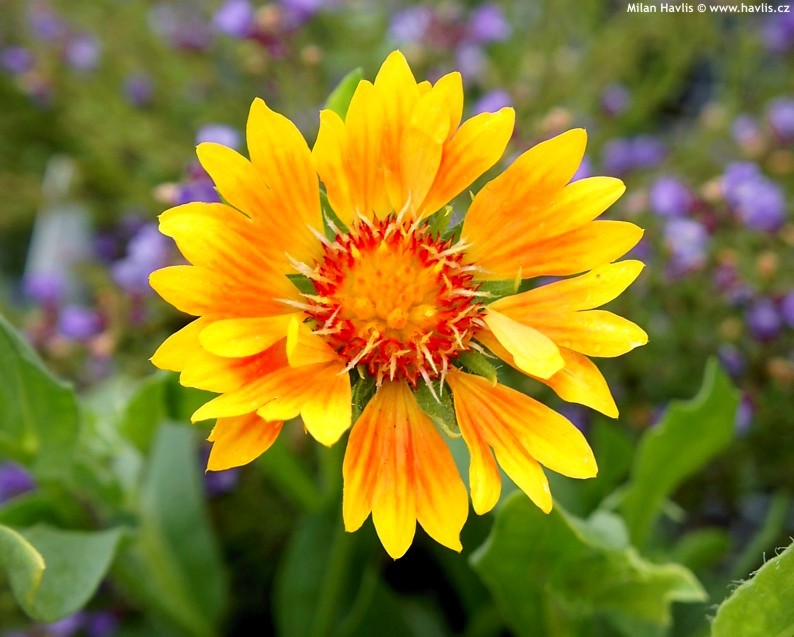
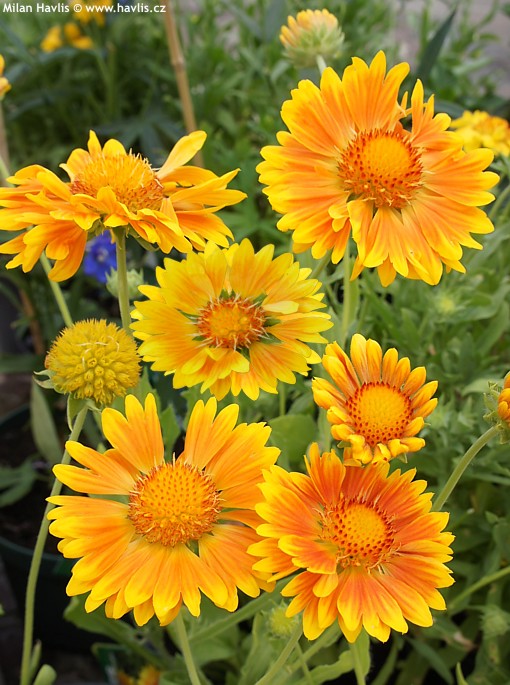
Oranges and Lemons describes perfectly the colour play of this blanket flower. The inflorescence is composed of tangerine orange and golden yellow disc florets, and orange ray florets with yellow tips. The flowers are sterile and do not seed around. Deadheading is recommended for continuous and prolonged flowering. Deciduous leaves are light green. This variety makes erect stems, about 30-40 cm tall.
Last update 14-07-2012
Hybrid blanket flowers thrive in full sun and well‑drained, rather poor soil where their roots do not remain wet for long periods. For a compact appearance it is useful to remove spent stems so that they produce new buds more quickly, although this is not essential, as hybrids flower generously even without regular deadheading, only taking a little longer to form the next flush. In heavy, water‑retentive soils they may grow during the season but often rot in winter long before frost could harm them, as their root systems are more sensitive to moisture than those of pure G. aristata. Their frost tolerance is moderate, usually around minus -20 to -29 °C, with winter wet being a far greater limitation than cold itself. Their lifespan is naturally shorter, most often two to three years, with longer persistence in lines carrying a higher proportion of G. aristata. They self‑seed fairly readily, although the offspring are seldom uniform, as they revert to traits of both parents. Hybrid blanket flowers are happiest where the soil is poor, the sun strong and the care light – and where it does not matter if they are replaced by younger plants after a few years.