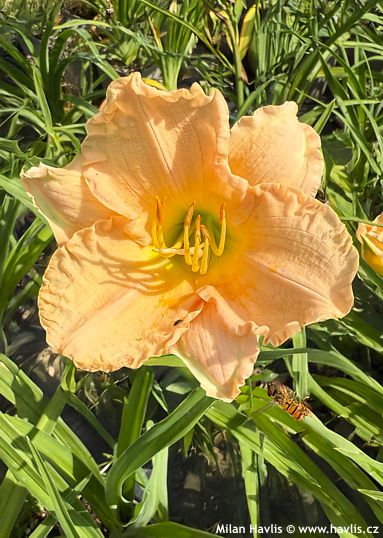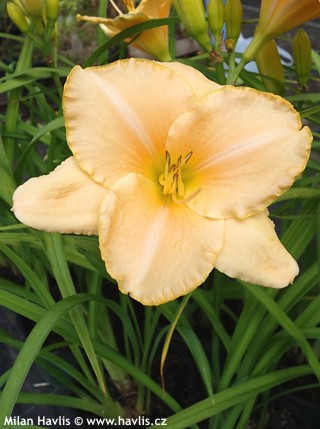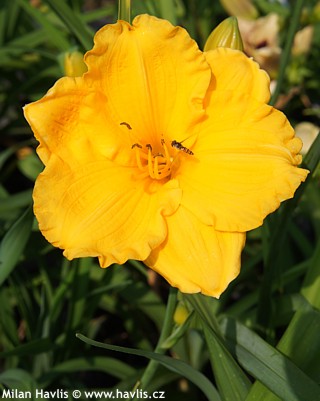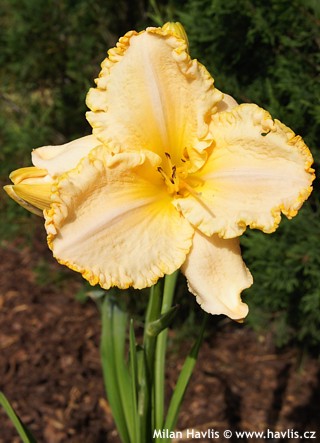
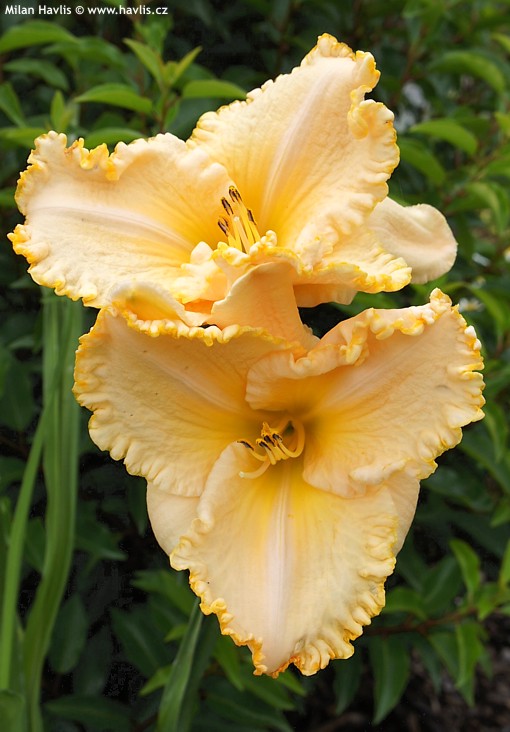
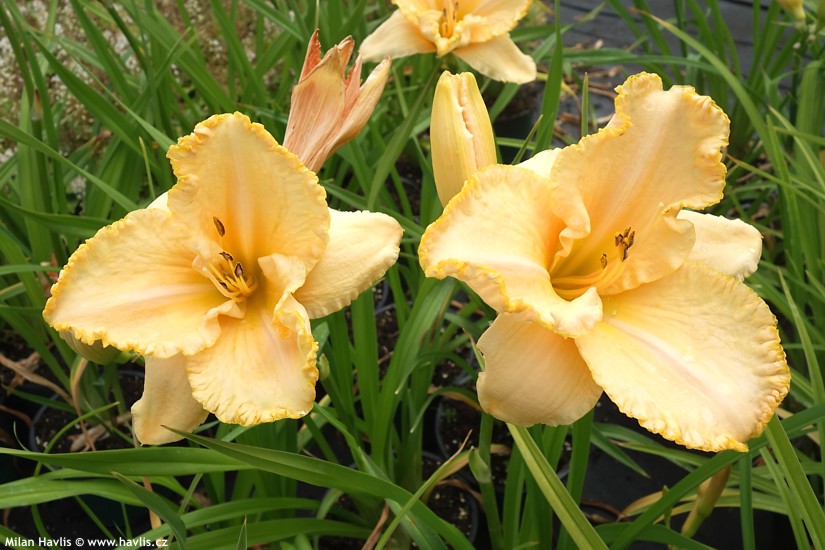
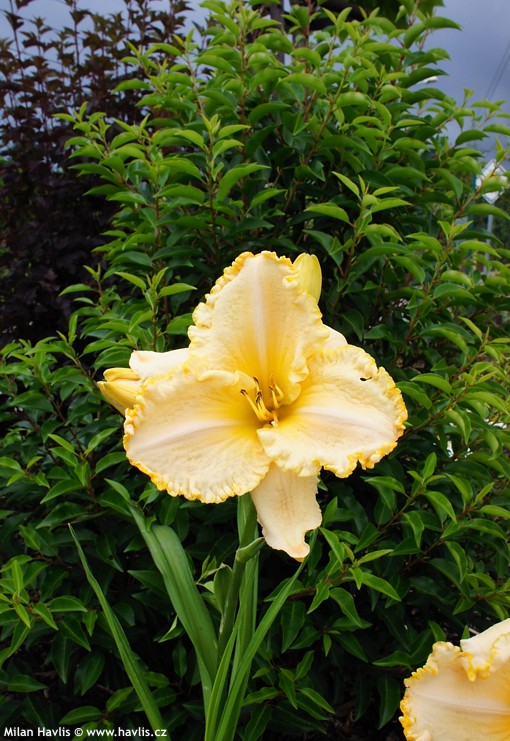
Hemerocallis 'JIM McKINNEY' daylily (tetraploid)

 Symbivit Tric (arbuscular)
 Symbivit (arbuscular)
Hemerocallis
The genus Hemerocallis comprises roughly fifteen species of perennial herbs in the family Asphodelaceae, native to eastern Asia, where they grow along woodland margins, in grassy valleys and on moist slopes. They are characterised by grass‑like, two‑ranked leaves arising from short rhizomes and by flowering scapes bearing tubular to funnel‑shaped blooms that open for only a single day. This rhythm gave the genus its name: the Greek hemera means day and kallos beauty. The first formal description was published by Carl Linnaeus (1707–1778), yet several species had been cultivated in China for millennia as medicinal plants and vegetables. Daylilies reached Europe in the sixteenth century, but true breeding progress began only in the twentieth century in the United States, where thousands of cultivars were created with an astonishing range of colours, shapes, sizes and flower types. Modern collections include miniature forms, giant blooms, spider types, doubles and extremely free‑flowering lines that have placed daylilies among the most widely grown perennials in the world.
Daylilies have accompanied people for centuries, acquiring surprisingly different meanings across cultures. In China they were valued as medicinal plants, and their flower buds – the ‘golden needles’ – are still used in cooking as a delicate vegetable; at the same time they are regarded as a flower of forgetting one’s worries, as they were traditionally given as a gesture of comfort and care, a symbolism reflected in old literary and poetic records. In Korea they symbolised motherhood and feminine devotion, while in Japan they appear in poetry as an image of transience, opening in the morning and fading by evening. In European gardens they became popular for their reliability, longevity and ability to flower throughout summer with minimal care. And although each bloom lasts only a single day, the plant produces so many that a border appears as a continuously renewed wave of colour. Modern breeding has brought a spectacular array of colours and flower forms, from cream, lemon yellow, apricot, pink, red and wine shades to almost black tones, together with bold edges, bands, veining and ruffled margins that have made daylilies one of the most variable perennials of today. With a touch of humour, yet entirely deservedly, they are also counted among the plants described as “foolproof”, because they survive almost anything even the most inexperienced gardener might do to them.
Jim McKinney is a fascinating daylily variety with extra large flowers that can be up to 15 cm across (tetraploid). The flowers are golden yellow with some pale pink shades and a few variations of lighter stripes. Its main 3 sepals have distinctly frilled margins. The stems grow about 50 cm tall, under ideal conditions yet a little taller, and bear flowers from late June until early August. Leaves are semi-evergreen, medium wide.
It was bred by Clarence Crochet in 1994. Crochet was an artist, musician, and a teacher from Lousiana, USA, who was famous not only as a daylily breeder but also for his sense of humour. He would not pass an opportunity to make a little joke which eventually everyone expected. He fell in love with daylilies yet during his work at Dutchtown Elementary School. His first variety was named after the eldest of 4 daughters Mary Crochet and registered in 1966. During his fruitful life he managed to hybridize altogether 85 varieties of which 6 were tetraploids, allegedly the future in daylily breeding. He was elected the 21.president of the AHS (American Hemerocallis Society). His last contribution to the daylily world was named after his late wife Beth Crochet in 2010. He died aged 89 in 2014.
Last update 22-07-2013; 04-12-2016
Daylilies thrive in full sun or light partial shade and grow best in deeper, fertile, well‑drained yet consistently slightly moist soils. Thanks to their fleshy roots (rhizomes) they tolerate even prolonged dry periods without damage. They flower most abundantly in sunny positions and when clumps are divided every four to six years, which maintains vigour and prevents congestion in the centre. After flowering, the foliage of some cultivars may look tired, so it is advisable to remove the entire spent scapes and, when needed, the oldest or damaged leaves to maintain a clean appearance and encourage further blooming. Young shoots can be attractive to small shelled slugs, which slightly damage them visually, particularly in moist spring weather. The roots are very hardy in the ground and overwinter reliably even in severe winters; most cultivars tolerate temperatures down to around –40 °C (USDA zone 3). In containers they perform well only in sufficiently large pots with quality substrate, regular watering, feeding and protection from summer overheating, otherwise they dry out quickly and reduce flowering. They are long‑lived, reliable, undemanding and generally free from serious pests and diseases.