

































Jacobaea maritima 'SILVER DUST' silver ragwort, dusty miller

 Symbivit Tric (arbuscular)
 Symbivit (arbuscular)
Jacobaea
The genus Jacobaea comprises roughly forty species distributed across Europe, North Africa and western Asia, many of which inhabit open, sunny and often dry habitats. For a long time it was treated as part of the vast genus Senecio, which included hundreds of morphologically diverse species. Only modern molecular analyses revealed that this broad group was not natural, and several species were therefore reassigned to the separate genus Jacobaea, named after the Renaissance physician and botanist Jacob Theodor of Bergzabern (1525–1590), known as Tabernaemontanus. Early botanists had already noticed differences between the “true” ragworts and the species we now place in Jacobaea, but lacked the tools to separate them with certainty. Today the genus is valued not only for its ecological role in the landscape but also for several species that have become popular ornamental plants thanks to their silvery foliage and ability to thrive in demanding conditions.
If you walk along the Mediterranean coast in summer, among salt‑worn rocks and low shrubs of sage and cistus, you will almost certainly notice a silvery clump that seems to catch both sun and wind. This is the natural home of Jacobaea maritima, silver ragwort, a species described by Carl Linnaeus (1707–1778) in 1753 as Senecio maritimus. It captivates you at first sight—not only because of its colour, but because of the way it fits so naturally into a harsh yet beautiful landscape where salty winds and intense sunlight act as a true test of endurance. In cultural history, coastal ragwort appears as early as the nineteenth century as a favoured plant in urban parks, valued for its ability to brighten shaded corners and lend plantings a gentle Mediterranean character. It differs from other members of the genus through its exceptional tolerance of drought, wind and salt spray, making it one of the most reliable silver‑leaved plants for gardens in temperate climates.
Last update 06-10-2023; 26-06-2026
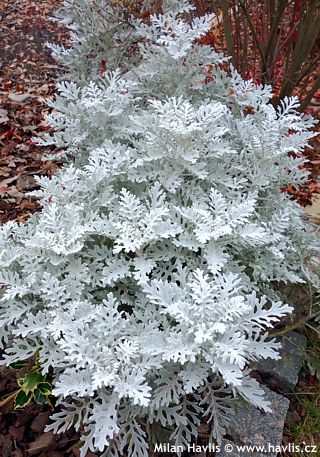
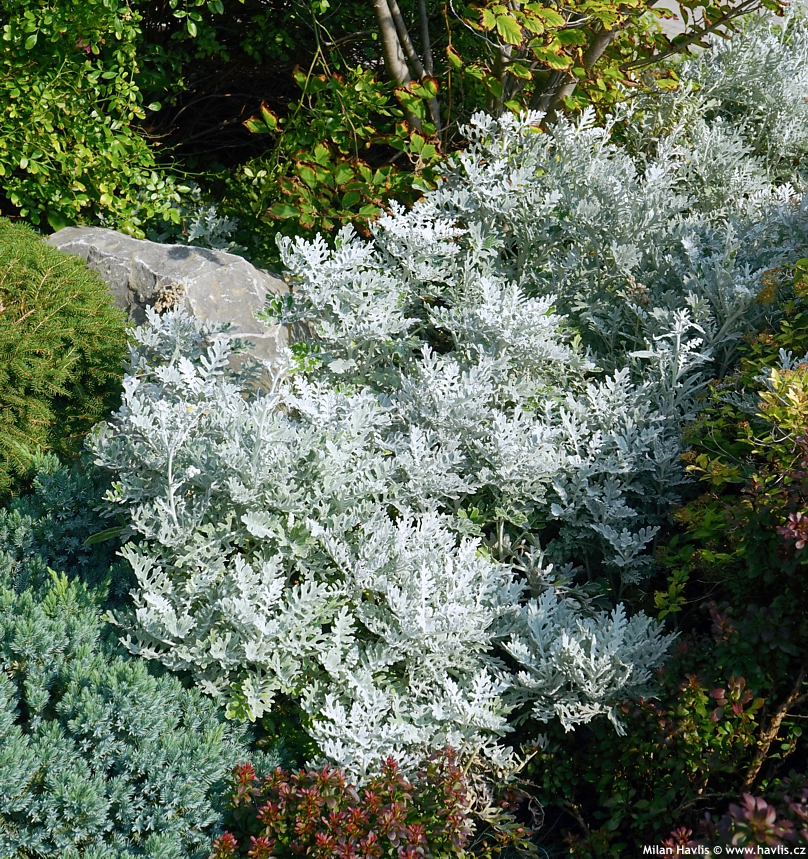
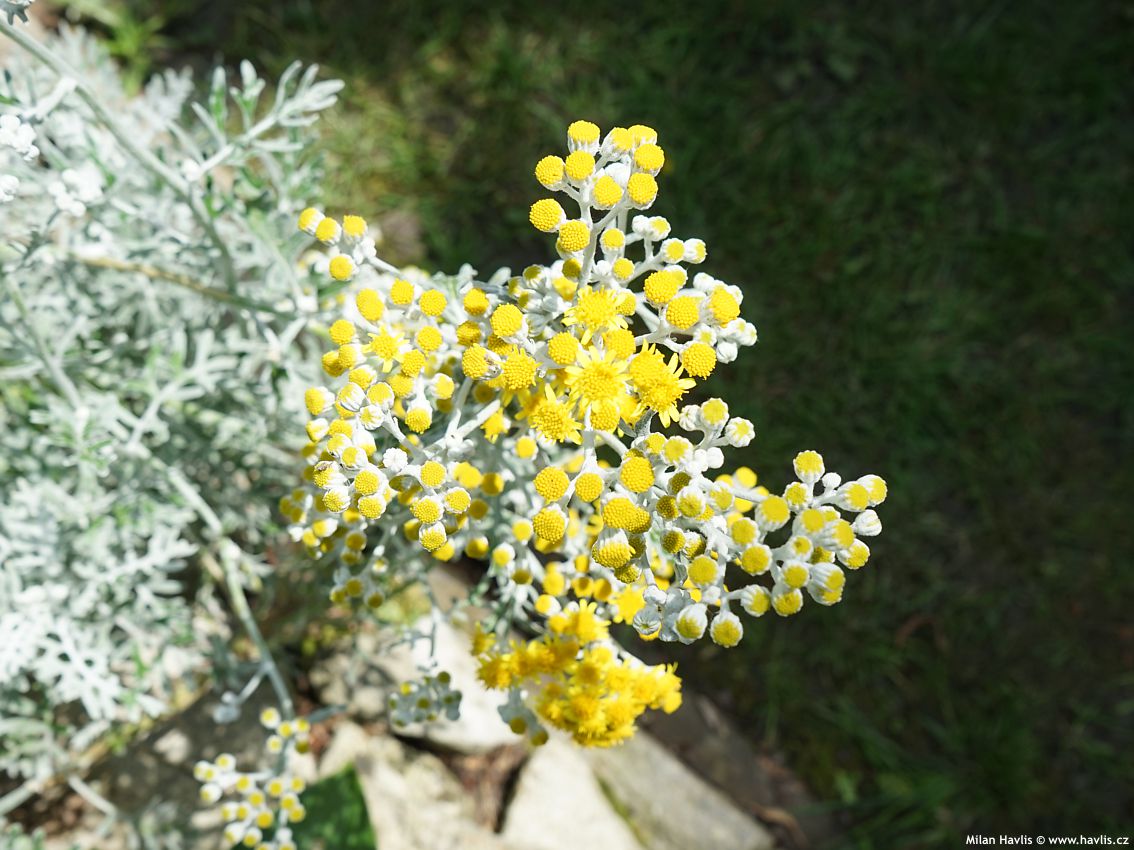
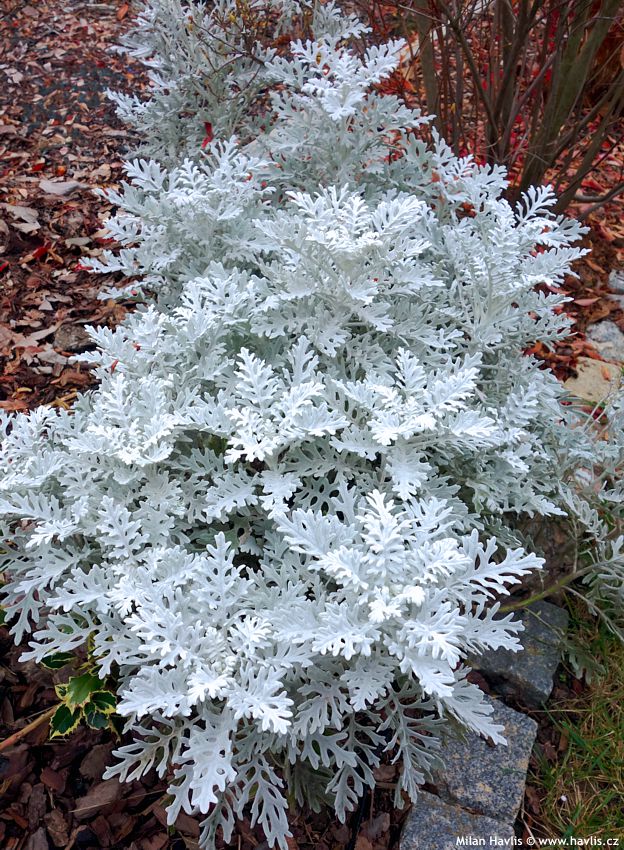
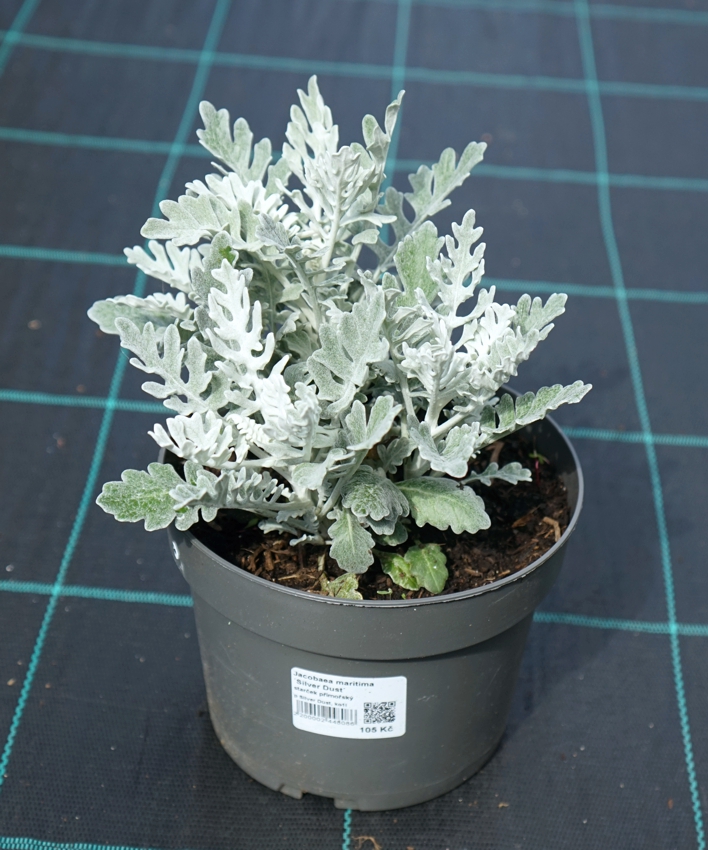
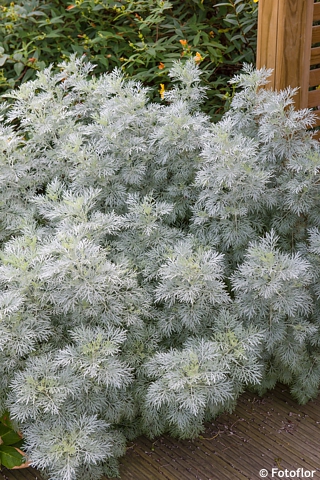
Silver Dust cultivar of silver ragwort looks as if it came from another world – delicate, silvery, with leaves so pale and finely cut it makes the heart leap. It forms low clumps with dense, slightly irregular branching that keeps the plant natural rather than overly tidy. The leaves are deeply divided into thin lobes and folds, so that from a distance they resemble Brussels lace, while up close they look like the soft antlers of a young roe deer. It grows slowly, and its colour comes from the finest downy felt nature can place on a plant. The leaves are dark green at the base, but you can hardly tell, because the whole clump looks as if someone had dusted it lightly with flour. The common English name dusty miller is therefore perfectly apt, as the plant truly appears “floured” from top to bottom, including the stems, which share the same silvery tone. In summer it produces small yellow flower heads that rise above the silver mass of foliage like tiny sunlit dots; they are not the main attraction, but they give the plant a gentle, unobtrusive sense of movement. They are often removed together with their stems so they do not disturb the silver expanse. The dense felt on the leaves withstands intense sun and long periods of drought, and the plant remains evergreen in our climate, providing beauty even in winter. In a snowy border it can be almost invisible – its silvery surface blends with the snow as if it had been part of the winter landscape all along. In England the cultivar ‘Silver Dust’ has been awarded the AGM (Award of Garden Merit) by the Royal Horticultural Society for its beauty and resilience.
Silver ragwort can create a dusting‑of‑snow effect in the border even during the fiercest summer heat. Its silvery foliage has a curious ability to soften surrounding colours without dulling them: beside rich pink phlox it feels like a cooling stone, with blue salvias it deepens their tone, and with yellow rudbeckias it forms a contrast as clean and precise as fine jewellery. In dense plantings it acts as a texture that threads through the whole composition like a carefully worked piece of lace – soft, matte, velvety – exactly the quality you need between glossy or dark leaves. It performs beautifully in containers too, where its silver makes the pot look as if it carries its own inner light. In dry parts of the garden it becomes a natural “cooling point” that calms even very warm colour schemes, and near rocks or gravel it behaves so naturally that it blends with the material like moss with a boulder. And when winter arrives, coastal ragwort loses none of its charm – its silver mass turns into a delicate winter drawing that holds the structure of the border even when every other colour has disappeared.
Last update 06-10-2023; 26-06-2026
In its native range, silver ragwort is a partly woody perennial, botanically a subshrub. In Central Europe it was long grown only as an annual, but experience has shown that this is not necessary. Many gardeners planted it out without expecting much and later discovered that it is alive after winter. I tried the same and it worked. The lowest temperature it has survived for me without damage was -19 °C and the longest it has lived was 5 years. For a perennial this may sound modest but given its usually low purchase price it offers a great deal of value for very little money and makes more of an impact in a border than many far more expensive species. Silver ragwort loves full sun and tolerates only light partial shade. It withstands heat, wind, drought and salt spray, and in our conditions requires a well-drained bed with ordinary or even poor soil. It will grow happily even on sand. There is no need to cover it for winter, and this allows you to enjoy its winter beauty. In spring simply remove a few old lower leaves. Pruning is not essential, but overgrown plants can be cut back by up to two thirds after frost. The hardiness mentioned above applies only to plants grown in the ground. In outdoor containers silver ragwort usually looks good until spring and then dies off.
.jpg)
Goods are shipped all over Europe. For Russia and U.K. and for further details please read about SHIPPING OPTIONS HERE.
Are you interested in a serious discount for orders NOV-FEB? Check your options here.
THE PRICES INCLUDE VAT of 15%. For quick conversion you can use 1 CZK = approx. 0.04 EUR
- STANDARD QUALITY - Plants of this group are 1st class quality with number of branches and overall density adequate to their size and age, considering they were container grown.
- DE LUXE QUALITY - This label guarantees a luxurious quality of manually selected plants that, compared to their height and age, are exceptionally dense and beautiful.
- EXTRA - These plants are usually mature and bigger specimens with exceptional overall appearance.
- STANDARD (as described in the plant form) means a tree with a trunk of 190-210 cm and a crown at the top, unless specified differently. The commercial size for trees is their girth measured in the height of 1m from ground.
- HOBBY - These plants are of the same quality as our standard-quality plants but younger and therefore cheaper.
- SHRUB - a woody plant with branches growing bushy from the ground level.
- HALF-STANDARD or MINI-STANDARD - a small tree with shorter trunk, its size is usually specified.
- FEATHERED - These are trees with branches growing already from the base of the trunk and up along the stem.
- GRASSES and PERENNIALS - Sizes given usually read the diameter of the pot or the clump, as specified.
