

































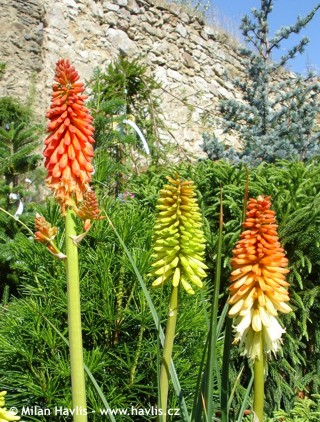
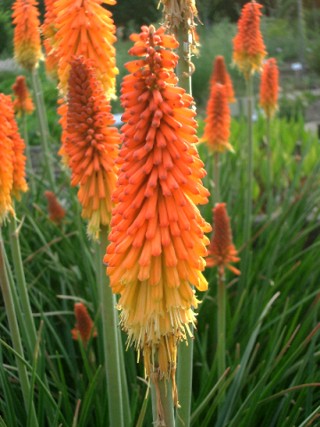
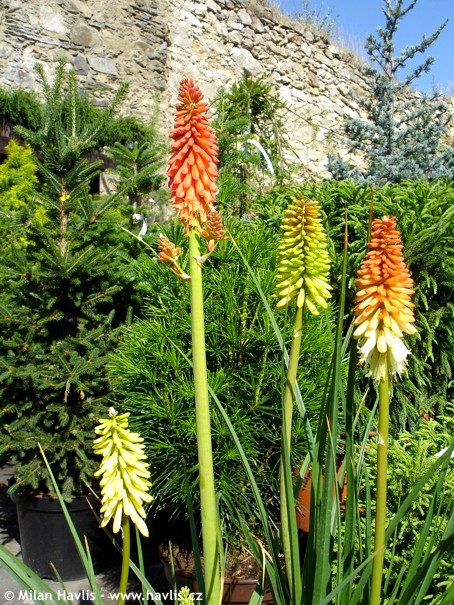
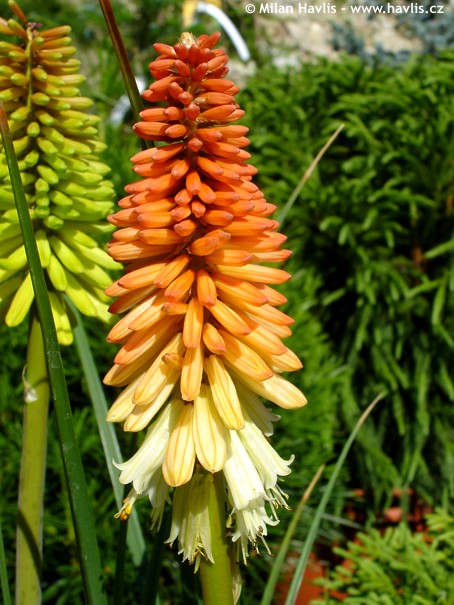
Kniphofia uvaria 'FLAMENCO' torch lily, red hot poker

 Symbivit Tric (arbuscular)
 Symbivit (arbuscular)
Kniphofia
The genus Kniphofia began long before anyone realised that the grassy mountains of southern and eastern Africa were hiding unexpected treasures. The name was first used by the German botanist Conrad Moench in 1794, when he separated the then‑known “tritomas” from Aletris and Veltheimia and dedicated the group to his compatriot Johann Hieronymus Kniphof (1704–1763). The modern, accepted circumscription of the genus, however, comes from Lorenz Oken, who redefined Kniphofia in 1841; his concept is the one used today. We now know that the genus contains roughly 70–73 species, all native to Africa, with a single outlier in Yemen and a handful on Madagascar. Their home lies mainly in the higher and cooler regions of eastern and southern Africa, where many species grow on isolated mountain ridges. This fragmented landscape encouraged rapid diversification, and some species are so closely related that botanists still struggle to draw clear boundaries between them. This history – shaped by glacial cycles, secondary contacts and repeated isolation – explains the taxonomic complexity of the genus. Botanists such as Syd Ramdhani, Nigel P. Barker and Himansu Baijnath have described Kniphofia as a “recent Afromontane radiation”. Don’t worry if that sounds cryptic; I’m not entirely convinced they understand it themselves 😊 What matters is that Kniphofia represents a long evolutionary story, one that is still unfolding and continues to challenge botanists today.
Kniphofia uvaria is native to the south‑western and southern Cape regions of South Africa, where grassy slopes alternate with seepage lines and light sandstone soils. It is a landscape shaped by regular fires, which have an unexpected significance for this species: the fire season is often followed by winter rains, and it is precisely at this moment that the plant produces its most spectacular flowering displays. In the wild it forms tufted stands in places where water moves through the soil but never stagnates – a hallmark of the fynbos, one of the most remarkable ecosystems in the world. Carl Linnaeus described the species as Aloe uvaria in 1753, at a time when the genus Kniphofia did not yet exist, and during the late 18th and early 19th centuries it became one of the first members of the group to reach European gardens. Its striking bicolour heads made it a foundation species for the earliest garden hybrids, which began to spread in England around 1800. Its later travels are no less interesting: thanks to its robust growth and ability to adapt to different climates, it has naturalised in Australia, Madeira, Portugal, Spain and the north‑western United States. In Britain it became so familiar that Victorian gardeners regarded it as “an exotic behaving like a native plant”. The tradition of breeding hardy hybrids is rooted in K. uvaria and continues today, as its genetic stability and distinctive appearance form the starting point for most modern cultivars.
The English common name of Kniphofia has travelled a surprisingly lively path. The earliest name, “red-hot poker”, appeared in the 19th century and captured the plant’s dramatic flower spikes that look as if someone had plunged a glowing iron into the border. Soon after came “torch lily”, a gentler and more botanical term that emphasised the torch-like inflorescences while hinting at the plant’s place among monocots. In some regions “tritoma” survived well into the 20th century, inherited from older botanical classifications before Moench separated the genus. Today “red-hot poker” remains the most widespread name, partly because it conveys the plant’s character in a single glance, while “torch lily” persists in more formal horticultural writing.
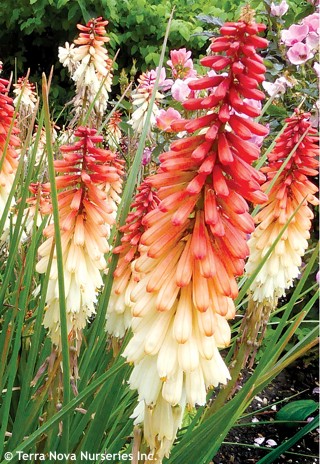
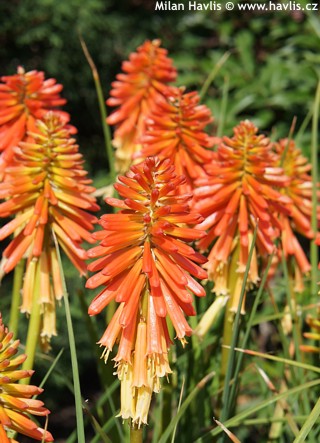
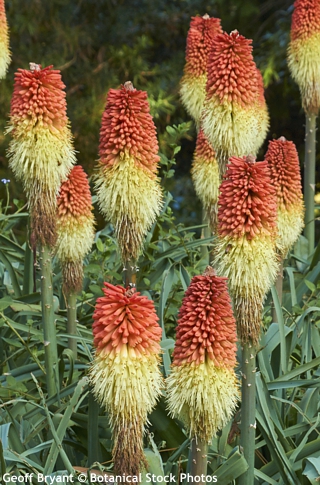
Flamenco is one of the liveliest and most changeable red hot pokers, because its flower heads are not monochrome but made up of a vivid mixture of shades from yellow through orange to red, so in a border it looks like a small fiery celebration. The flower spikes are medium‑long, firm and carried on strong, upright stems that typically reach around one metre. The leaves form a broad, sword‑shaped clump that keeps its shape even outside the flowering season. The cultivar flowers reliably from July to August and, thanks to the gradual opening of individual florets, always appears in motion. It differs from the botanical species mainly in its colour variability, while compared with Grandiflora it feels lighter and less monumental – its flower spikes are not as massive or as long, but they excel in colour diversity and visual dynamism. Its enhanced cold hardiness is also important, as Flamenco tolerates down to –29 °C (USDA zone 5) with mulch, whereas Grandiflora usually manages approximately –23 °C.
Last update 02-07-2008; 09-07-2026
Kniphofia uvaria requires a sunny position and a fertile, evenly moist but well‑drained soil. In the wild it grows in wet meadows, yet in temperate gardens they dislike winter wet, so heavy clay is a problem. In mild winters it is enough to remove the old leaves at the base in spring, as new growth emerges from the centre. In colder regions it is advisable to tie the leaves into a bundle before winter, much like ornamental grasses; if frost damages them, they can be safely cut back to about 10 cm in early spring without harming the crown. Hardiness of the species is around –23 °C (USDA zone 6), but in areas with long winters a light mulch over the roots is helpful and hardiness of selected varieties is usually better. The plant spreads slowly by rhizomes and, in warmer climates, also by seed. After flowering it is best to remove the spent stems, so the plant does not waste energy on seed production.

Goods are shipped all over Europe. For Russia and U.K. and for further details please read about SHIPPING OPTIONS HERE.
Are you interested in a serious discount for orders NOV-FEB? Check your options here.
THE PRICES INCLUDE VAT of 15%. For quick conversion you can use 1 CZK = approx. 0.04 EUR
- STANDARD QUALITY - Plants of this group are 1st class quality with number of branches and overall density adequate to their size and age, considering they were container grown.
- DE LUXE QUALITY - This label guarantees a luxurious quality of manually selected plants that, compared to their height and age, are exceptionally dense and beautiful.
- EXTRA - These plants are usually mature and bigger specimens with exceptional overall appearance.
- STANDARD (as described in the plant form) means a tree with a trunk of 190-210 cm and a crown at the top, unless specified differently. The commercial size for trees is their girth measured in the height of 1m from ground.
- HOBBY - These plants are of the same quality as our standard-quality plants but younger and therefore cheaper.
- SHRUB - a woody plant with branches growing bushy from the ground level.
- HALF-STANDARD or MINI-STANDARD - a small tree with shorter trunk, its size is usually specified.
- FEATHERED - These are trees with branches growing already from the base of the trunk and up along the stem.
- GRASSES and PERENNIALS - Sizes given usually read the diameter of the pot or the clump, as specified.
