The genus Liriope is not only small but also relatively little known. It comprises roughly six species distributed across eastern and south‑eastern Asia, where they form a characteristic part of woodland understorey from the subtropical regions of China to the temperate zones of Japan and Korea. It was described botanically by André Michaux (1746–1802) at the end of the 18th century, but its taxonomic history is full of reshuffling: for a long time it overlapped with the genus Ophiopogon, as both share similar ecological strategies and growth forms, and it was only Liberty Hyde Bailey (1858–1954) who finally stabilised it in 1929 as the Liriope we recognise today. Historical sources show that Liriope had been cultivated in Asia long before its formal botanical description – as a plant used to unify the edges of paths, fill empty spaces between shrubs and help hold soil on slopes, because some species of Liriope produce rhizomes capable of forming extensive colonies and thus act as a natural lock against erosion. Europe has known the genus only since the twentieth century, thanks to Bailey, and its early use was limited to a low, evergreen alternative to ornamental grasses.
Liriope muscari, lily-turf, was described by Joseph Decaisne (1807–1882) in 1867 under the name Ophiopogon muscari, and it took more than sixty years before Liberty Hyde Bailey transferred it to Liriope. Decaisne did nothing wrong at the time – the boundaries between Ophiopogon and Liriope were unclear in the mid‑19th century and the two genera shared almost identical morphological features. Decaisne was also one of the leading authorities of his era: he headed the Jardin des Plantes in Paris, then the most important botanical institution in the world, where collections from across the known world were gathered, research was carried out, herbarium material exchanged and new species described. His work covered plant systematics, anatomy and physiology and was valued for its precision, so it is no surprise that Bailey relied on Decaisne’s herbarium material when reassigning the species. The plant originates from south‑eastern China, Taiwan, Japan and Korea, where it grows in forested valleys, along the edges of bamboo groves and in places traditionally used by people. Its specific epithet refers to the grape hyacinth, Muscari armeniacum, familiar as an inseparable part of spring bulb borders, as the spike‑like inflorescences are quite similar. Modern horticulture values the plant for both its evergreen foliage and flowering, and probably most importantly for its overall ease of cultivation.
Description of the plant
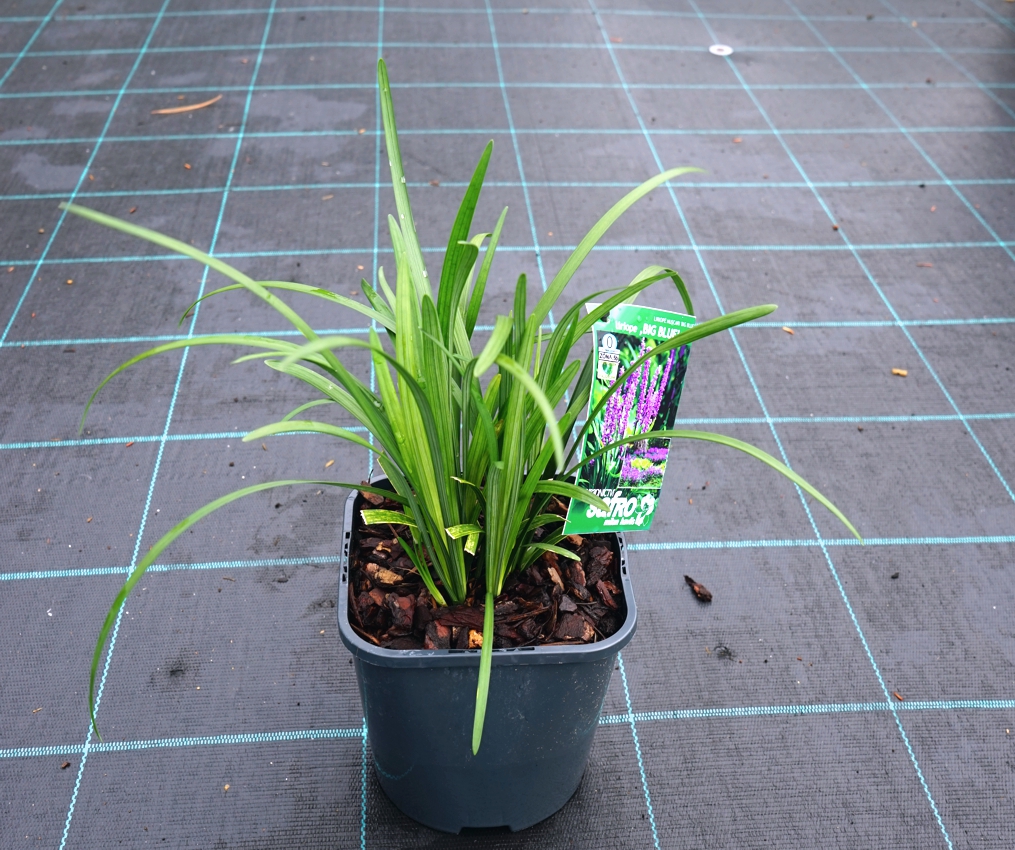
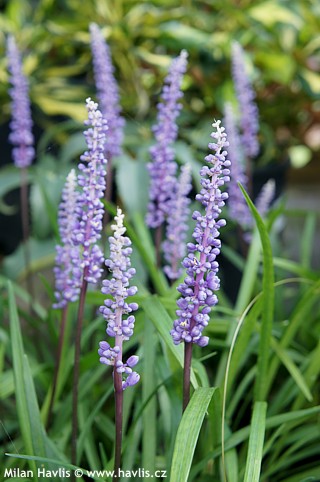
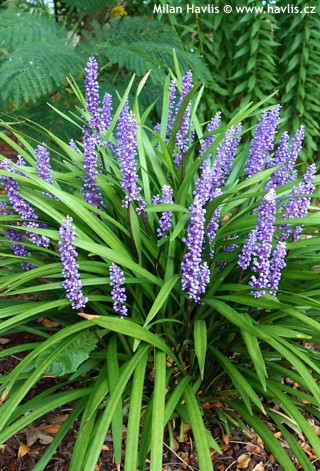
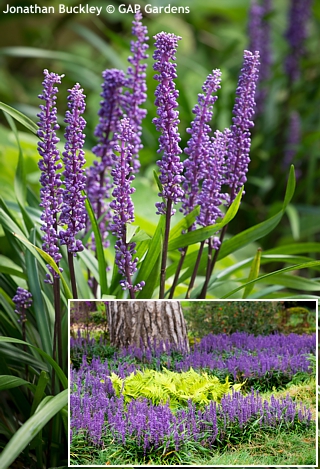
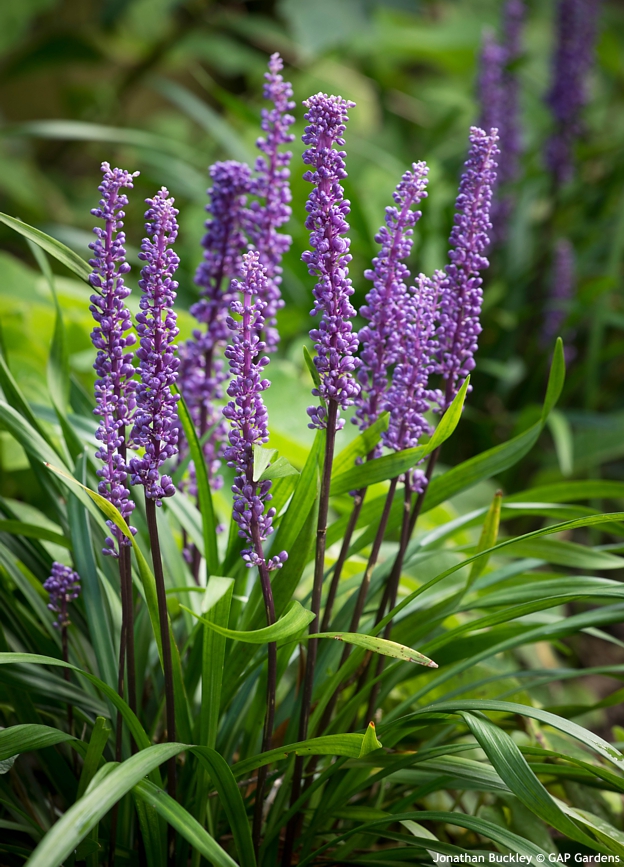
Big Blue is an American turf-lily cultivar that has earned a reputation as the most reliable and most striking liriope in the USA thanks to its unusually deep flower colour that can brighten even deep shade in late summer. It forms firm, dark green, glossy and truly evergreen leaves that arch gently towards the ground and create neat, compact cushions without any tendency to splay. From late August it produces stems up to about 45 cm tall, carrying spike‑like inflorescences with rounded, strongly lavender‑purple buds, so the plant is attractive long before the flowers actually open. Flowering lasts a long time, often in two flushes, because in good conditions it can produce new flowering stems even in the second half of autumn. Compared with the species, Big Blue is taller, more strongly coloured and altogether more robust.
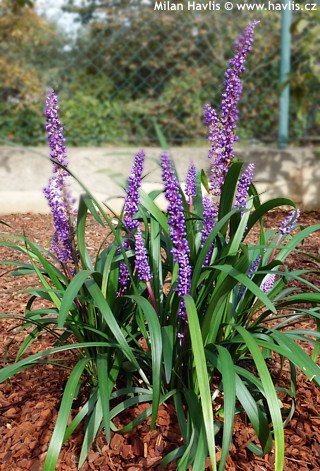
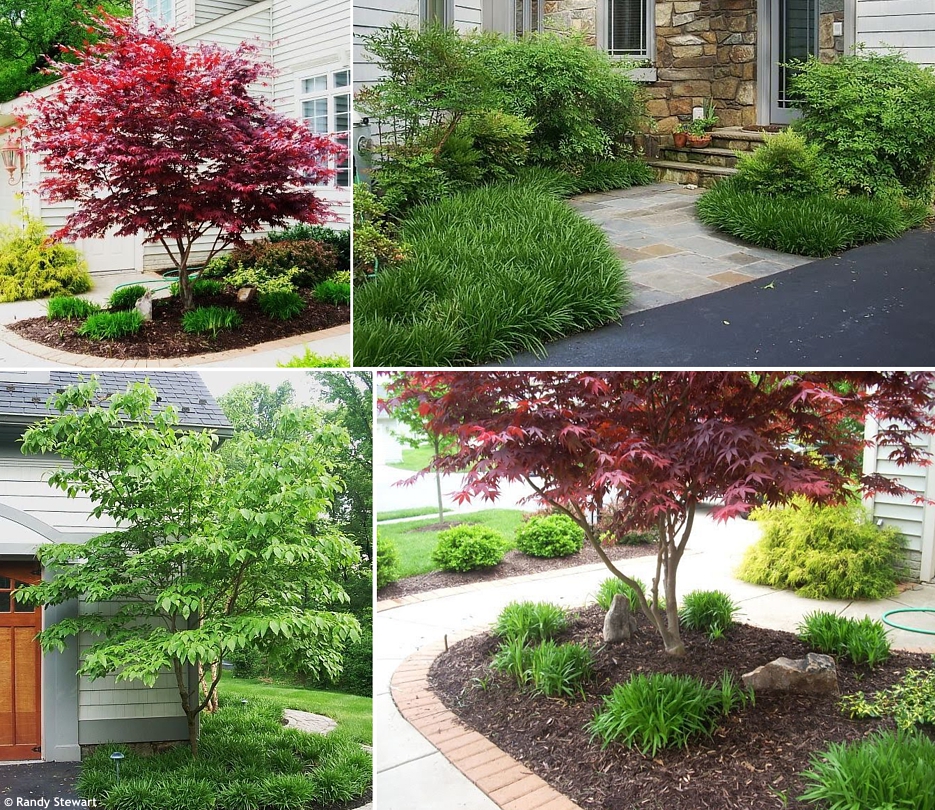
Liriope muscari is at its best as evergreen underplanting beneath multi‑stemmed shrubs and small trees, where, if planted densely at five plants per square metre, it forms a calm, continuous surface without gaps and provides an evergreen interest. It grows into larger clumps but is not invasive. It is used to edge paths, steps and low walls where you want a clean line and a touch of ornament. In shady and semi‑shady borders it makes an excellent contrast to ferns, hostas, epimediums, astilbes or pulmonarias, because its dark, arching leaves provide a stable background for the lighter or more textured foliage of these perennials. In smaller gardens it works well as a single‑colour ground cover that visually unifies the space and replaces areas where other perennials may struggle. Thanks to its long and, above all, late flowering period, it can colour the garden at a time when most shade‑loving plants are no longer in bloom.
Last revised 28‑09‑2021; 07‑10‑2026
Growing conditions and care
Liriope muscari prefers partial shade to full shade and is highly tolerant of drought. It will be more lush in soil that can hold some moisture without staying waterlogged, though ordinary garden soil with a touch of humus is perfectly sufficient. We’ve found that it grows slightly better in acidic soils, with deeper green foliage, but it isn’t essential – it will manage almost anywhere, only perhaps a little slower. Its strong drought tolerance has become especially evident in recent decades, as rainfall decreases and older perennial species begin to show that the new conditions don’t suit them. Liriope copes well even in drier spots under the trees and between their roots, and in urban beds without irrigation, relying solely on whatever rain arrives. Conversely, if you water regularly or have irrigation, you can grow it in full sun. It doesn’t require feeding, but it responds quickly to nutrients with stronger foliage and more generous flowering. The leaves are left on through winter, though if they look tired and untidy by spring, they can be cut back to about 5 cm above the ground. This isn’t needed every year – once every few seasons is enough. Its hardiness reaches –29 °C (USDA zone 5), so in Central Europe it usually needs no winter protection, except for a light mulch in its first year. It can also be grown in outdoor containers with excellent drainage.
Goods are shipped all over Europe. For Russia and U.K. and for further details please read about SHIPPING OPTIONS HERE.
Are you interested in a serious discount for orders NOV-FEB? Check your options here.
THE PRICES INCLUDE VAT of 15%. For quick conversion you can use 1 CZK = approx. 0.04 EUR
GLOSSARY
STANDARD QUALITY - Plants of this group are 1st class quality with number of branches and overall density adequate to their size and age, considering they were container grown.
DE LUXE QUALITY - This label guarantees a luxurious quality of manually selected plants that, compared to their height and age, are exceptionally dense and beautiful.
EXTRA - These plants are usually mature and bigger specimens with exceptional overall appearance.
STANDARD (as described in the plant form) means a tree with a trunk of 190-210 cm and a crown at the top, unless specified differently. The commercial size for trees is their girth measured in the height of 1m from ground.
HOBBY - These plants are of the same quality as our standard-quality plants but younger and therefore cheaper.
SHRUB - a woody plant with branches growing bushy from the ground level.
HALF-STANDARD or MINI-STANDARD - a small tree with shorter trunk, its size is usually specified.
FEATHERED - These are trees with branches growing already from the base of the trunk and up along the stem.
GRASSES and PERENNIALS - Sizes given usually read the diameter of the pot or the clump, as specified.
By pressing the „I Agree“ button, you agree that we will provide you with meaningful and useful services based on your web browsing tracking data.
Of course, you can change your consent at any time in the „Settings“ section.
Settings
I agree
Cookie settings
You can choose how your personal data is used.
Technical Cookies
The use of cookies ensures that this website remains functional and usable with all content. In addition, this will allow us to ensure the most comprehensive measurement and evaluation of the range.
I agree
Better service offerings
The use of cookies allows us to optimize this website for your needs. Based on the measured data, we will know what we can improve and ensure that we continuously adapt our services and offers for the best possible experience.



































 Symbivit Tric (arbuscular)
 Symbivit (arbuscular)