












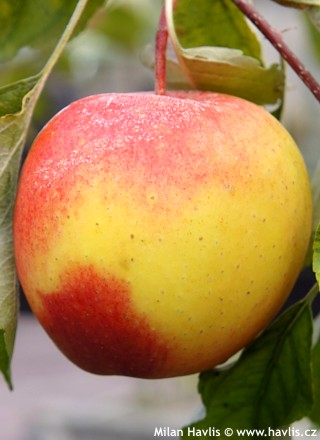
Malus domestica 'SANTANA' apple - medium late, pollination group 4

 Symbivit Tric (arbuscular)
 Symbivit (arbuscular)
Malus
The group of apple trees grown for their fruit (Malus domestica) is one of the most important temperate fruit crops. It is not an original species but a domesticated hybrid complex whose genome is formed mainly by M. sieversii from the Tien Shan mountains; genetic analyses show that this species accounts for up to 90 per cent of the genome of modern cultivated apples. Smaller contributions come from M. orientalis from the Caucasus region and from the European wild apple M. sylvestris, which played only a minor role in domestication. Although the genus Malus includes roughly 55 to 60 species, only a few of them had a significant influence on the origin of the domestic apple. Botanically it belongs to the family Rosaceae, together with pears, quinces and cherries.
The apple tree has been cultivated and selected by humans for thousands of years. Archaeobotanical evidence confirms its consumption as early as the Bronze Age, while the first deliberate breeding began in classical antiquity. Modern pomology developed during the 18th and 19th centuries, when the first stable cultivars known today were established. The apple is now the most widely grown fruit tree in the world, with an annual production exceeding 86 million tonnes and thousands of cultivars differing in shape, flavour, colour and ripening time. Its distribution is determined by climate: it requires 800 to 1200 hours of winter chill, which makes it a rare and expensive delicacy in subtropical and tropical regions, much as we view their mangoes or papayas. In Europe and across the temperate zone it is so familiar that we take it for granted, even though its true genetic origin lies deep in the mountains of Central Asia.
We Europeans consider apples our everyday treasure – both in flavor and in health. The well-known English proverb “An apple a day keeps the doctor away” has its roots in 19th‑century Wales, where it originally went: “Eat an apple on going to bed, and you’ll keep the doctor from earning his bread.” Modern research gives this saying a surprisingly firm foundation: regular apple consumption lowers cholesterol, benefits the heart, supports a healthy gut microbiome, is associated with reduced risk of diabetes and certain cancers, strengthens the body, and aids detoxification. Polyphenols act anti‑inflammatorily, and fiber (especially pectin) regulates digestion – making the apple a true “little pharmacy in your pocket.” And at the same time, it tastes wonderful. Who doesn’t know the typical Central European apple strudel, with its oldest recipe recorded in Vienna in 1697? From an aristocratic dessert it became a symbol of homely comfort even in modest households, and although it remains one of the most beloved pastries in Austria, the Czech Republic, and Germany, like all good things it has spread across the world and been warmly embraced. Incidentally, the abundance of fruit alleys along old country roads in our land is thanks to Empress Maria Theresa, who during her reign (1740–1780) ordered their planting. The trees were meant to provide shade and fruit for soldiers and travelers, while at the same time preventing looting and food theft in villages.
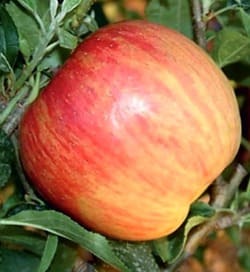
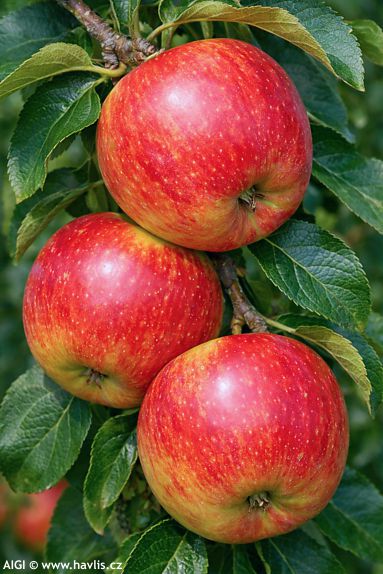
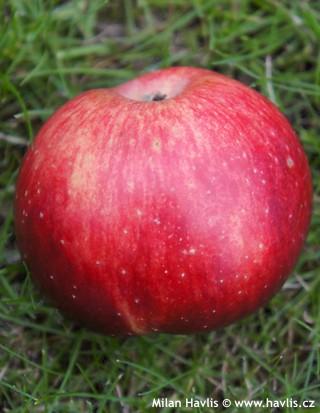
Santana is now among the most sought‑after apple cultivars, not only for its excellent flavour but also for its very low allergenic potential, making it suitable for many people who react to common apples (it contains only small amounts of PR‑10 proteins). The fruits are medium to large, almost round and nicely uniform, with smooth skin that turns from yellow‑green to deep red in autumn, sometimes as a single blush, sometimes as a marbled overlay. The flesh is cream‑yellow, juicy and crisp, with a sweet‑tart profile inherited from its parent Elstar – fresh, bright, with a gentle spicy note that becomes rounder after a few weeks of storage. The aroma is clean and distinctly appley, without any mealy tones. It is a mid‑late to late cultivar that ripens from late September to early October; the fruits can be eaten immediately after picking, although a few weeks of storage give them a rounder and fuller flavour. Storage life is excellent: in a standard cold room the fruits keep until February or March without losing juiciness, and in commercial cold stores close to 0 °C they can last well into summer. They are ideal for fresh eating, salads and baking, as they hold their shape and do not release excess moisture. Hardy to about -34 °C (USDA zone 4).
The tree grows at a medium rate, forming a naturally pyramidal and rather open crown that allows good light penetration and reliable colouring even inside the canopy. Disease resistance is strong: the Vf gene provides high resistance to apple scab, while the cultivar is more susceptible to powdery mildew, which should be monitored especially in warm and dry regions. ‘Santana’ is self‑sterile, pollination group 4, and is reliably pollinated by e.g. Idared, Jonathan, Cox's Orange Pippin, Gala, Rubin, Golden Delicious, Elstar, Spartan, James Grieve and Discovery. It was bred in 1978 at Wageningen University & Research in the Netherlands within a programme led by Dr C. de Jong. It is a cross of Elstar × Priscilla, with scab resistance derived from the Vf gene of Malus floribunda. It was registered in the European catalogue in 1998 under EU Plant Variety Rights no. APP192. Today it is grown mainly in the Netherlands, Belgium, Germany and northern France, where it ranks among the most commercially successful apples for allergy‑sensitive consumers; in Central Europe it is still found mostly in small orchards and private gardens.
Last update: 18-10-2026
Apple trees in general are not demanding to grow. They thrive best in sunny sites with fertile loamy to sandy‑loam soils that are well‑drained and moderately moist. The optimal pH is slightly acidic to neutral. They do not tolerate permanently waterlogged soils, nor extremely dry and windy locations where fruit may drop prematurely. Young slender trees and half‑standards should be tied to a stake to ensure straight growth, while tall‑standards benefit from a firm wind‑brace for the first three years. During this period (and preferably longer) the soil above the roots should be kept clean of grass and weeds. Fertilization can be light, ideally organic, but is not essential. Pruning, on the other hand, is generally discouraged – it is an old and misguided habit of previous generations that often resulted in water sprouts and overcrowded crowns without fruit. Modern experience shows that, given the right site, apple trees shape a balanced crown on their own and bear reliably without intervention. Most cultivars are highly frost‑hardy, easily withstanding temperatures below –30 °C, so in our conditions they require no winter protection. At harvest and in storage, however, the fruit should be handled carefully, as even small bruises can shorten its keeping quality.

Goods are shipped all over Europe. For Russia and U.K. and for further details please read about SHIPPING OPTIONS HERE.
Are you interested in a serious discount for orders NOV-FEB? Check your options here.
THE PRICES INCLUDE VAT of 15%. For quick conversion you can use 1 CZK = approx. 0.04 EUR
- STANDARD QUALITY - Plants of this group are 1st class quality with number of branches and overall density adequate to their size and age, considering they were container grown.
- DE LUXE QUALITY - This label guarantees a luxurious quality of manually selected plants that, compared to their height and age, are exceptionally dense and beautiful.
- EXTRA - These plants are usually mature and bigger specimens with exceptional overall appearance.
- STANDARD (as described in the plant form) means a tree with a trunk of 190-210 cm and a crown at the top, unless specified differently. The commercial size for trees is their girth measured in the height of 1m from ground.
- HOBBY - These plants are of the same quality as our standard-quality plants but younger and therefore cheaper.
- SHRUB - a woody plant with branches growing bushy from the ground level.
- HALF-STANDARD or MINI-STANDARD - a small tree with shorter trunk, its size is usually specified.
- FEATHERED - These are trees with branches growing already from the base of the trunk and up along the stem.
- GRASSES and PERENNIALS - Sizes given usually read the diameter of the pot or the clump, as specified.
