












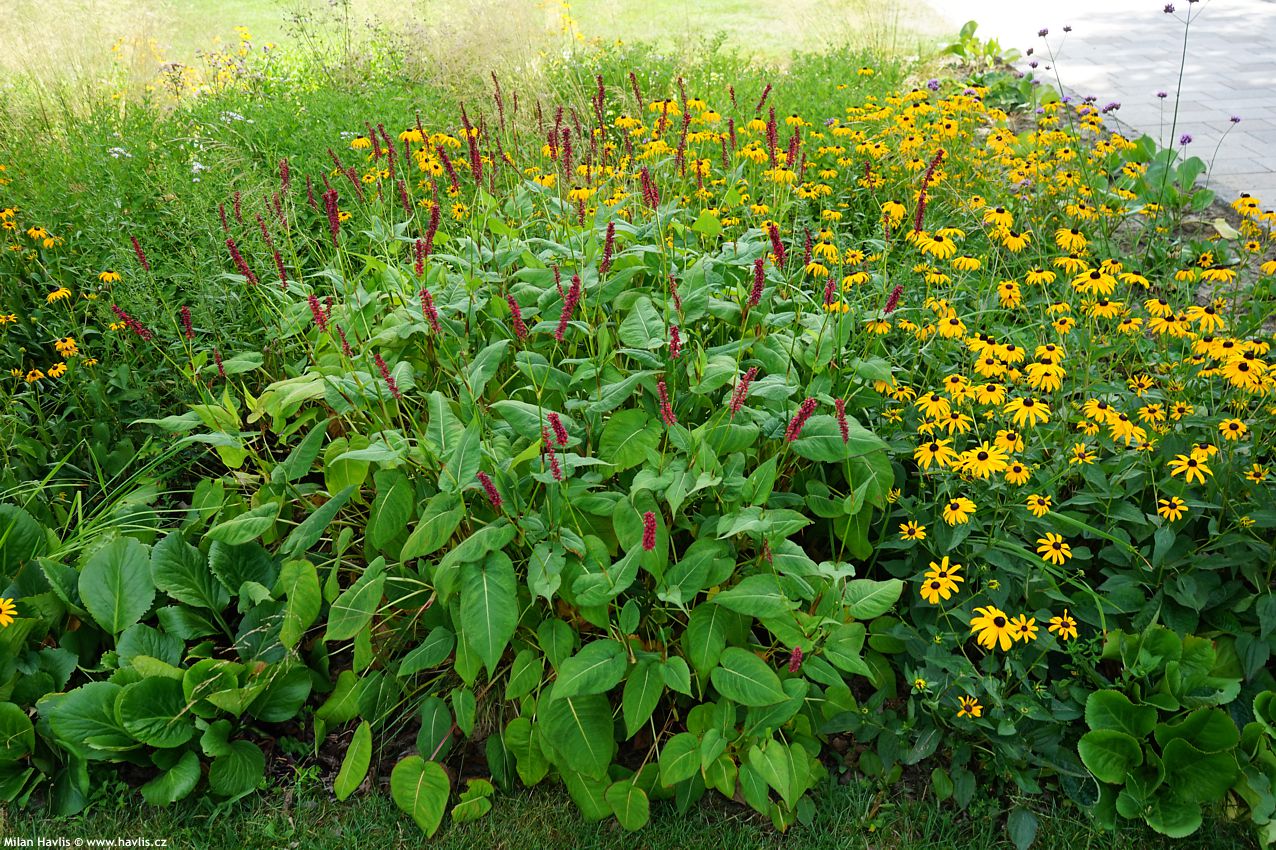
Persicaria amplexicaulis 'DARK RED' mountain fleece, red bistort

 Symbivit Tric (arbuscular)
 Symbivit (arbuscular)
Persicaria
The genus Persicaria is a broad group comprising approximately 132 species, most of which are perennials, though annual herbs, several subshrubs and even climbing forms also occur. It is distributed across almost all continents, so every part of the world has its characteristic knotweed: in Europe the best known is Persicaria bistorta, while in gardens the most commonly grown species originate from Asia. The genus belongs to the knotweed family, which appears in Tertiary fossil records, and its taxonomy was long unsettled: botanists alternately merged it with the broadly defined genus Polygonum or separated it according to leaf and inflorescence morphology. The first systematic descriptions were published by Carl Linnaeus (1707–1778), but the true delimitation of the genus was established only in the twentieth century through anatomical and later molecular studies. Interestingly, some species were once considered weedy, whereas others have become icons of modern garden design thanks to their ability to flower for most of the summer.
Persicaria amplexicaulis, the clasping knotweed, originates from moist montane regions of the Himalayas, where its natural range extends from Afghanistan through Pakistan and Nepal to central and south‑eastern China. The species was described by the Scottish botanist David Don (1799–1841) in 1825, based on Nepalese collections that at the time represented one of the most valuable botanical sources in Asia. Several decades later it was studied by George Bentham (1800–1884), whose work helped to clarify the species and place it within the wider context of the knotweed group. The clasping knotweed reached European gardens very soon after its botanical description: by 1826 it was already present in British gardens, where it became popular for its exceptionally long flowering period and its ability to create a soft, mobile rhythm in perennial plantings, produced by the combination of slender inflorescences and large, flexible leaves reminiscent of waves on the sea. The first records from the wild in Britain date to around 1908, showing that the species gradually spread beyond cultivated areas. In subsequent decades it became established throughout Europe and is now a common component of modern naturalistic plantings. The striking way in which the leaves clasp the stems gave rise to the species name and creates an ornamental detail that feels both exotic and familiar in the garden.
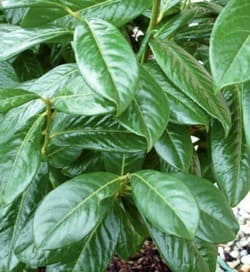
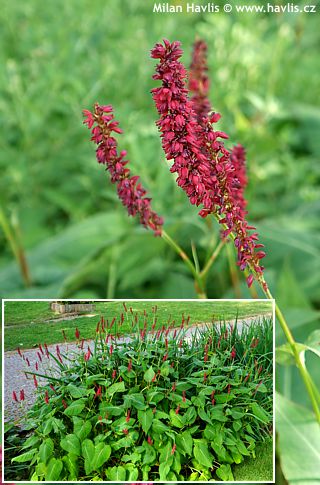
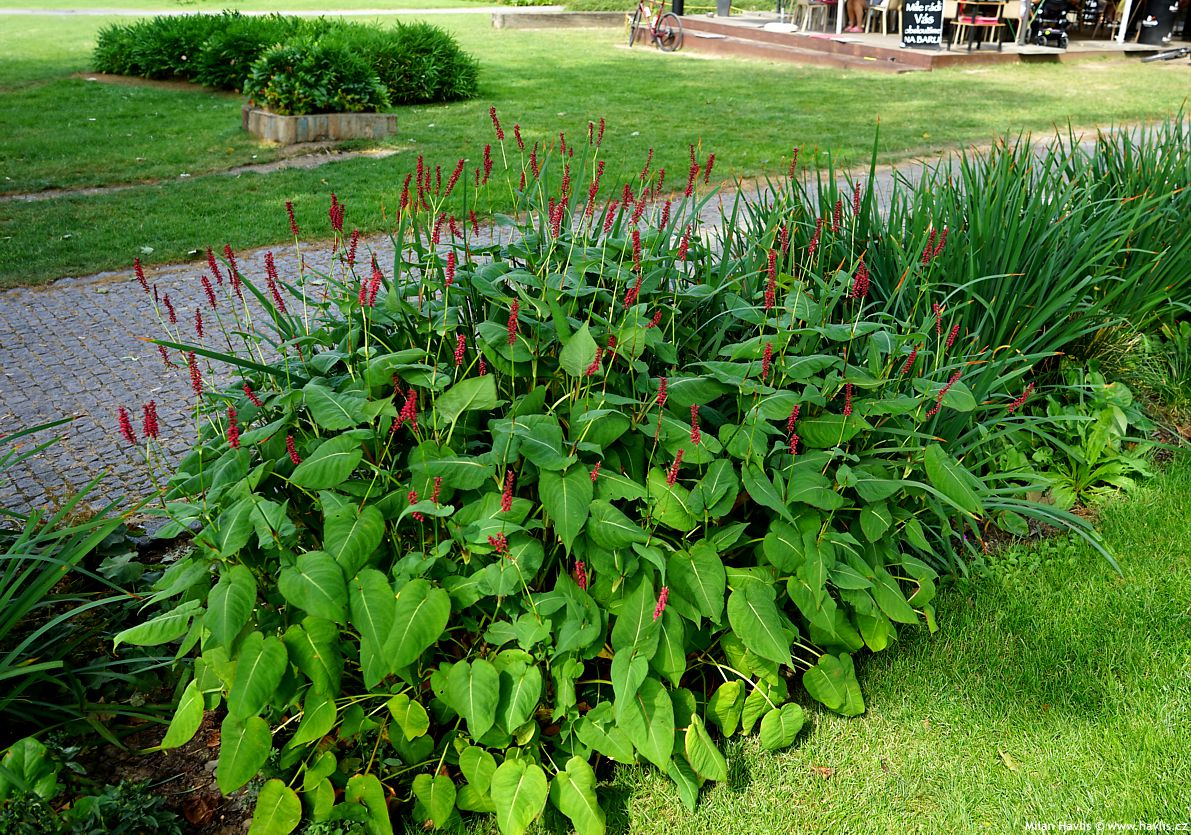
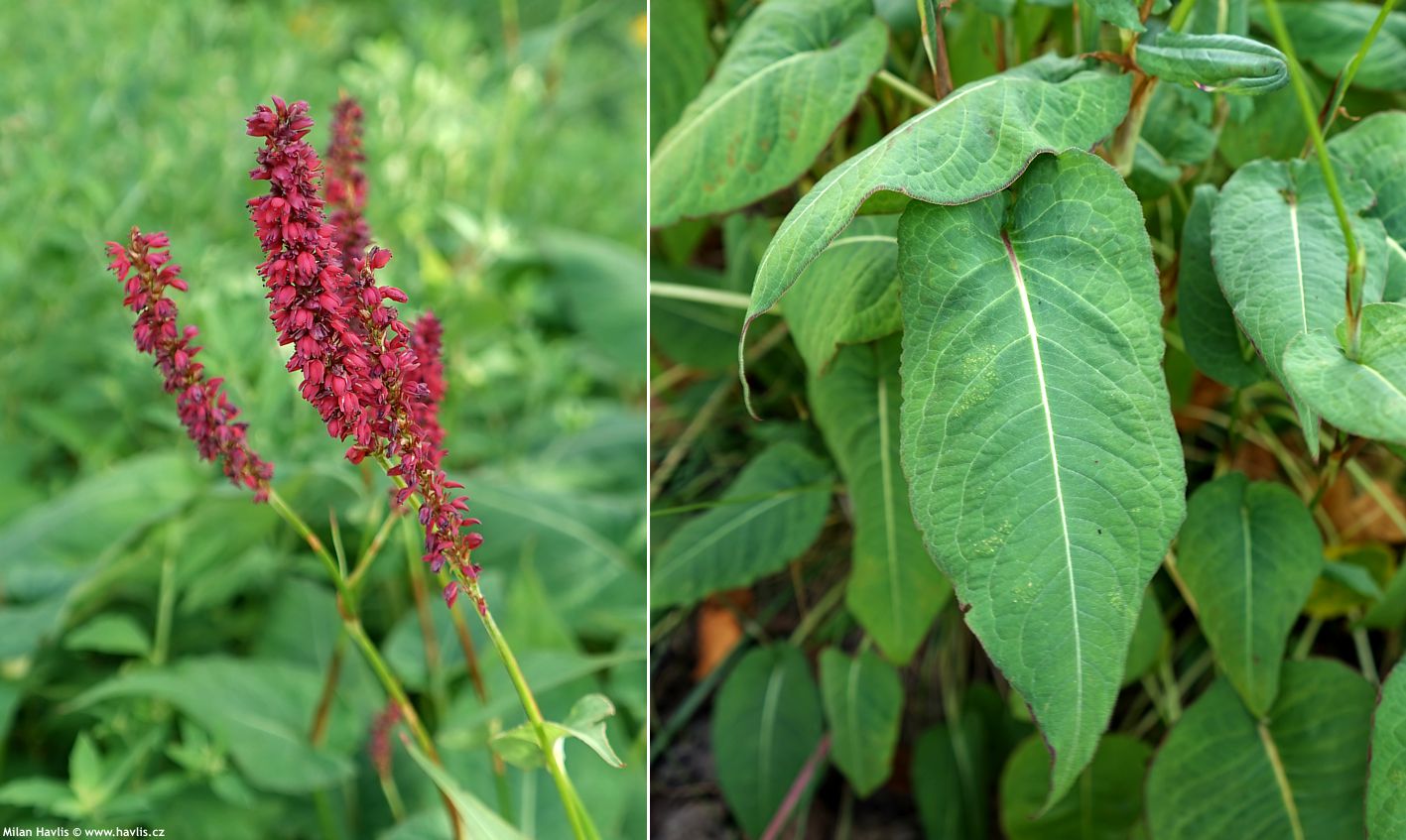
Dark Red is a highly attractive variety of mountain fleece and is considered an improved version of Firetail, the original and very successful variety of similar appearance, just shorter flower spikes. It is a reliable perennial with large leaves and an incredibly long flowering period from July till September. The leaves are broadly lanceolate, up to 25 cm long, conspicuously veined, and their ends embrace the stem with flowers so closely making an impression that the stem cuts through the leaf. They are deep green, matte, and semi-evergreen in mild climates. The stems reach 60-100 cm, and are topped with about 10 cm long, exceptionally longer spikes with dark red flowers whose nectar attracts bees and butterflies all summer long.
This large-leaved form of mountain fleece is deservedly popular among gardeners and landscape architects as the plants can offer a perfect ground cover with unusually shaped and healthy leaves with an extra-long blooming time. The clumps with leaves only, before the flowers appear, are at least 40-50 cm high, which will provide enough mass in early spring to cover areas with finished spring bulbs and their leaves which need to remain on the plant but as they wither, they do not bring much beauty as the season progresses. And the dark ruby red flowers are a great combination with other perennials with different colours that bloom at the same time and require similar conditions such as anemone, rudbeckia, aster, tall salvia and nepeta, etc. And if you love the jungle-like large-leaved vegetation, use it as an understory for taller plants like gunnera, tetrapanax or magnolia grandiflora.
Last update 17-09-2024
In terms of practical usefulness, clasping knotweed has one undeniable advantage over many summer perennials: it tolerates heavy, clayey and even occasionally waterlogged soil exceptionally well. Together with its high frost hardiness, these qualities have quickly made it one of the most frequently used perennials among garden designers who value reliability above all. The soil may be ordinary garden loam, moderately fertile or poorer, though ideally it should be moist, humus‑rich and friable. It is not demanding regarding pH: it tolerates neutral and slightly acidic soils, though strongly alkaline clays do not suit it. It may take a little longer to establish after planting, but once settled it grows beautifully and fills its space without becoming invasive: clasping knotweed forms clumps, produces no runners and does not spread into the surroundings. It may self‑seed occasionally, but never to a troublesome degree. It performs best in full sun to light partial shade; in partial shade it flowers slightly longer and the foliage remains fresher, while in full sun the inflorescences are more abundant, but the plant requires more moisture. It dislikes drought, and during hot, rainless summers it appreciates additional watering – the improvement in leaf vitality is almost immediate. It is fully hardy to at least –34 °C (USDA zone 4), so it overwinters without difficulty throughout central Europe.

.jpg)
.jpg)
