Phillyrea × media intermediate mock privet, green olive tree


 Symbivit Tric (arbuscular)
 Symbivit (arbuscular)
Phillyrea
The genus Phillyrea belongs to the olive family (Oleaceae) and includes only two species of evergreen shrubs and small trees, primarily distributed around the Mediterranean. It was scientifically described in 1753 by Carl Linnaeus (1707–1778) in his seminal work Species Plantarum, where he openly acknowledged that phillyreas were not newly discovered plants from distant expeditions but woody species long familiar to the European landscape and culture. The father of modern botany, as Linnaeus is often called, merely gave them systematic names and classification. In recent decades the genus has returned to the attention of gardeners and botanists in connection with climate change. Slightly rising temperatures, later onsets of winter, abrupt weather swings and, above all, long‑term declines in precipitation create conditions in which some traditional woody species reach the limits of their tolerance while others, previously overlooked, begin to thrive unexpectedly. Phillyreas are among those that cope with these changes calmly and without obvious signs of stress — and remain evergreen.
Phillyrea latifolia originates from somewhat milder but still very dry parts of the Mediterranean, where it functions as one of the key structural elements of the native vegetation. It occurs from the Iberian Peninsula across southern France and Italy to the Balkans, often on rocky slopes, in open woodlands and at the margins of macchia, where it forms a transition between open scrub and forest. Unlike the narrow‑leaved phillyrea (Phillyrea angustifolia), which is a specialist of extreme drought and poor soils, P. latifolia appears more balanced and less narrowly adapted – a species capable of occupying a broader spectrum of natural habitats within the Mediterranean landscape.
The origin of its scientific name reaches deep into Greek mythology. The story tells of a sea nymph named Φιλύρα (Philyra), so beautiful that the god Cronus fell madly in love with her. To avoid discovery – since he already had a wife – he transformed himself into a stately stallion and seduced her in that guise. From their union was born the centaur Chiron, half man and half horse, later one of the most important centaurs in Greek myth. Philyra, ashamed and distraught, begged the gods to free her from human form; they granted her plea and transformed her into a tree – the phillyrea – a name that the genus still bears.
This mock privet is considered a natural hybrid between the narrow-leaved and broad-leaved mock privets. In the literature it appears under the name Phillyrea media or Phillyrea × media to highlight its mixed origin. It is neither a garden cultivar nor a deliberately selected plant, but a form that arises spontaneously in nature and persists over time in Mediterranean maquis vegetation. Some authors include it within broad-leaved mock privet, while others treat it separately; in practice, however, it represents a well-defined intermediate type with its own consistent features. Its leaves are broader and shorter than those of narrow-leaved mock privet, yet smaller and less robust than those of the typical broad-leaved species, a balance that is well reflected in the English name intermediate mock privet. It occurs mainly in the western Mediterranean, especially in the southern parts of the Iberian Peninsula, where it forms a natural and locally rather uncommon component of the native vegetation.
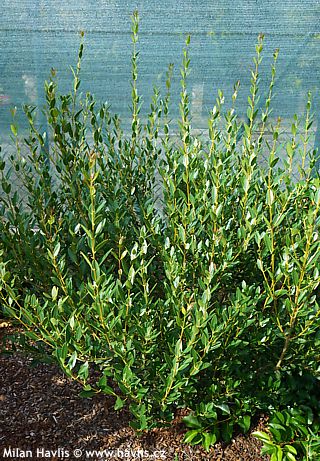
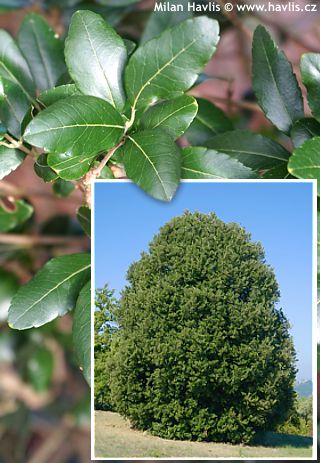
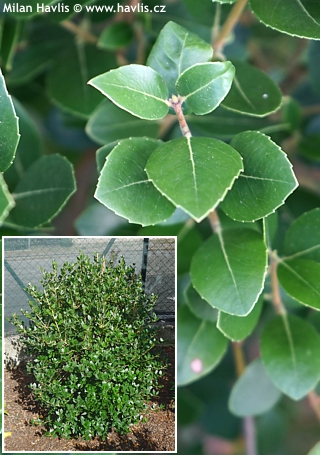
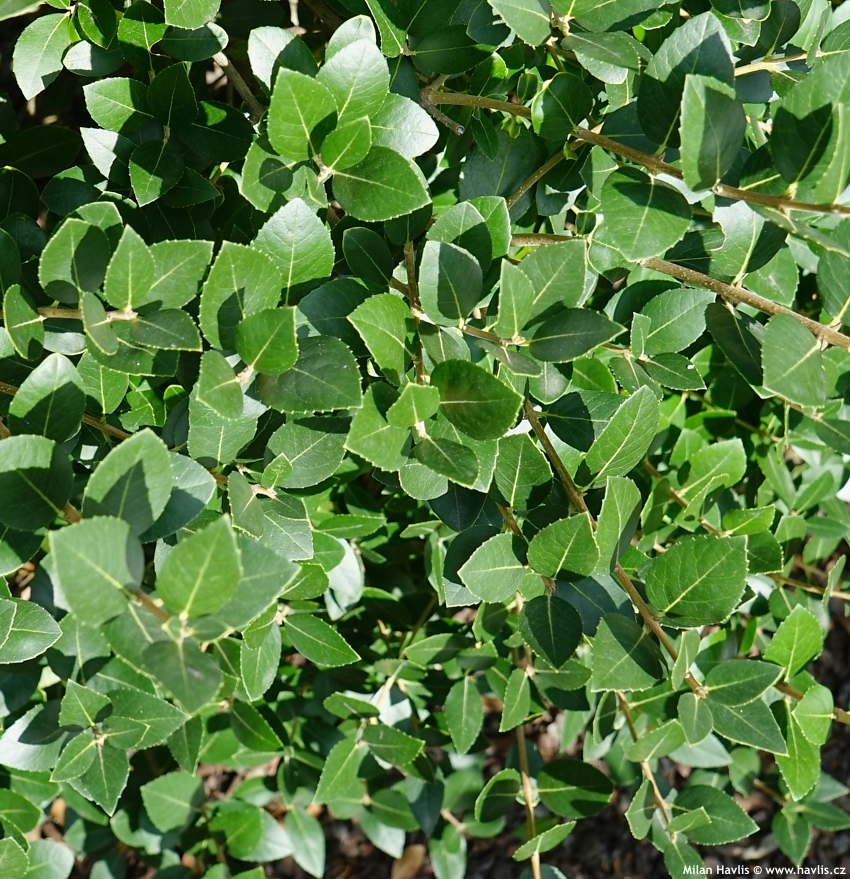
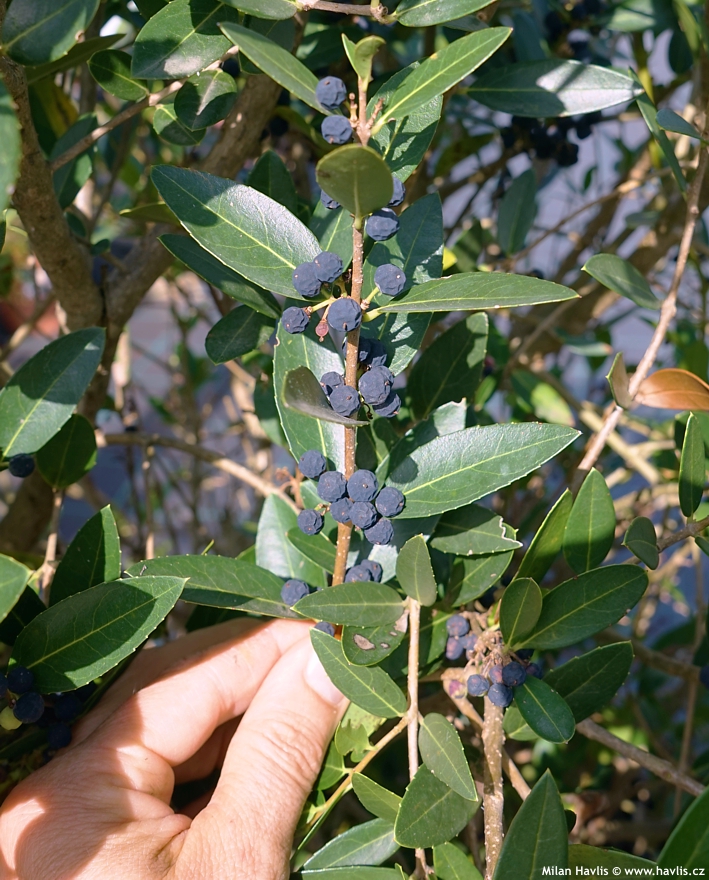
Media mock privet bears evergreen, opposite, 3-4 cm long, broadly elliptic, very dark green, leathery, and glossy leaves. In mid or late spring appear profusion if tiny, insignificant, creamy white flowers followed by small, blue-black, spherical fruit which recalls tiny balls of black pepper when fully mature.
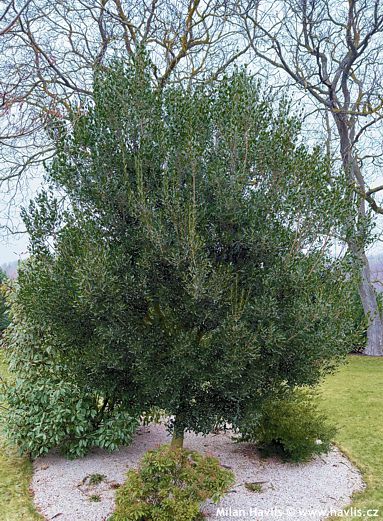
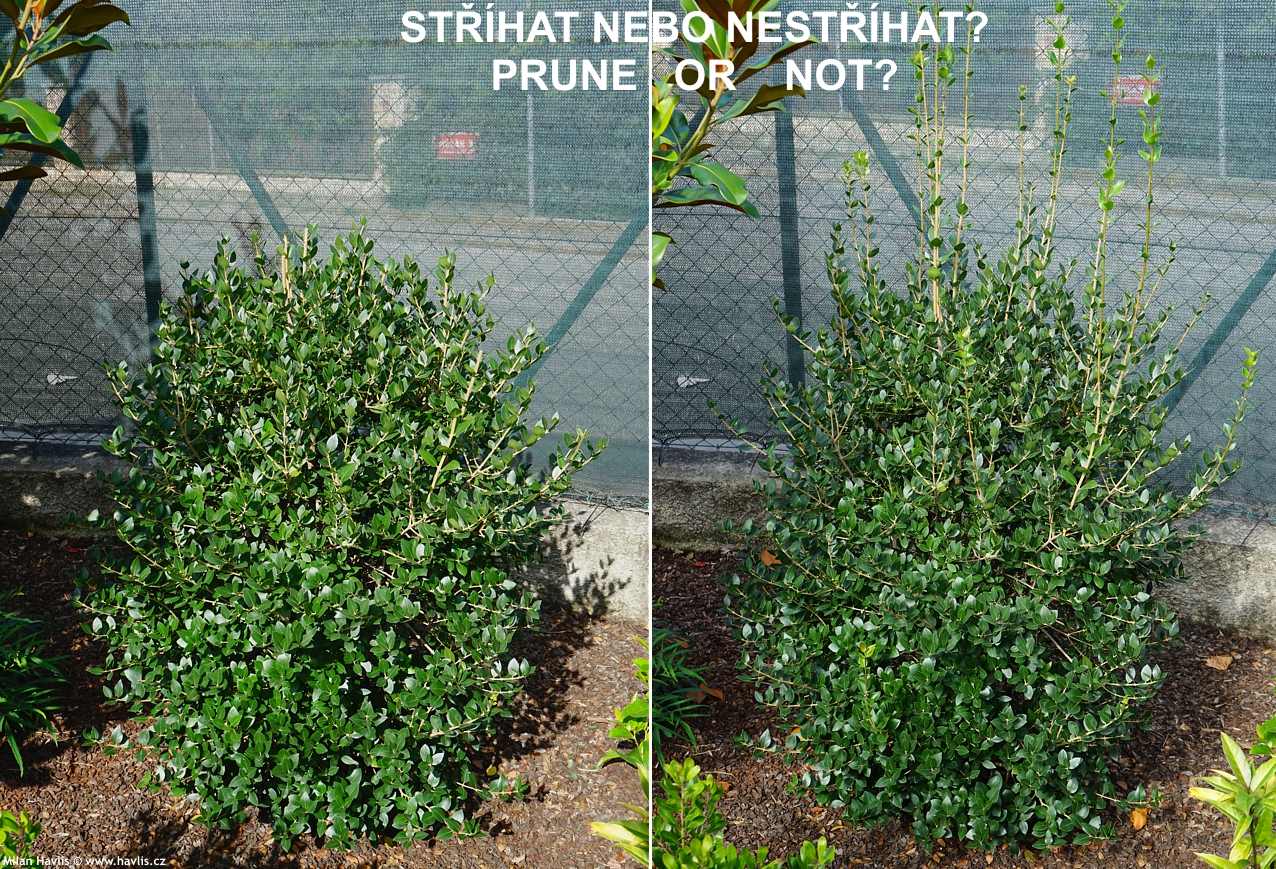
Its habit is best described by one of its common names – a broccoli tree. Young plants grow fast and unevenly into upright shrubs and slow down with age as they get some three meters tall. Then they begin to form very dense, almost congested canopies with stiff, upright branches. Plants are commonly pruned in spring in order to achieve this shape sooner, or clipped to mushroom heads or ball shapes where a second trimming is required in midsummer. Use it as a beautiful small specimen tree in Mediterranean-style landscape.
Last update 07-10-2021; 23-02-2026
Grow it in extremely well-drained, humus-rich soil in full sun or only very light shade. Acidic soil enhances the depth of green colour in leaves but is not essential. Just avoid compacted or water-logged ground where the roots may suffer. It will need even moisture after transplanting but once established stay away from watering. It is disease free and only wine weevils like it. We have tested and confirmed it hardy to USDA zone 6 so far as it has withstood short spells of -24 °C without any injury. Choose older plants for growing in zone 6 and provide good mulch for winter.