

































Photinia × fraseri 'Mandarino' CARRÉ ROUGE Fraser's photinia - STANDARD TREE


 Symbivit Tric (arbuscular)
 Symbivit (arbuscular)
Photinia
The genus Photinia belongs to the rose family and comprises roughly thirty species of shrubs and small trees distributed from the Himalayas across China to Japan, with a single representative in North America. Fossil finds from the Eocene confirm that the genus has existed on our planet for tens of millions of years, and its taxonomy has long been unsettled: some species were repeatedly shifted between the related genera Stranvaesia and Heteromeles and back again, as botanists’ understanding of their relationships evolved or as they came under the scrutiny of genetic research. This tangled history is reflected in the internal diversity of the genus, which was first formally described in 1820 by the British botanist John Lindley (1799–1865), who aptly chose the Greek word phōteinos, meaning “shining”, as a reference to the glossy leaves of most species, especially the evergreen ones. Yet there are also deciduous mountain species, such as Photinia villosa or Photinia beauverdiana, which may seem atypical at first glance, but modern genetics confirms that they truly belong here. The main unifying feature of the genus is its geographical continuity across East Asia and the stable morphology of its flowers and fruits, which holds the genus together despite its evolutionary adventures.
Fraser’s photinia is the child of two Asian parents – the Japanese mother Photinia glabra and the Chinese father Photinia serratifolia – who met only on the other side of the world. Since their flowers are fully compatible, they hybridise spontaneously, and this accidental union was first recorded around 1940 in Birmingham, Alabama, USA, where both species were commonly grown at the time. It was noticed by growers at Fraser Nursery, after which the hybrid was eventually named, and their original seedling was simply called ‘Birmingham’ after the place of discovery. The formal description under the name Photinia × fraseri was published only in 1961 by the American botanist W.J. Dress, who confirmed that it is a stable hybrid. What remains unclear is whether the later successful cultivars from Australia and New Zealand arose from imported American material, or whether the same spontaneous hybridisation occurred independently in the Southern Hemisphere. Either way, thanks to its resilience and near indestructibility, Fraser’s photinia soon became one of the most successful evergreen shrubs of the second half of the 20th century.
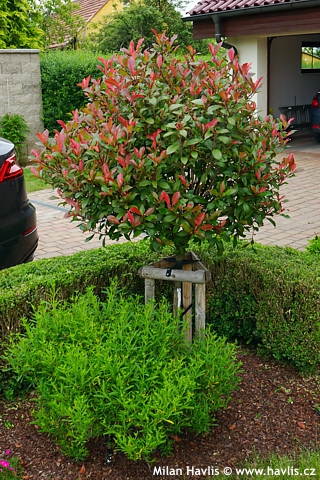
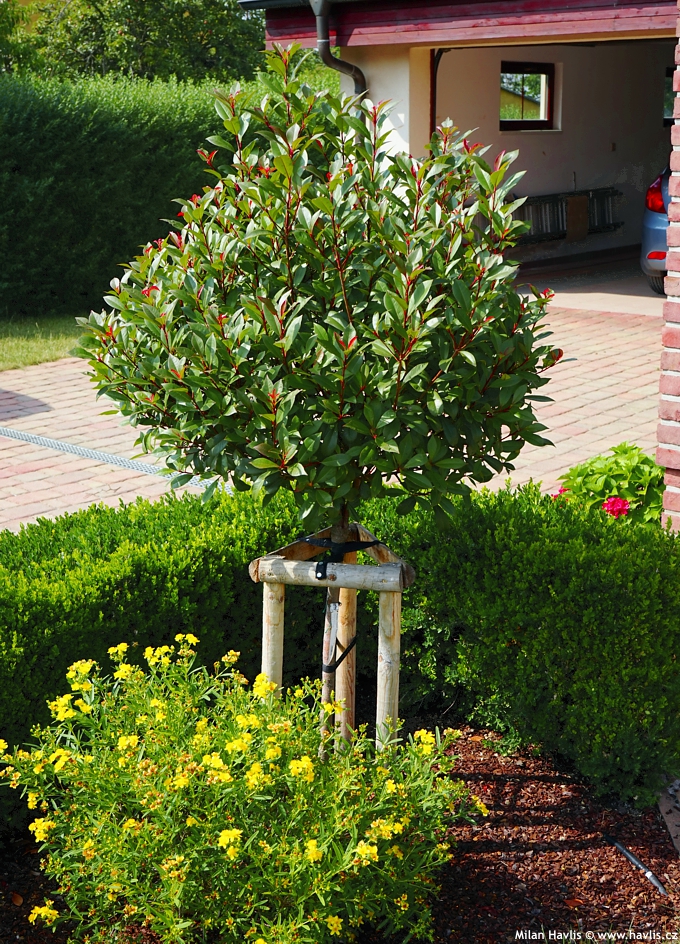
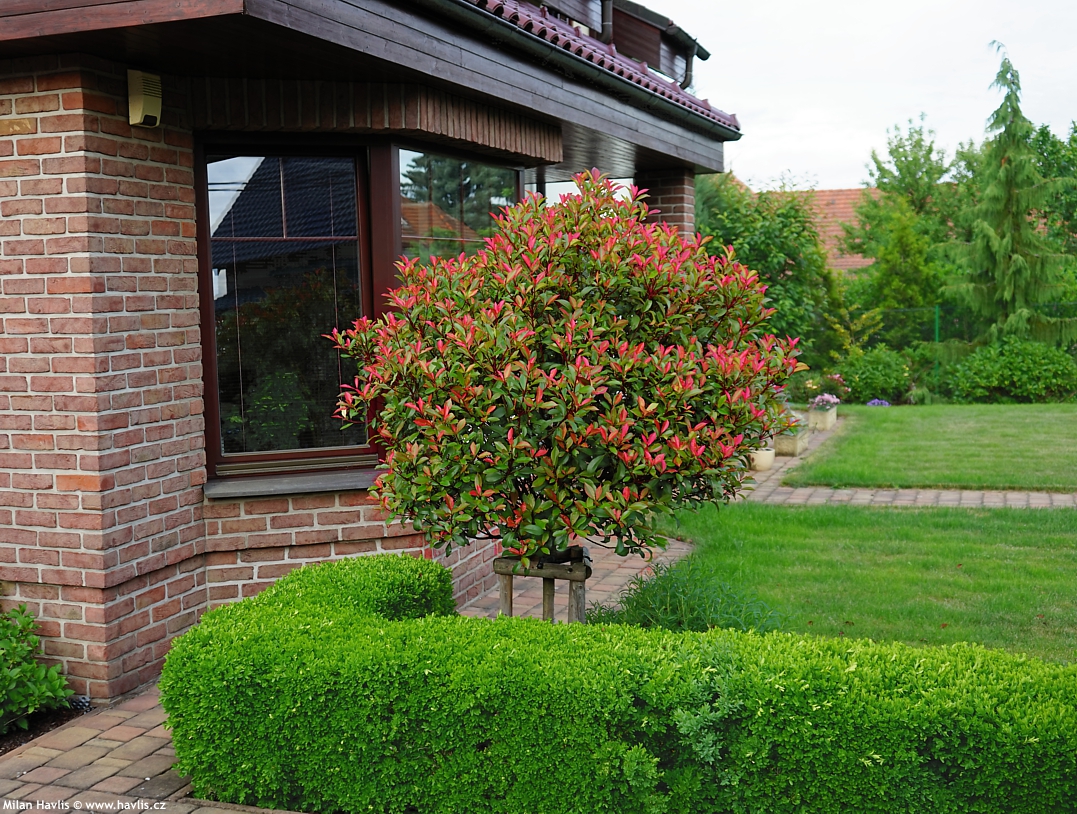
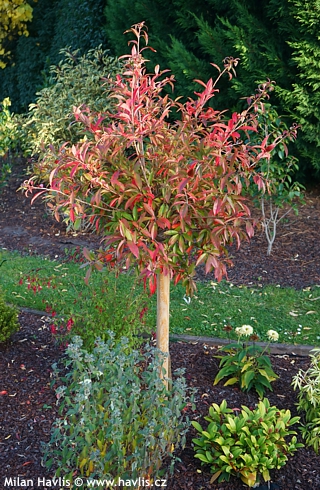
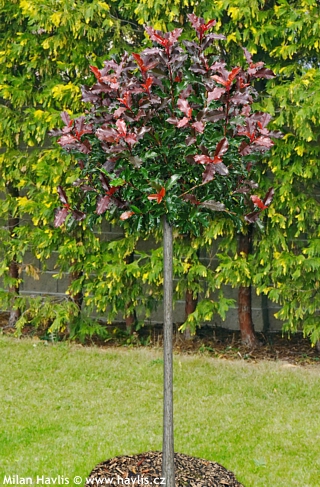
From the very moment CARRÉ ROUGE photinia hit the market, it became an overnight sensation. It originates from the hugely successful ‘Red Robin’, but offers a far more compact and denser habit, with slower growth and smaller leaves that look elegant and completely smother the plant’s coat, turning the photinia into a Red Riding Hood. The French cultivar name CARRÉ ROUGE translates as “Red squared” and refers to the colour of the young foliage, which emerges in a much deeper red with a burgundy undertone. The leaves are evergreen and leathery, elliptic, but smaller and narrower than those of ‘Red Robin’, they are 5–7 × 3–4 cm. The plant has a distinctly tidy, upright habit, forming a broadly ovoid outline with dense branching in maturity. Fresh flushes of red young leaves appear at least twice a year. The dense habit develops fully only after several seasons, as young plants naturally tend to shoot upwards first and only later begin to bush out.
As for its origin, CARRÉ ROUGE has a story that would deserve its own detective novel. The original mutation appeared in Pistoia, Tuscany – the heart of a vast region of nurseries producing woody plants for all of Europe. It arose as a mutation within a stock block of ‘Red Robin’ and received the working name Mandarino (perhaps red mandarins were ripening at the time…). The exact year is not documented, but it was towards the end of the 20th century. From there it travelled to France, where the nursery Pépinières La Forêt reselected it, stabilised it and introduced it to the market under the name CARRÉ ROUGE. And just to keep things interesting, another compact form of Red Robin was being sold in Europe at the same time – Robusta Compacta, a French selection from the Minier nursery dating back to 1991. Judging by the name, it may well relate to the Australian cultivar ‘Robusta’ as its smaller counterpart, and at first glance the two really do look very similar. CARRÉ ROUGE was never patented, so the plants spread freely under varying names which led to a small international muddle. Growers had probably had enough of the confusion, so Dutch nurseryman Nico Bouter decided to register at least the variety name CARRÉ ROUGE to bring some order to the chaos. He succeeded in 2012.
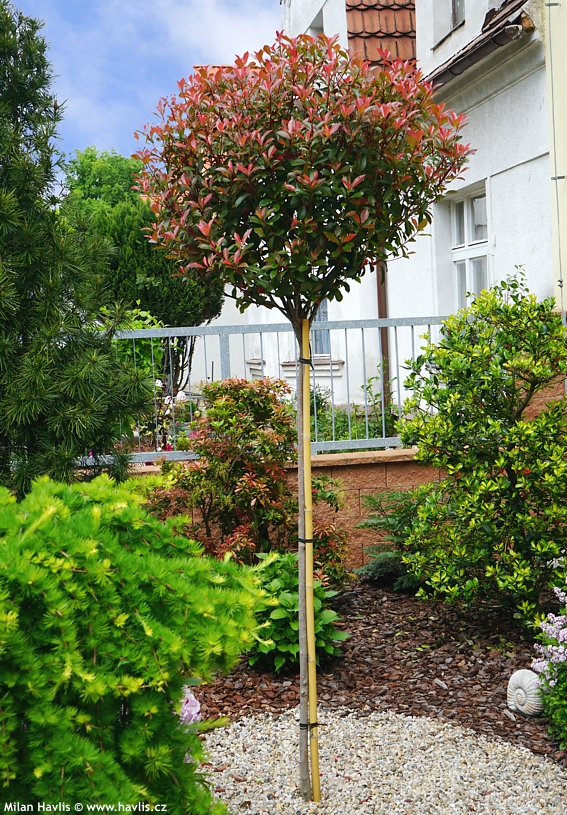
A single‑stem, or standard tree, is an attractive way to grow evergreen woody plants. It offers permanent greenery at a higher level than shrubs branching from the base, allows free passage beneath the crown, and creates an airy, bright space for underplanting. It also provides better screening from unwanted views from neighbouring windows, as the main foliage mass sits higher than in shrub forms. The eventual height depends on how the plant was trained: non‑grafted trees formed by removing side shoots along the stem reach the same height as shrub forms of the given species or cultivar, while grafted trees may exceed this by the height of the rootstock. They are commonly offered as half‑standards with a stem of around one metre, three‑quarter standards, or full standards with the crown set at approximately two metres. Like all single‑stemmed trees, they require firm staking for the first three years and a clean area above the roots, free of lawn and weeds.
When small red spots appear on the leaves, they are caused either by natural pigmentation triggered by temporary physiological stress or by a common fungal disease (Entomosporium). In most cases, it is merely an aesthetic issue. Only in the event of heavy leaf-drop do we recommend treating them with appropriate fungicide and disposing of fallen leaves from the garden (do not compost them!). The plant will soon replace the shed foliage.
Last update 26-02-2020; 31-12-2025
Fraser’s photinia is surprisingly tolerant of various environments. It thrives best in moist but not waterlogged soil and in a fertile position, yet it will grow even in ordinary or poorer soil – it will simply be a little less dense. Acidic soil enhances leaf colour, but it is not essential. It colours best and grows most densely in full sun, but it also tolerates light partial shade. In deep shade, however, it loses the colour of its young leaves, produces elongated shoots, and appears thin. Due to the high evaporation rate we recommend mulching generously after planting and giving young plants extra water during summer. Once established (usually after 1–2 years), it becomes remarkably drought-tolerant, which is why you encounter it so often in Mediterranean gardens, even in places scorched by heat. Just one thing – Mediterranean winters bring plenty of rain, a luxury continental Europe does not always enjoy. Therefore, during dry winters, if the ground is not frozen, water the plant thoroughly once a month so the leaves can better withstand severe frosts. Proven hardiness reaches –24 °C (USDA zone 6) without damage and can go a few degrees lower. After very strong frosts, the tips of the leaves may become dehydrated or scorched, but the plant regenerates reliably after a spring prune. It tolerates pruning extremely well – you can shape it almost anytime, and it even handles hard rejuvenation cuts. A spring prune in April encourages branching, while a summer prune helps refine the shape and often triggers an autumn flush of new red shoots. Suitable for cultivation in large outdoor planters (min. 80x80x80 cm) with regular watering.

.jpg)
Goods are shipped all over Europe. For Russia and U.K. and for further details please read about SHIPPING OPTIONS HERE.
Are you interested in a serious discount for orders NOV-FEB? Check your options here.
THE PRICES INCLUDE VAT of 15%. For quick conversion you can use 1 CZK = approx. 0.04 EUR
- STANDARD QUALITY - Plants of this group are 1st class quality with number of branches and overall density adequate to their size and age, considering they were container grown.
- DE LUXE QUALITY - This label guarantees a luxurious quality of manually selected plants that, compared to their height and age, are exceptionally dense and beautiful.
- EXTRA - These plants are usually mature and bigger specimens with exceptional overall appearance.
- STANDARD (as described in the plant form) means a tree with a trunk of 190-210 cm and a crown at the top, unless specified differently. The commercial size for trees is their girth measured in the height of 1m from ground.
- HOBBY - These plants are of the same quality as our standard-quality plants but younger and therefore cheaper.
- SHRUB - a woody plant with branches growing bushy from the ground level.
- HALF-STANDARD or MINI-STANDARD - a small tree with shorter trunk, its size is usually specified.
- FEATHERED - These are trees with branches growing already from the base of the trunk and up along the stem.
- GRASSES and PERENNIALS - Sizes given usually read the diameter of the pot or the clump, as specified.
