Pieris japonica 'LITTLE FROSTY' lily-of-the-valley shrub

 Rhodovit (ericoid)
Pieris
The genus Pieris belongs to the heath family and comprises roughly seven species distributed across eastern Asia and North America, regions characterised by misty valleys, acidic soils and forests with a deep layer of humus. Fossil evidence is scarce but confirms that the genus is old and stable, without dramatic evolutionary shifts, which corresponds well with its present appearance and ecological requirements. It was described botanically by David Don (1799–1841) in the first third of the nineteenth century, at a time when European botany began to study woody plants from eastern Asia in a systematic way. It is worth noting that Pieris does not appear in the landmark work Species Plantarum of 1753, which described much of the botanical world at the time, because Linnaeus did not know the genus and it entered European science only several decades later. For a long time Pieris was the subject of minor disputes over its precise delimitation; some older works placed it close to Lyonia or Andromeda because of its similar bell-shaped flowers and leathery leaves. Its distinctiveness was eventually recognised, especially thanks to its characteristic alternation of growth phases, its toxic glycosides and its marked ability to thrive in acidic, nutrient-poor soils. In horticultural history the genus became well known mainly thanks to the Japanese and Taiwanese species, which became popular ornamental shrubs in European parks by the late nineteenth century.
Pieris japonica, lily-of-the-valley shrub, originates from the mountainous regions of Honshu, Shikoku and Kyushu, where it grows in lightly shaded forests together with rhododendrons and cryptomerias, so its natural environment can easily be imagined as calm, moist slopes with soft light. The species was described by Carl Peter Thunberg (1743–1828), who during his stay in Japan in the 1770s collected extensive botanical material and filled gaps that Linnaeus could not address. Within the species a group known as yakushimanum gradually became distinguished, named after the island of Yakushima, where compact, low-growing forms occur with dense branching, smaller leaves and exceptional resistance to wind and humid weather; they often grow on exposed, sunny slopes. These plants later formed the basis of modern cultivars with a firm habit and pronounced spring flush. Pieris japonica differs from other species by its more marked spring onset of new shoots, which appear gradually in several distinct stages, by its abundant flowering and by its ability to form sturdy evergreen shrubs even in deeply acidic soils that may be humus-rich or nutrient-poor, reflecting the varied conditions of its Japanese homeland.
In Japanese garden culture Pieris japonica is a symbol of calm and constancy, because its evergreen leaves and early spring flowering act as a gentle counterbalance to rapidly changing seasons. It reached Europe in the 1830s and 1840s and is documented in British gardens by around 1850, fitting naturally into the then fashionable Japanese corners of urban parks. It arrived in North America later, only at the end of the nineteenth century, because nurseries there preferred the native Pieris floribunda, which was reliable and well known to growers. Only in the twentieth century did the Japanese pieris become a valued ornamental shrub in the United States, appearing in modern breeding programmes that made use of its finer habit and abundant flowering. In our gardens it is most noticeable in spring, flowering at a time when most shrubs are only beginning to gain strength, and again with the arrival of warmer weather when it produces new coloured leaves.
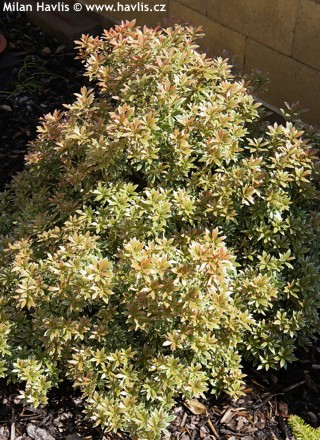
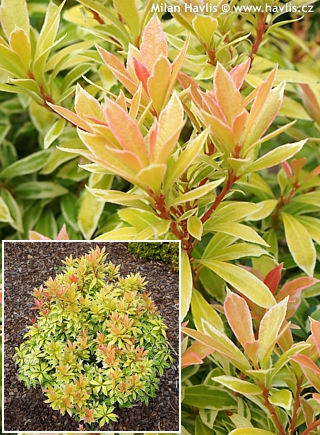
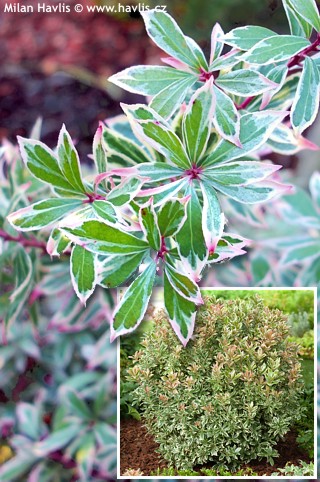
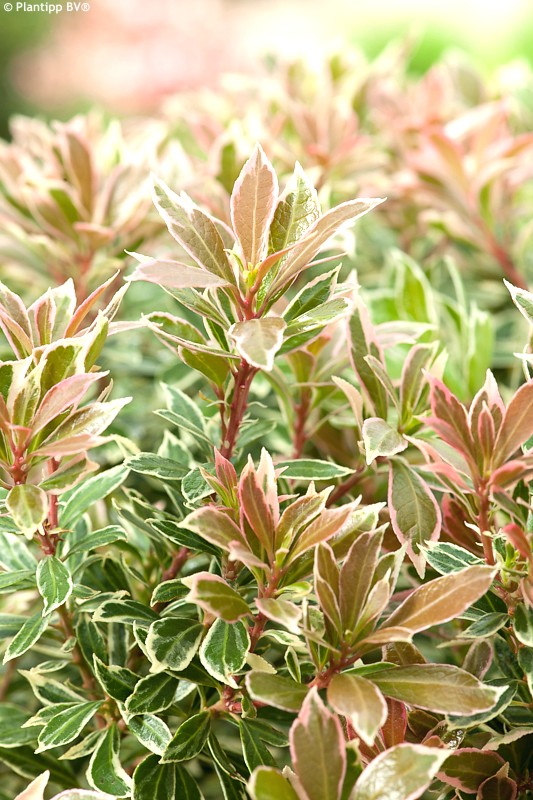
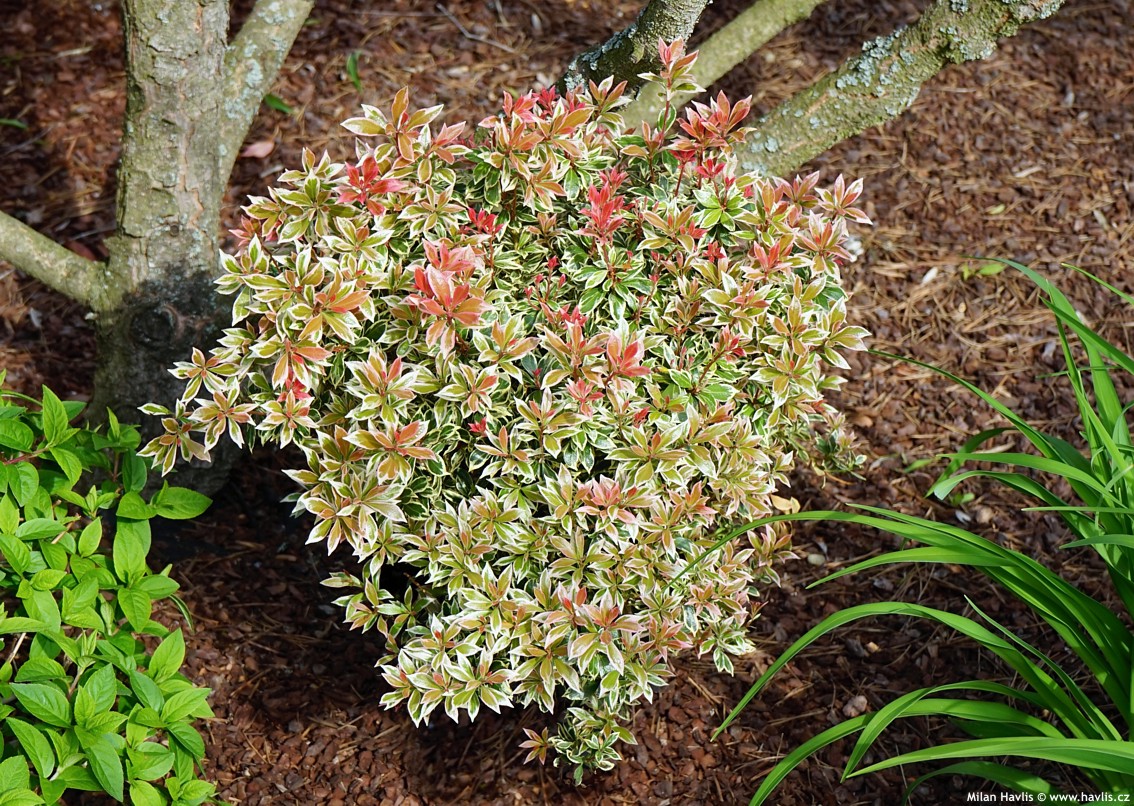
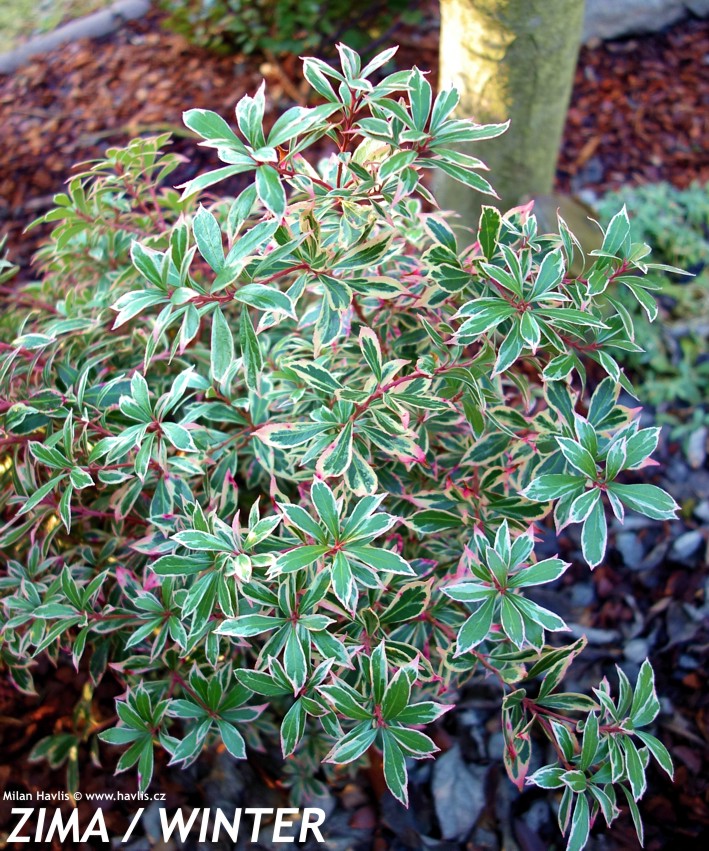
Little Frosty is a dwarf lily-of-the-valley shrub bred by Ron van Opstal. Its evergreen leaves are narrowly elliptic, short, acuminate, medium green with white variegation at margins. In spring they emerge coppery orange to orange brown and their white margins gain pink shades. In winter pink colour returns, especially to the tips which turn rich pink. Winter also enhances the colour of the stems which are purple red.
All in all, one could say this plant is more attractive in winter which makes it an ideal pick for locations that are in frequent use, especially in winter, such as entrances, pathways leading to them, and places near the windows - evergreen plants create the best choice when you want to see a lively landscape even at times when the weather is not really tempting for an outside walk.
Little Frosty is rather slow growing and makes a uniform, rounded, evergreen shrub which needs no pruning to remain handsome. Yet clipping and pruning is possible any time from spring until midsummer. The breeder mentions short clusters of white, urn-shaped flowers in early spring, however, we have not witnessed any yet, and possibly, just like some other dwarf pieris varieties, this one, too, might be a little shy when it comes to flowering. In any case, if the flowers do appear make sure to remove them soon after flowering to prevent production of seeds that exhaust the plant and make it look untidy.
Last update 12-12-2018
Pieris does not require complicated care, but several precise steps strongly influence its condition. After flowering it is advisable to remove the spent inflorescences so that the plant does not produce fruit, which unnecessarily weakens and disfigures the shrub. Once or twice during the season check the upper surface of the leaves; if small pale speckles appear, the plant has been attacked by the rhododendron lace bug, whose larvae feed on the tissues and glue the underside of the leaves. In such a case a suitable insecticide is sufficient; ecological preparations based on natural oils also work well. In winter it is advisable to gently shake off heavy snow if the plant is within reach, so that the brittle branches do not bend or break. They generally do not require pruning, but they tolerate cutting into older, hard wood very well – either in early spring before the new flush, or after flowering.
Pieris is long-lived and trouble-free if planted correctly, similarly to rhododendrons. It is a heathland plant that requires acidic, light, well-drained and humus-rich soil. An ideal mixture is peat with decayed leaves or leaf mould, or fine bark chips with composted sawdust. In heavy, clayey or water-retentive soil it will not thrive – the leaves yellow and fall and the plant becomes more susceptible to pests and soil diseases. The planting hole should be wide, shallow and well drained, not deep; in clay subsoil the planting must be slightly raised. Watering and fertilising are the most frequent concerns: pieris likes moisture but of an airy kind, so frequent watering is not healthy. Its fine fibrous root system is easily damaged by artificial fertilisers and by excess water. If you feel like feeding, use fertilizer for leaves. Water sparingly and at longer intervals; it tolerates temporary drying much better than permanently wet or saturated soil. It is ideal to keep the plant continuously mulched, which stabilises moisture, temperature and soil structure. Most species are hardy to around –27 °C, so they are reliable even in colder regions and can be grown in outdoor containers provided they have excellent drainage.