












.jpg)
Prunus dulcis 'ROBIJN' sweet almond


 Symbivit Tric (arbuscular)
 Symbivit (arbuscular)
Prunus
The almond (Prunus dulcis) is among the oldest cultivated woody plants grown by humankind, and its history reaches back to southwestern Asia, the Balkans and probably also northern Africa. Archaeological evidence shows that almonds were part of the human diet as early as the 3rd millennium BC. As early as the 4th century BC, Theophrastus, Aristotle’s pupil, described the almond in his Historia Plantarum as a tree with a clear distinction between sweet and bitter kernels and with a native range in the dry lands of the eastern Mediterranean. Several centuries later, Pliny the Elder included it in his Naturalis Historia and devoted a separate chapter to it, noting its medicinal effects, cultivation methods and the varieties known at the time. During the Renaissance, the almond appears in the most important European herbals: Otto Brunfels illustrated it in 1530, Leonhart Fuchs described it in 1542, Pietro Andrea Mattioli included it in his commentaries on Dioscorides, and Caspar Bauhin listed it in 1623 in his Pinax Theatri Botanici under the name Amygdalus communis, although modern nomenclature established the correct name as Prunus dulcis (Mill.), published in 1967.
Since antiquity, the almond has been surrounded by symbolism and cultural meaning. Hebrew texts call it the “tree of vigilance”, because it is the first of all trees to flower. In Greek mythology it is linked to the story of Phyllis (Φύλλις), the Thracian princess who fell in love with Demophon, son of the Athenian hero Theseus. After returning from the Trojan War, Demophon failed to keep his promise that he would soon come back to her, and Phyllis waited for him so long that grief drained her strength and, according to the legend, she was transformed into an almond tree. Demophon eventually returned, but too late, and when he embraced the trunk in sorrow, the tree burst into blossom. Since then, almond blossoms have been a symbol of fidelity. In Europe almonds were valued not only for their fruit but especially for their flowers: by the 16th century they were already grown in Britain as ornamental trees, traditionally grafted onto plums, because on their own roots they are less hardy and more demanding in soil. Their natural habitats lie in the dry, stony regions of southwestern Asia – in Iran, Afghanistan, the Caucasus, Turkey and parts of the Levant – from where the cultivation spread across the Mediterranean, where numerous nut‑producing varieties were developed. In ornamental gardens, however, forms selected for early flowering and delicate colour are preferred. Old gardening manuals recommend planting almonds against a dark background, for example holly or holm oak, because the March sky is not always bright blue and the blossom loses half its charm against a cold grey backdrop.
The almond has a surprisingly long and remarkable history in the Czech landscape, although it is little known. The best‑known example is the freely accessible almond orchard on Prague’s Petřín Hill. Old varieties, planted as early as the 19th century, thrive here thanks to the warm microclimate of the southern slopes, the urban heat island and the well‑drained soil. The Petřín almonds have become part of Prague’s identity: in spring people come to admire their flowers, and at the end of summer they pick up the nuts, a tradition without parallel in Czech cities. This self‑harvesting is not only permitted but actively encouraged by the municipal forestry authority, Lesy hl. m. Prahy. The almond has left an even stronger mark in Moravia. In 1949 Hustopeče town established the largest almond orchard in Central Europe, originally intended for kernel production, which is now being restored and has become a symbol of the local landscape. Almonds also grow in the Pálava wine-growing region, especially around Mikulov, Klentnice and Pavlov, where they have been cultivated since the 19th century thanks to the warm, dry microclimate, calcareous soils and south‑facing slopes. Individual historic plantings also appear near the Mikulov château and in the gardens below the Holy Hill. Unlike Prague, self‑harvesting is not organised in Moravia, but in Hustopeče and Pálava it is traditionally tolerated. The almond has thus become a natural part of the Moravian landscape, as naturally as the apricot or the vine, and its presence shows that our environment can offer suitable conditions even for a tree otherwise associated with the Mediterranean.
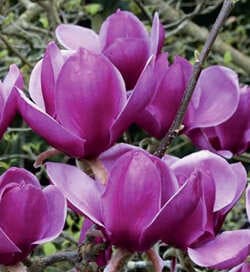
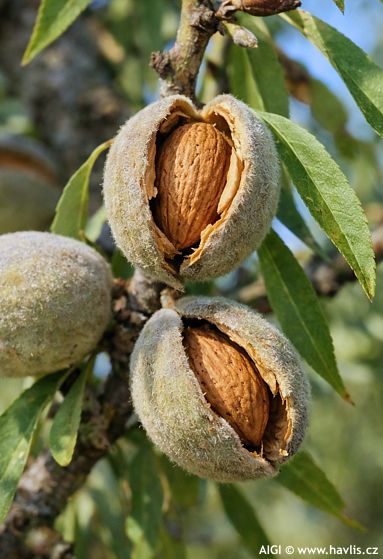
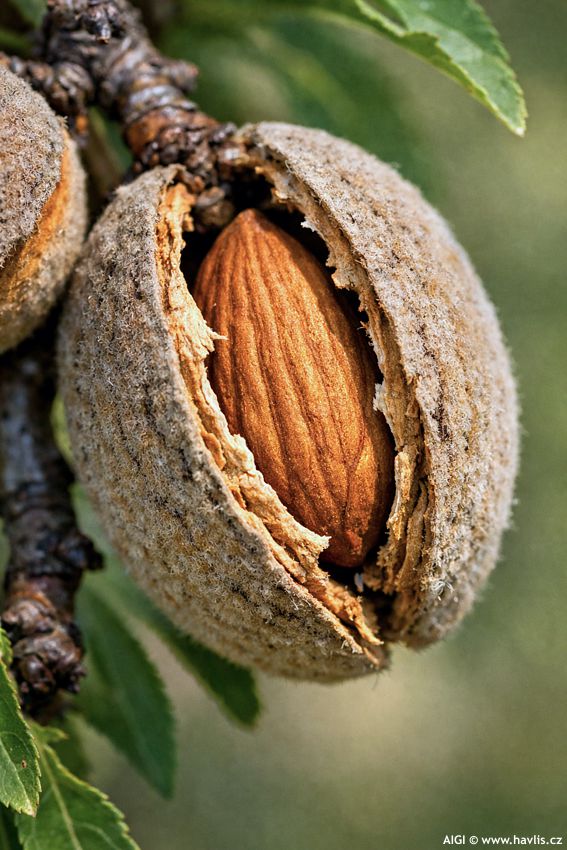
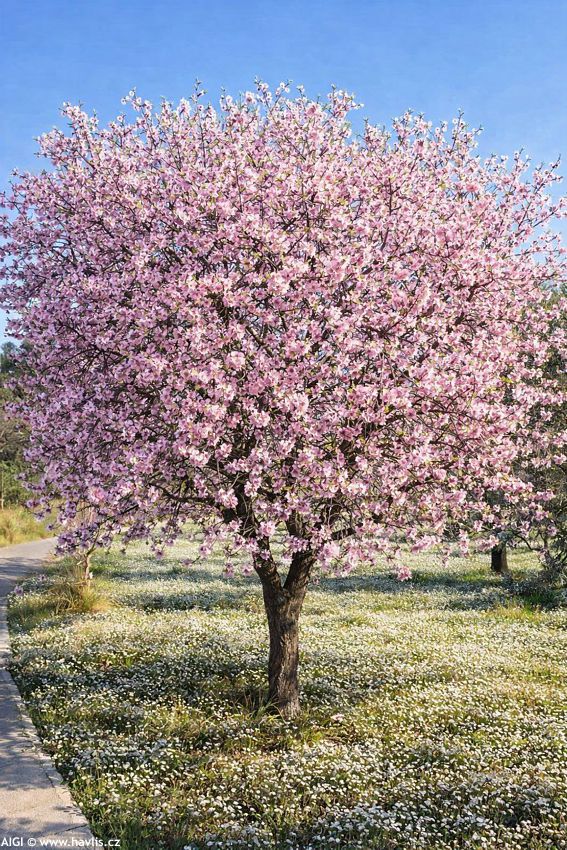
The almond cultivar Robijn originated in the Netherlands and is better adapted to the Central European climate. It is valued for its steady growth, good resilience and reliable fruiting. It grows moderately strongly, forms a spreading crown and reaches a height of about four metres, therefore less than the species almond. It flowers from late March to early April, which is later than Mediterranean varieties and significantly reduces the risk of damage from spring frosts. The flowers are white to pale pink, with gently reflective margins, and have the typical translucence characteristic of almonds. The nuts ripen from late August to early September, have a hard shell and a sweet, aromatic kernel without bitterness. The tree is self‑fertile, although the presence of other almonds increases the crop. ‘Robijn’ forms a regular, light crown that supports the formation of flower buds, and thanks to its later flowering it is a suitable choice for gardens that wish to combine the ornamental value of the almond with the possibility of obtaining high‑quality sweet kernels. If given a warm, sheltered position, light soil and plenty of sun, it thrives excellently and produces a rich spring cloud of blossom and a regular harvest of sweet kernels every year.
Last revision: 29‑06‑2026
The almond can suffer from several diseases typical of stone fruits, especially in cold and wet springs. The most common problem is blossom blight (monilinia), which attacks flowers and young shoots; it appears as dieback of shoot tips, which must be removed down to healthy wood, ideally during full growth (May). In warm summers leaf spot caused by fungi of the genera Cladosporium or Alternaria may occur, but in almonds it is usually mild and is managed by maintaining an open crown and limiting nitrogen. The tree may also suffer from bacterial canker, especially if planted in heavy, cold soil. Among pests, aphids sometimes appear on young shoots, tortricid moths on the fruit and, in warm regions, spider mites. Almond pruning is moderate: it flowers on previous year’s wood, so a strong spring cut would remove most of the blossom. Young trees require only formative pruning; mature trees need a light maintenance cut after flowering, focused on removing dead, diseased or overcrowding branches. The almond does not tolerate hard pruning which leads to the formation of strong, non‑fruiting shoots.
The almond requires a sunny position, light soil and good drainage. In the first years after planting, it is advisable to protect the trunk from frost and provide support until the tree strengthens. Feeding should be moderate, ideally with compost or well‑rotted manure, never with high doses of nitrogen, which promotes growth at the expense of flowers. Watering is necessary only in the first years after planting; a mature tree is highly tolerant of drought and does not withstand waterlogging. In winter it is advisable to protect the graft with jute or reed matting, especially in the first two years. Compared with apricots or peaches (the same genus), the almond is surprisingly long‑lived: in suitable conditions it reaches 40–60 years, sometimes more, although its highest productivity is between the 10th and 25th year. Its frost tolerance is around –23 °C (USDA zone 6).