Pulmonaria 'RASPBERRY SPLASH' lungwort

 Symbivit Tric (arbuscular)
 Symbivit (arbuscular)
Pulmonaria
The genus Pulmonaria was described by Carl Linnaeus (1707–1778) in 1753 and includes species native to Europe and western Asia, stretching naturally from the Pyrenees to the Caucasus. Today the genus comprises around sixteen species, each with its own character: Pulmonaria officinalis with its firm green leaves, P. longifolia described by Augustin Pyramus de Candolle (1778–1841) with long, narrow blades, P. rubra identified by F. A. Marschall von Bieberstein (1768–1826) with unusually red flowers, and P. saccharata, treated scientifically by Johann Christian Daniel von Schreber (1739–1810), with its distinctive “sugared” spotting. A shared hallmark of the genus is its early spring flowering and the curious ability of the blooms to shift from pink to blue depending on the chemistry of the nectar – a small botanical trick often noticed even by casual gardeners.
Among all species, Pulmonaria officinalis holds a special place. It became a traditional European medicinal herb, appearing in herbals as early as the Middle Ages. People believed that its spotted leaves resembled diseased lungs and therefore helped with coughs, fevers and “inner chills”. Although this symbolism was more imaginative than scientific, the plant does contain mucilaginous compounds and tannins that soothe irritated mucous membranes. For that reason, it was used for coughs and colds, and in folk medicine it retained its reputation as a lung remedy well into the twentieth century. It grows naturally in deciduous woodlands from France to Ukraine, often in partial shade and moist soils, and its resilience made it one of the most important parent species for later breeding.
Modern hybridisation of pulmonarias began only at the end of the twentieth century, when breeders set out to elevate the genus from modest medicinal herb to a fully-fledged garden perennial for shade and semi‑shade. In the 1990s, Alan Bloom (1906–2005) of Blooms of Bressingham in Britain and American breeder Dan Heims of Terra Nova Nurseries began crossing P. saccharata, P. officinalis, P. longifolia and P. rubra. Their aim was to produce plants with stronger leaf markings, longer flowering and, above all, greater resistance to powdery mildew, which plagued older cultivars. The result is today’s hybrids with leaves reminiscent of an artist’s canvas, compact growth, a longer season of foliage and the reliability that has made them staples of mixed borders. And as an intriguing side effect of these crosses, many modern cultivars also show a more stable flower colour, with the classic shift from pink to blue far less pronounced than in the original species.
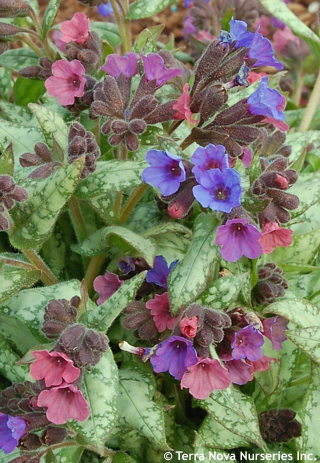
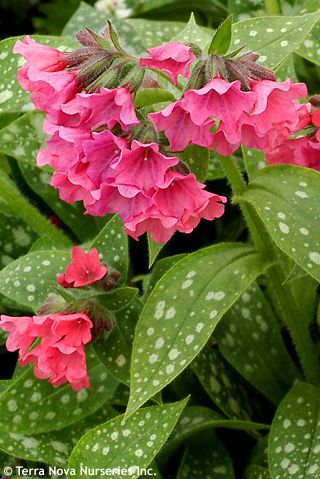
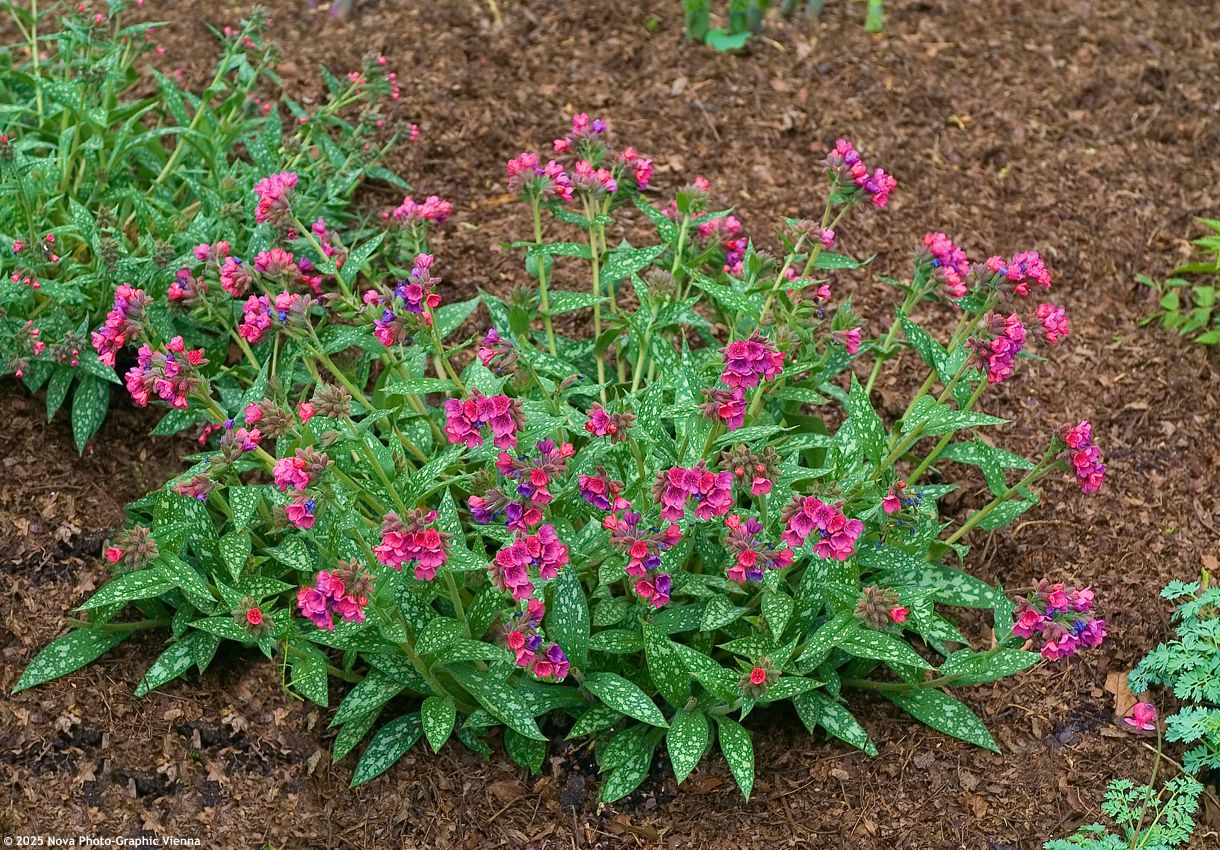
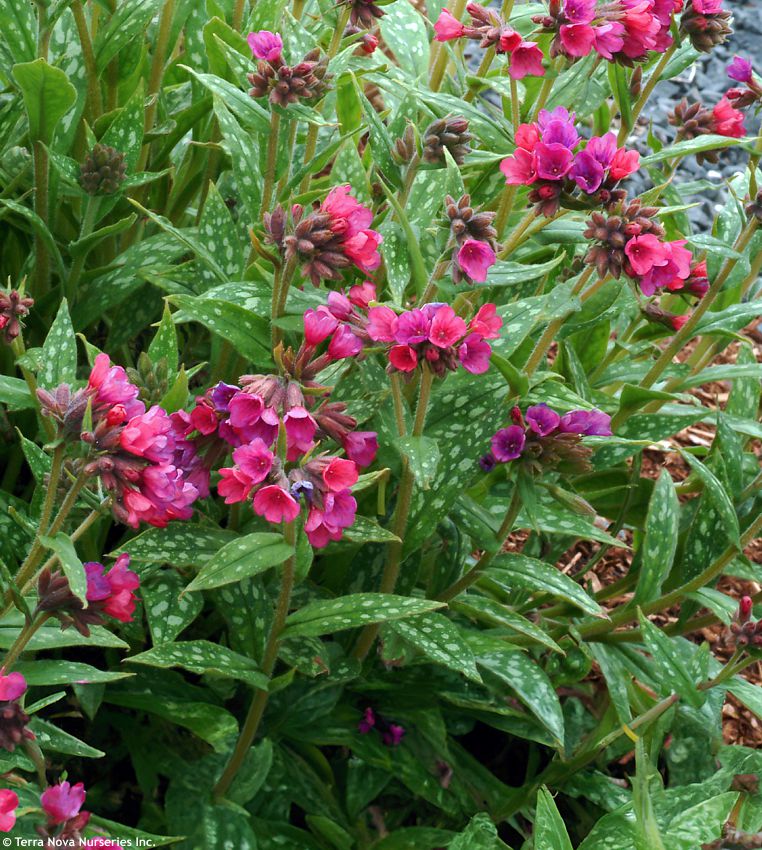
Raspberry Splash lungwort stands out with its unique flower colour, which is initially vibrant raspberry pink and later transitions to purple and bluish violet. This change is caused by chemical processes in the flower cells, specifically by changes in pH, which influence pigments called ančthocyanins. The flowers are small, bell-shaped, and appear at the tips of about 25 cm long, slightly arching, and sparsely leaved stems. Blooming in Central European conditions begins during the first warmer days of spring, usually in the first half of April, and lasts for about a month.
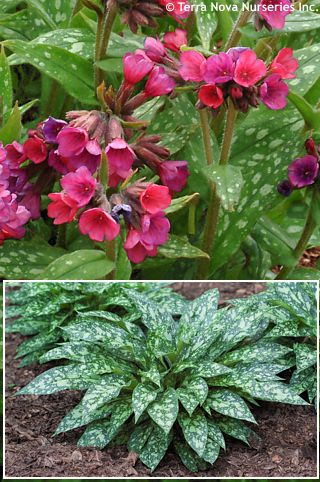
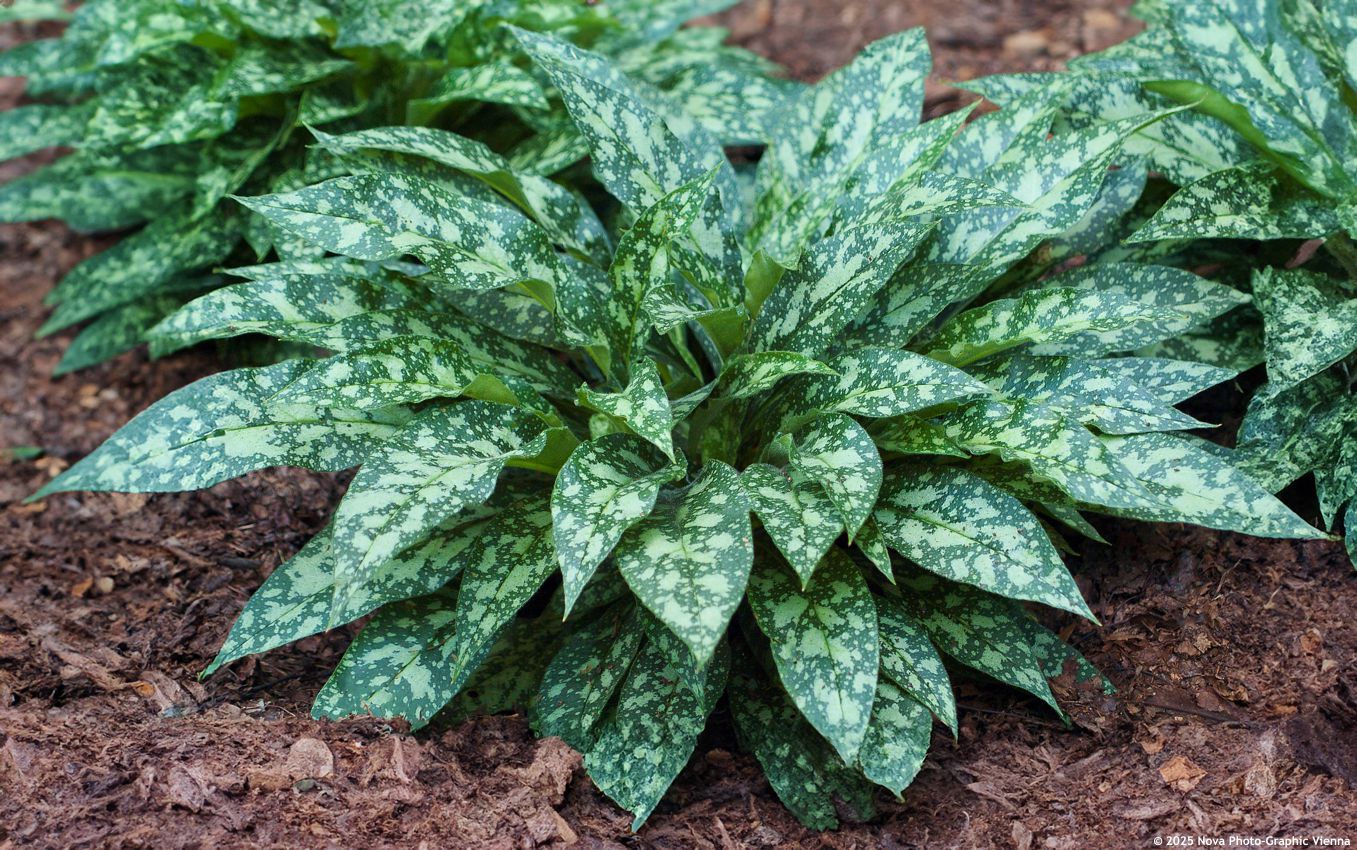
Leaves are the second, and often the more significant feature for which we purchase these hybrid lungworts. Once the plant finishes flowering, you remove the stems with spent flowers, and new leaves begin to sprout from the ground. These leaves are considerably larger compared to those present before flowering and showcase a striking transformation in colour. While earlier leaves appear subdued and less prominent, the post-flowering foliage bursts with vibrancy, featuring dark green tones accented by irregular silver-grey blotches that resemble leopard’s fur. This dramatic change highlights the plant's ornamental value, making it a centrepiece of any garden bed.
The semi-evergreen, broadly lance-shaped leaves are noticeably hirsute, adding a unique texture to their appealing look. Raspberry Splash is a hybrid variety combining two different species: Pulmonaria longifolia 'E.B. Anderson' which gives the leaves more elongated shape, and Pulmonaria saccharata 'Leopard' which contributed to the spotted pattern. The plant forms dense mounds with elegantly arranged leaves in an almost horizontal rosette owing to which it is also suitable as ground cover. Additionally, it is one of the few varieties that tolerates full sun without sun scorch. It is protected by patents PP12138 (USA – 2001) and 11545 (EU – 2003).
Last update 27-04-2025
Large‑leaved forms of lungwort require a fresh, well-drained but evenly moist soil that neither dries out nor remains permanently waterlogged to avoid fungal diseases. In the wild they naturally grow beneath trees that protect them from drying out, and in good soils with a mildly acidic to neutral reaction – they do not tolerate strongly calcareous loam. They prefer partial shade to full shade; in full sun their leaves can suffer scorch, except for varieties specifically rated as tolerant of sun. Although some leaves may remain attractive after winter, early in spring – before stems with flowers have burst into growth – it is advisable to remove all overwintered foliage. Lungwort is hardy down to about −34 °C (USDA zone 4) and is not ideal for containers, because it resents fluctuations between wet and dry.