

































.jpg)
Robinia × margaretta 'Pink Cascade' CASQUE ROUGE black locust

 Symbivit Tric (arbuscular)
 Symbivit (arbuscular)
Robinia
Locusts (Robinia) belong to the legume family and form a small genus of deciduous trees and shrubs native exclusively to North America. In their natural habitats they grow mainly on dry, rocky slopes, in open woodland and on disturbed sites, where their rapid growth and symbiosis with nitrogen‑fixing root nodules give them a clear advantage. They were introduced to Europe at the beginning of the 17th century and quickly gained popularity not only as ornamental trees, but also as valuable timber and reclamation species. Typical features of the genus include pinnate leaves, thorny branches and papilionaceous flowers arranged in pendulous racemes that appear in late spring. Black locusts are valued for their tolerance of drought, pollution and poor soils, while their light, airy crowns allow plenty of light to pass through, giving them a distinctive, open character.
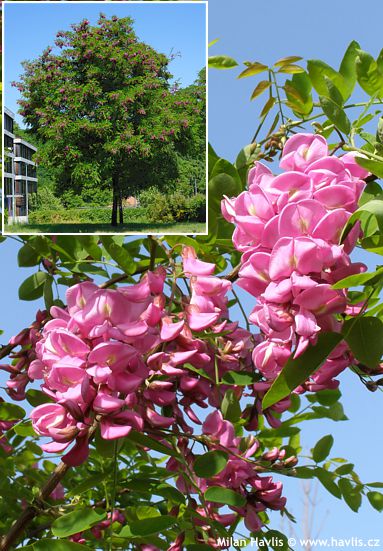
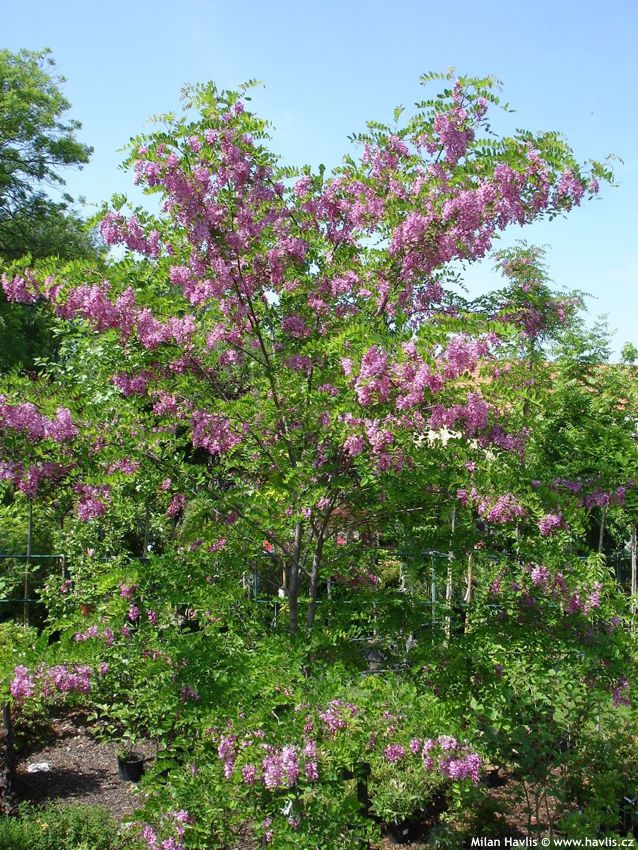
Casque Rouge is among the most striking ornamental locust trees grown in gardens of the temperate zone, immediately recognisable by the colour and size of its flowers. It is not a botanical species, however, but a garden hybrid with a surprisingly complex background. It originated from a cross between Robinia pseudoacacia and Robinia hispida var. kelsey. From the former it inherited the length and structure of the flower racemes, from the latter their intense colouring. The exact circumstances of its origin remain a matter of debate, which only adds to its appeal. Specialists at Kew Gardens believe it was originally a spontaneous hybrid discovered as early as 1914 in Durand–Eastman Park in Rochester, New York (USA). It was found by B. H. Slavin and described under the name Robinia × slavinii. Another record dates from 1933, when British growers at the Hillier nursery achieved the same result through deliberate crossing and introduced it under the cultivar name ‘Hillieri’. Just a year later, the American nursery Princeton Nurseries in New Jersey presented the identical tree as Robinia × ambigua ‘Pink Cascade’. And finally comes the greatest mystery of all – for reasons that remain unclear, the same tree appeared much later in Europe under the French name ‘Casque Rouge’. With such an identity crisis, one might almost feel sorry for it.
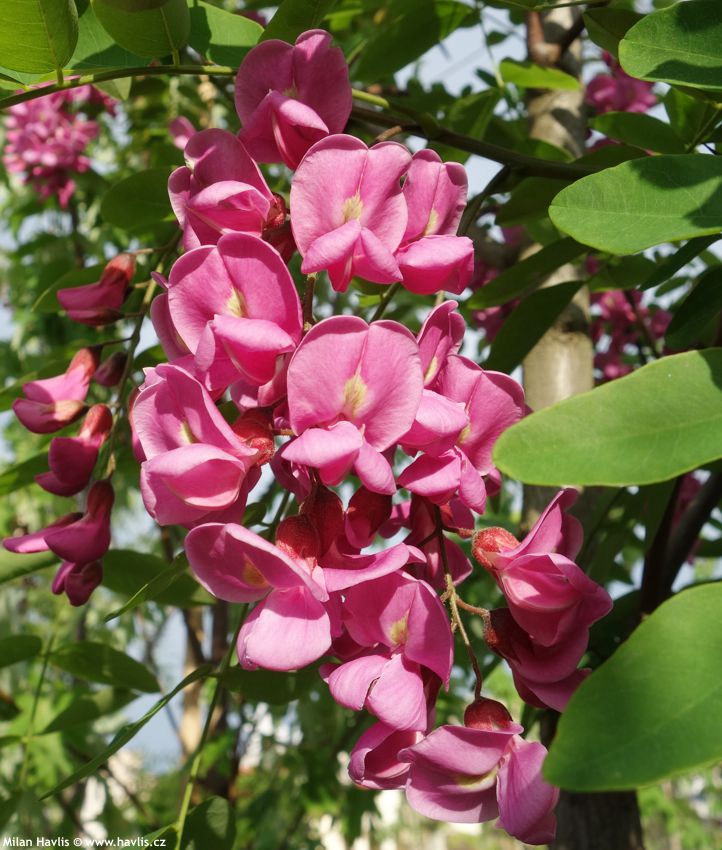
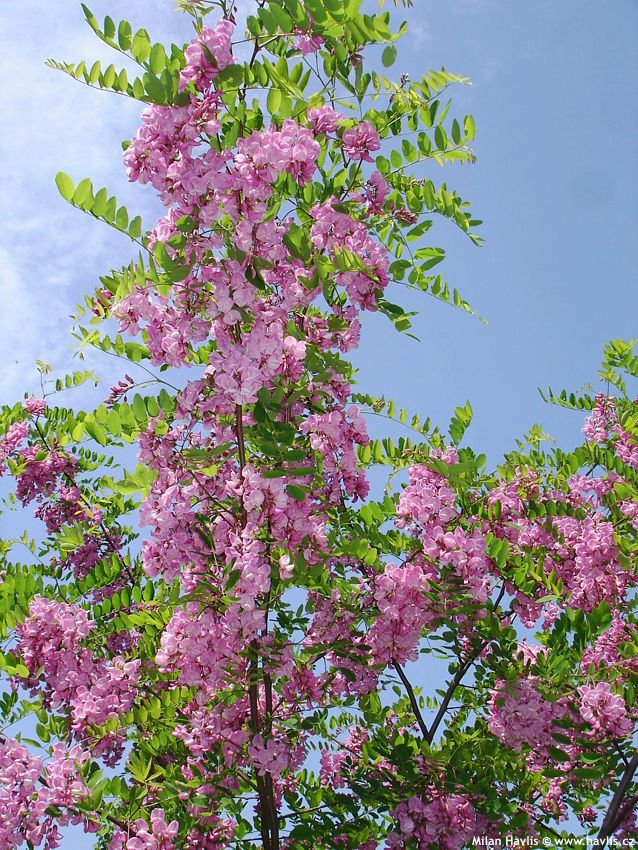
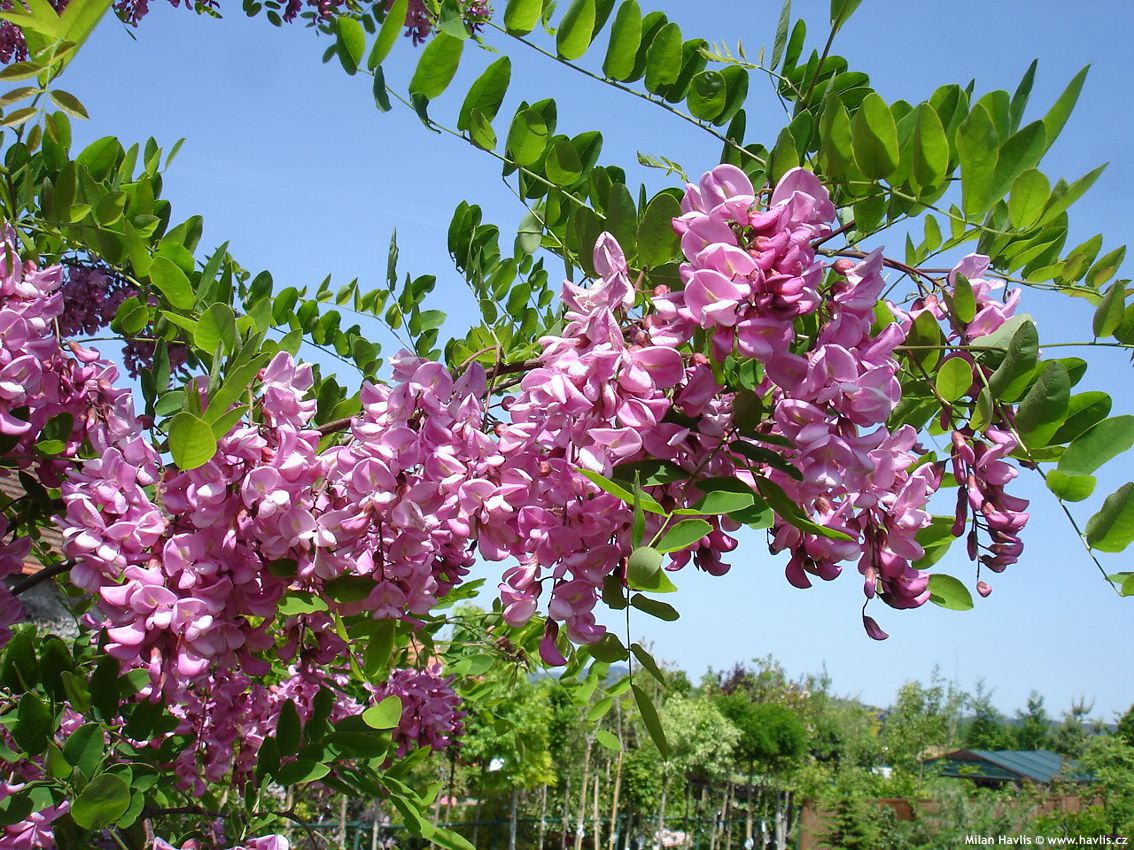
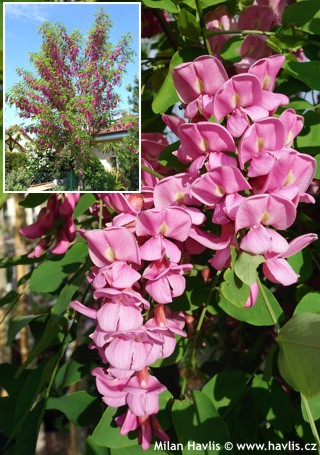
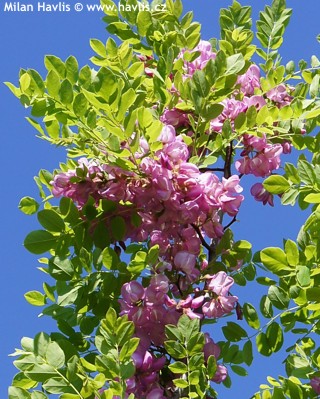
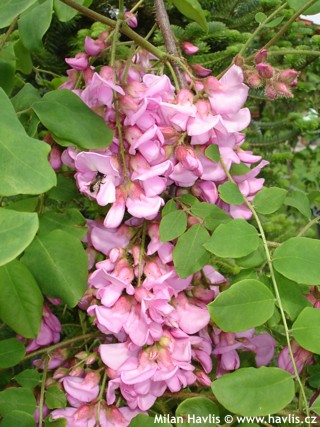
The name Casque Rouge means “Red Mane”, and this locust certainly lives up to it. Its deep pink to purplish papilionaceous flowers are borne in dense, pendulous racemes 15–20 cm long. It blooms for the first time in mid‑spring (May) and is capable of sporadic remontant flowering later in summer. This can be encouraged by light pruning in June, after the first flush. The tree continues to grow throughout the growing season and flowers even on new shoots, so with suitable pruning a second wave of bloom may follow later in summer.
The leaves are typically locust‑like, pinnate and medium green. New shoots and foliage continue to develop well into autumn, so the tree retains a fresh appearance for much of the year until leaf fall. The crown is light, open and broadly pyramidal, yet fairly regular in shape, especially in old trees. This cultivar rarely exceeds a height of 8 metres. Thanks to its airy canopy, other shrubs or perennials can be grown beneath it. The branches are thorny, a feature characteristic of the genus as a whole.
Last update 08-12-2008; 27-05-2018; 28-01-2026
Locust prefers well‑drained, rather poor soils and, once well established, tolerates drought with ease. In heavy, permanently waterlogged soils it has little chance of survival. Staking the trunk with a firm support system (the tripod) is essential for at least the first three years after planting, as the wood is relatively brittle and susceptible to wind damage. Regular annual pruning helps to strengthen the crown and significantly reduces the risk of branches breaking in strong winds. It is tolerant of road salt, and its roots are not aggressive, so they do not pose a risk near roads, underground utilities or building foundations. While black locust (Robinia pseudoacacia) is well known for its invasive behaviour in Europe, other species and hybrids of the genus Robinia do not pose the same problem. This also applies to the cultivar ‘Casque Rouge’, so there is no need to worry about root suckers or uncontrolled spread in the garden. Hardiness is high, to at least –34 °C (USDA zone 4).
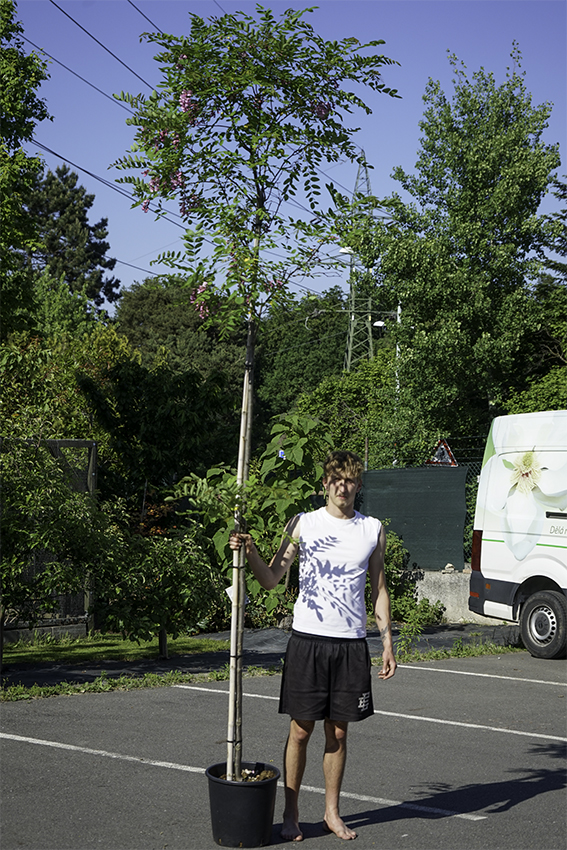
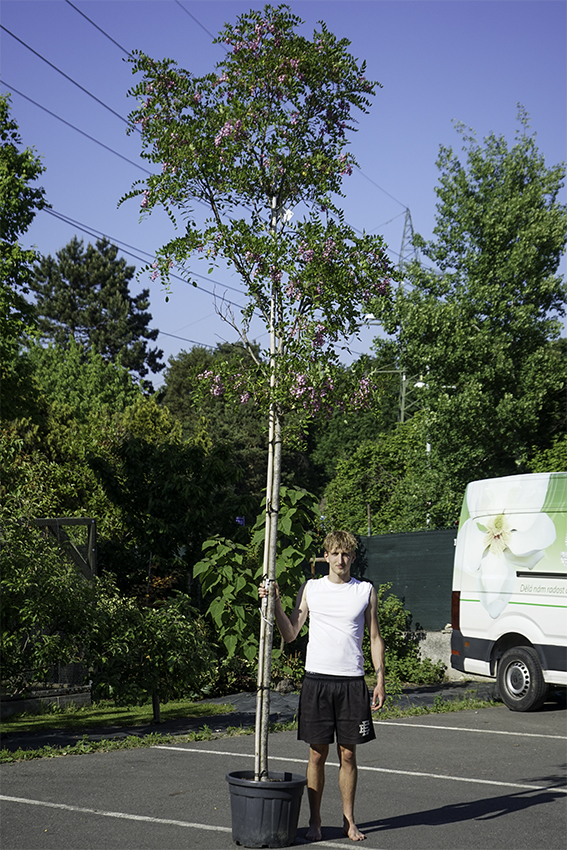
Goods are shipped all over Europe. For Russia and U.K. and for further details please read about SHIPPING OPTIONS HERE.
Are you interested in a serious discount for orders NOV-FEB? Check your options here.
THE PRICES INCLUDE VAT of 15%. For quick conversion you can use 1 CZK = approx. 0.04 EUR
- STANDARD QUALITY - Plants of this group are 1st class quality with number of branches and overall density adequate to their size and age, considering they were container grown.
- DE LUXE QUALITY - This label guarantees a luxurious quality of manually selected plants that, compared to their height and age, are exceptionally dense and beautiful.
- EXTRA - These plants are usually mature and bigger specimens with exceptional overall appearance.
- STANDARD (as described in the plant form) means a tree with a trunk of 190-210 cm and a crown at the top, unless specified differently. The commercial size for trees is their girth measured in the height of 1m from ground.
- HOBBY - These plants are of the same quality as our standard-quality plants but younger and therefore cheaper.
- SHRUB - a woody plant with branches growing bushy from the ground level.
- HALF-STANDARD or MINI-STANDARD - a small tree with shorter trunk, its size is usually specified.
- FEATHERED - These are trees with branches growing already from the base of the trunk and up along the stem.
- GRASSES and PERENNIALS - Sizes given usually read the diameter of the pot or the clump, as specified.
