

































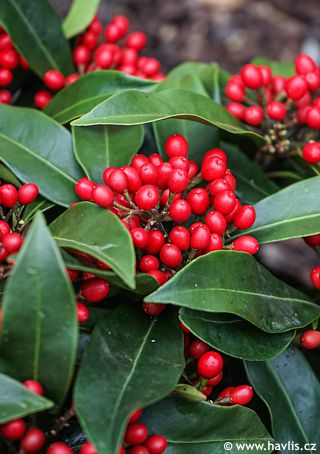
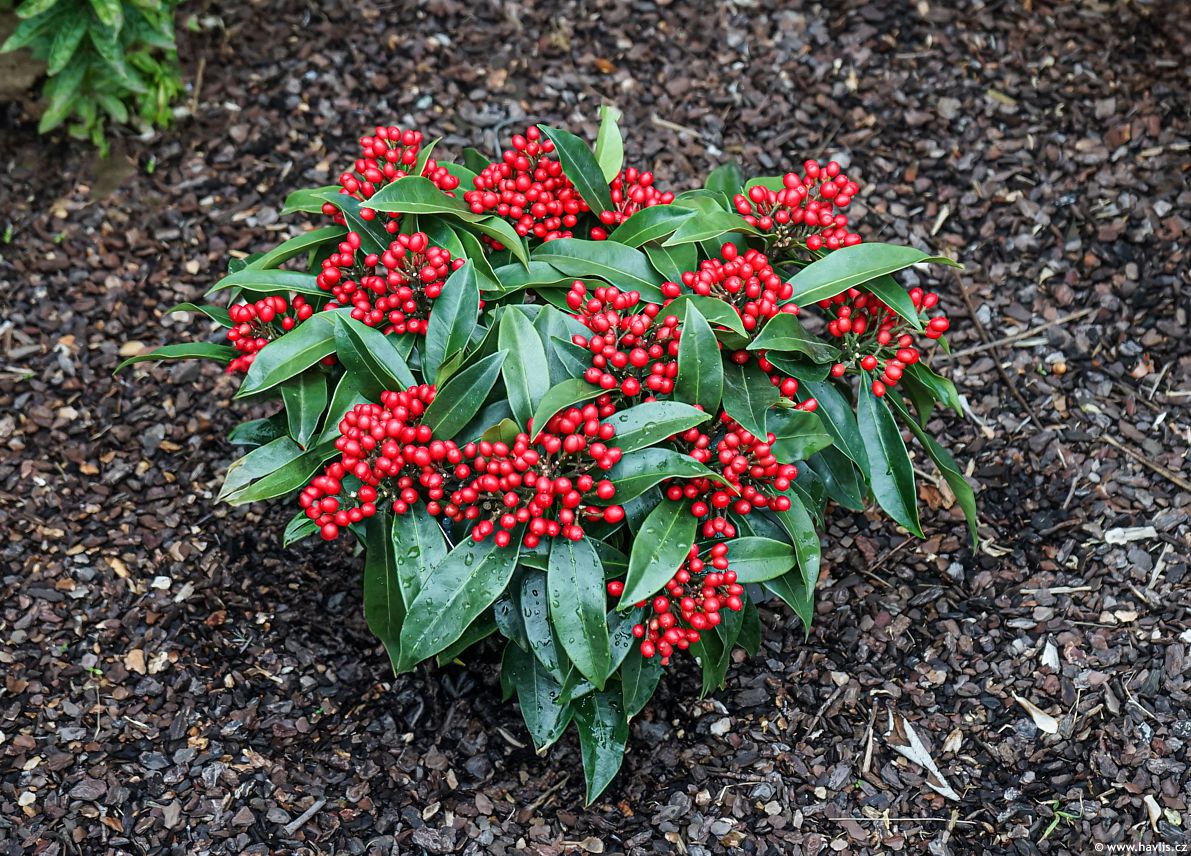
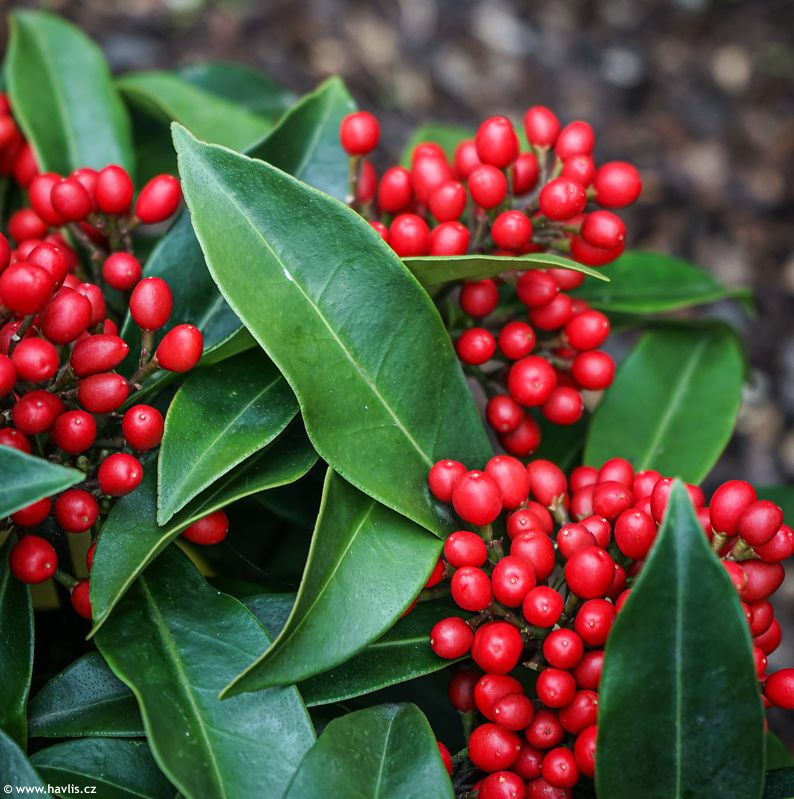
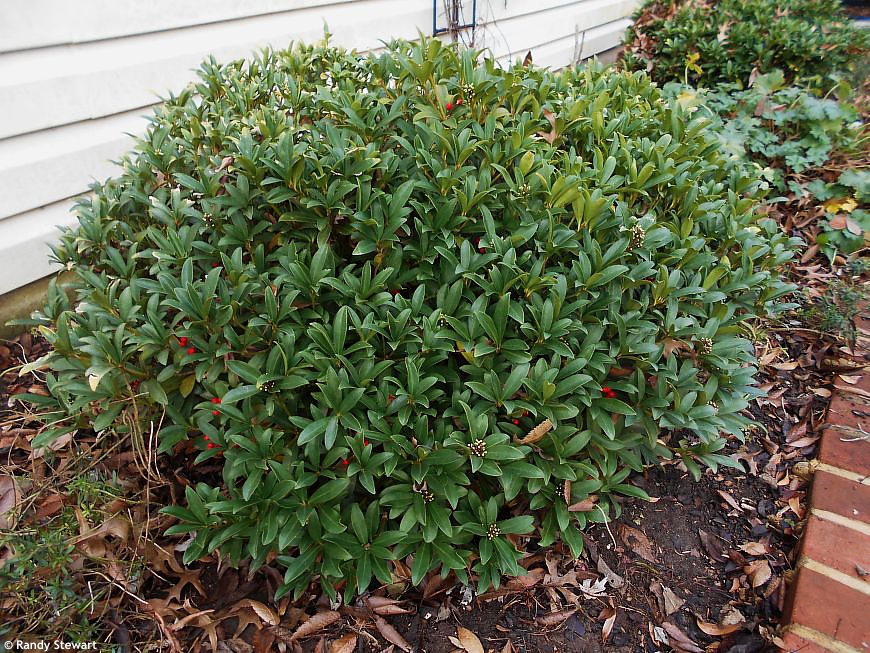
Skimmia japonica ssp. reevesiana Chinese skimmia (female)


 Rhodovit (ericoid)
Skimmia
The genus Skimmia comprises a small number of evergreen shrubs native to East Asia, particularly Japan, Korea, China and the Himalayan region. It belongs to the rue family (Rutaceae), which also includes, perhaps unexpectedly, citrus fruits, a relationship reflected in the structure of the flowers and the gently aromatic foliage. In Europe, skimmias have been known since the late eighteenth century thanks to the Swedish naturalist Carl Peter Thunberg (1743–1828), a pupil of Carl Linnaeus and one of the key figures in the early study of Japanese flora. Thunberg stayed in Japan in 1775–1776 as a physician to the Dutch East India Company and, based on the material he collected there, published his seminal work Flora Japonica in 1784, in which the genus Skimmia and the species Skimmia japonica were scientifically described for the first time. In their natural habitat, skimmias form part of the understorey of mountain forests, growing in partial shade in humus-rich, acidic soils with evenly balanced moisture. These ecological requirements later shaped their use in gardens as evergreen shrubs suited to shaded situations.
The generic name Skimmia is derived from the Japanese vernacular name miyama-shikimi (深山樒), meaning “mountain” or “wild shikimi”. In Japanese usage, the word shikimi on its own refers primarily to Illicium religiosum, an aromatic shrub traditionally associated with Buddhist rituals. The name reflects not only the similarity in leaf shape and scent between the two plants, but also cultural associations with purification, protection and calm that are linked to these aromatic shrubs in Japanese tradition. By adopting this name into scientific nomenclature, Thunberg preserved a direct connection between local usage and botanical description.
Japanese skimmia (Skimmia japonica) represents the key species that first found its way into European gardens. Its natural range includes Japan, the Ryukyu Islands and the Philippines, with forms extending as far north as Sakhalin and the southern Kuriles, and probably also parts of China and Taiwan. In Europe it was already being cultivated in the first half of the nineteenth century, as evidenced by records from the Royal Botanic Gardens, Kew, dating from 1838. Wider horticultural interest, however, followed only after a further introduction from Japan in 1861 by Robert Fortune for the nursery of Standish & Co. An initial wave of enthusiasm culminated in an award for fruiting plants exhibited in 1864, but disappointment soon followed when many distributed plants failed to produce the expected decorative berries. The reason lay not in cultivation errors, but in the biology of the species itself, its dioecious nature, which at the time was understood by very few gardeners. This fact became generally accepted only after Maxwell T. Masters published his study of skimmias in 1889. As a result, skimmia found its place in European gardens less as a showy specimen and more as a bearer of calm. It acts as a quiet, permanent backdrop beneath the canopies of trees and large shrubs, evoking an atmosphere close to the zen concept of the garden, where harmony, balance and endurance matter more than immediate effect.
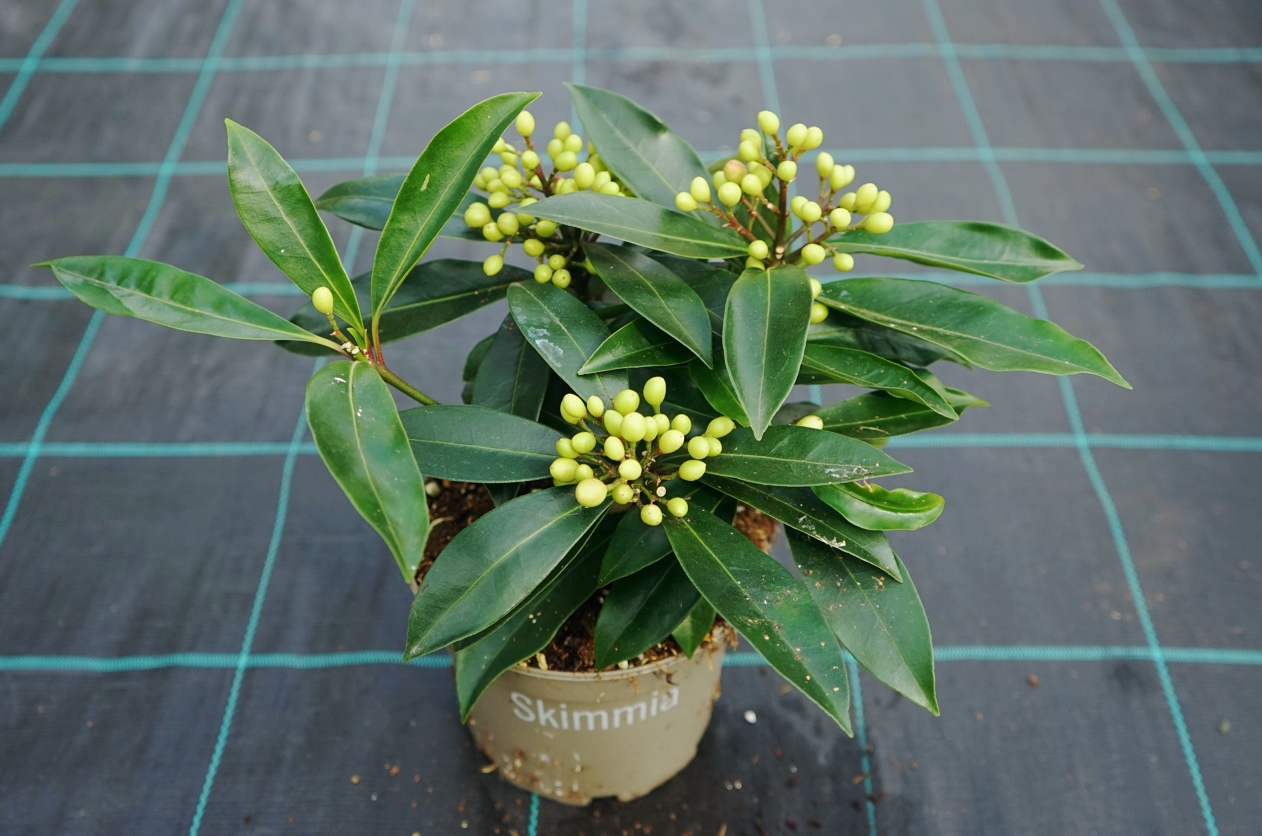
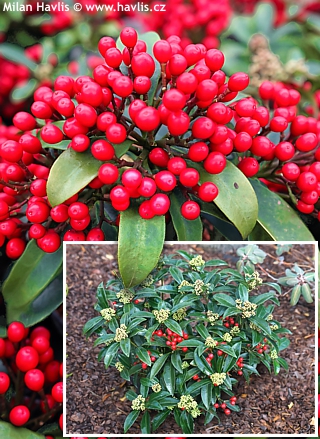
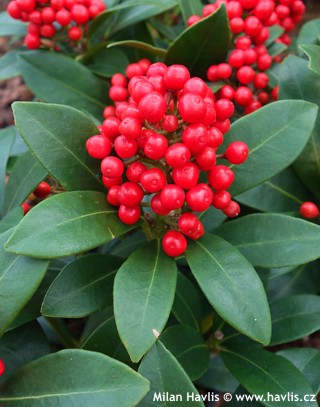
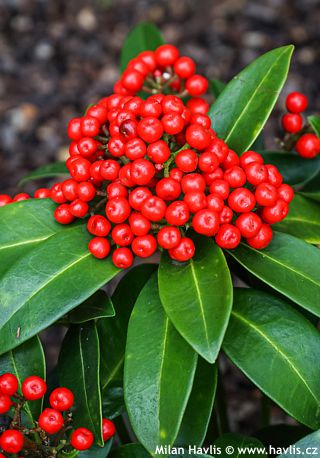
Reevesiana is a sought after subspecies of skimmia. It is a hermaphrodite plant that does not need a male pollinator to produce berries. These are vivid red and are follow tiny, white flowers in the autumn and winter. Evergreen leaves are elongated, elliptic, deep green and glossy. The plant grows slowly, making an attractive ground cover. Ideal for Japanese style gardens.
If you plant it well you needn’t look after it any longer except for occasional watering in dry spells. There are a few rules you have to obey if you want your skimmia look perfect: the soil has to be always moist but extremely well-drained, acidic (add peat) and light (add leaf mould), humus-rich. The best location is dappled shade or even deep shade (shady back of your house or under thick canopies of tall trees). When leaves turn pale or yellow the plant suffers from too much sun or water, or too little nutrients in the soil which should be acidic. Tolerant of atmospheric pollution. The plant is poisonous. Hardy to min. -27°C (USDA zone 5b).
Last update 28-12-2008
Goods are shipped all over Europe. For Russia and U.K. and for further details please read about SHIPPING OPTIONS HERE.
Are you interested in a serious discount for orders NOV-FEB? Check your options here.
THE PRICES INCLUDE VAT of 15%. For quick conversion you can use 1 CZK = approx. 0.04 EUR
- STANDARD QUALITY - Plants of this group are 1st class quality with number of branches and overall density adequate to their size and age, considering they were container grown.
- DE LUXE QUALITY - This label guarantees a luxurious quality of manually selected plants that, compared to their height and age, are exceptionally dense and beautiful.
- EXTRA - These plants are usually mature and bigger specimens with exceptional overall appearance.
- STANDARD (as described in the plant form) means a tree with a trunk of 190-210 cm and a crown at the top, unless specified differently. The commercial size for trees is their girth measured in the height of 1m from ground.
- HOBBY - These plants are of the same quality as our standard-quality plants but younger and therefore cheaper.
- SHRUB - a woody plant with branches growing bushy from the ground level.
- HALF-STANDARD or MINI-STANDARD - a small tree with shorter trunk, its size is usually specified.
- FEATHERED - These are trees with branches growing already from the base of the trunk and up along the stem.
- GRASSES and PERENNIALS - Sizes given usually read the diameter of the pot or the clump, as specified.
