










Viburnum trilobum (Viburnum opulus var. americanum) 'ALFREDO' American highbush cranberry

 Symbivit Tric (arbuscular)
 Symbivit (arbuscular)
Viburnum
The genus Viburnum includes around 150 species distributed across the temperate regions of the Northern Hemisphere, from eastern Asia through the Caucasus and Europe to North and South America. Botanically, it is an exceptionally diverse group: it comprises both deciduous and evergreen shrubs, species with strongly fragrant flowers as well as those with only a faint scent or none at all, and others grown primarily for their (inedible) fruit. This diversity is reflected in common horticultural practice and several informal groups – the fragrant winter viburnums (V. farreri and V. × bodnantense), the fruiting viburnums (V. opulus, V. trilobum), the evergreen Asian viburnums (V. davidii, V. tinus, V. cinnamomifolium), the large-leaved ornamental viburnums (V. plicatum, V. japonicum), and many more, including hybrids that combine traits from several groups. The genus has been known since antiquity, and its Latin name Viburnum appears in the works of Roman authors around the turn of the era, such as Virgil and Pliny the Elder.
American cranberrybush, Viburnum trilobum, is the North American counterpart of our European guelder rose (V. opulus) and for much of its history was regarded as a very close relative. In the wild it ranges from Newfoundland and the Labrador Peninsula through the Great Lakes region to Alberta, Manitoba and the northern United States. It is most often found along forest edges, around lakes and streams, or in the wetter parts of open landscapes, where it forms a conspicuous component of the local vegetation. The species was described by the British botanist William Aiton (1731-1793) in 1789, the specific epithet trilobum referring to the characteristic three-lobed shape of the leaves. Later botanists, however, pointed to its remarkable similarity to the European guelder rose, and many authors began treating it merely as a North American variety. For that reason, the name Viburnum opulus var. americanum is still encountered today, reflecting a more modern interpretation of its relationship. Its fruits were used for centuries by Native Americans and the first European settlers. After exposure to frost they were made into preserves, jellies, sauces and drinks, and their resemblance to cranberries gave the plant one of its best-known common names, American cranberrybush.
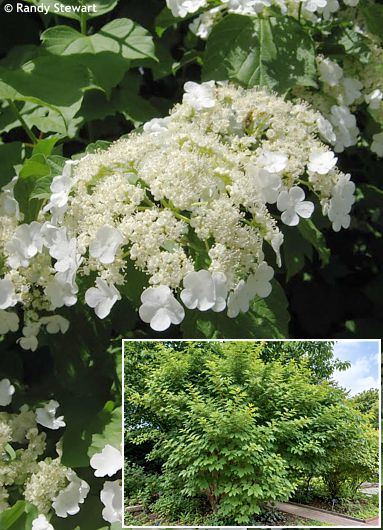
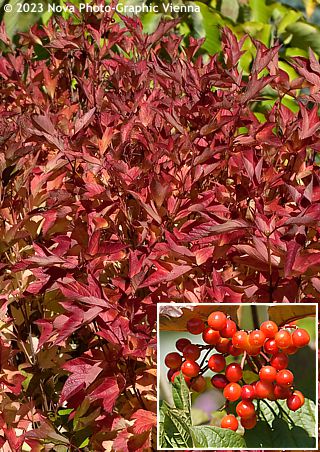
Alfredo is one of the smaller and particularly attractive cultivars of American cranberrybush. It originated in the USA, where Alfredo Garcia selected it at Bailey Nursery in Minnesota from plants distinguished by a denser habit, smaller leaves and outstanding autumn colour, making it suitable even for smaller gardens. It bears attractive deciduous leaves, three-lobed and maple-like with serrated margins, soft green through the growing season and turning brilliant red to burgundy in autumn. They are noticeably smaller than those of the species and fill the shrub beautifully. In late spring, flattened clusters of white flowers appear. The central flowers are small and fertile, while the outer flowers are larger and sterile.
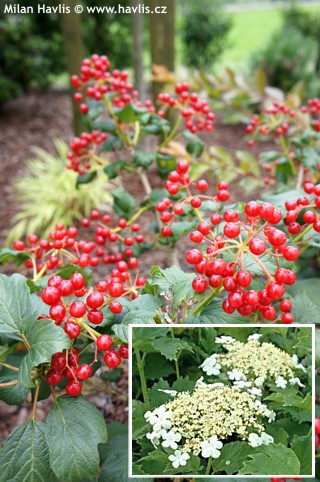
The plant is self-fertile and, towards the end of summer, produces large quantities of glossy, bright red, edible fruits that remain among its greatest ornamental features from late summer well into winter. They are rich in pectin and vitamin C, with a tart, slightly astringent flavour reminiscent of cranberries and much the same culinary uses. Expect fruiting somewhat later, however, as 'Alfredo' tends to flower heavily only when it reaches a more mature age. It grows at a moderate rate of about 30 cm per year and forms dense, well-branched, upright shrubs furnished right down to the ground, so there is no need for companion plants to disguise bare lower stems. It is used as a smaller specimen shrub in compact gardens, in informal hedges and among borders of deciduous shrubs.
Last update 31-01-2023; 22-11-2026
American cranberrybush is an exceptionally hardy, undemanding and long-lived shrub. It performs best in full sun or light partial shade, where it flowers and fruits abundantly and develops its finest autumn colours. It will also tolerate considerably more shade, although flowering and fruiting will be reduced. Although it most commonly occurs in nature around lakes, streams and wetlands, it is surprisingly adaptable in the garden. It appreciates deep, humus-rich soil that does not dry out completely during summer, but once established it also copes with short periods of drought, heavier clay soils and occasional waterlogging. It generally requires no fertiliser. Pruning is rarely necessary, as the plant naturally develops an attractive form. Should size reduction, thinning or rejuvenation be required, the best time is shortly after flowering. Hard annual pruning reduces both flower and fruit production and spoils the plant's natural habit. It is not particularly suitable for long-term container cultivation, as it eventually develops into a substantial shrub with an extensive root system. It tolerates wind, urban conditions, winter road salt and severe frost very well.
The fruits are edible and, after frost or culinary preparation, are traditionally used for making jellies, jams, sauces and drinks. Like other viburnums, it may be affected by viburnum leaf beetle, the principal pest of the genus Viburnum. The species is fully hardy to approximately -40 °C (USDA zone 3) and has no difficulty coping with the winters experienced across much of Canada.