












CURRENTLY IN STOCK:
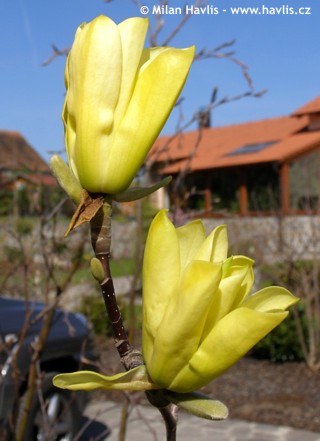
Another unique jewel among magnolias is this yellow flowering hybrid called Butterflies. It is a cross between M. acuminata var. acuminata ‘Fertile Myrtle’ and M. denudata ‘Sawada’s Cream’. It was raised by Phil Savage in Michigan, USA, introduced in 1989 and patented in 1991. Both their colour and ...

IV - V

3 - 5m

3 - 5m

full to partial sun

5 (down to -29°C)

for zone 5+6

for zone 7
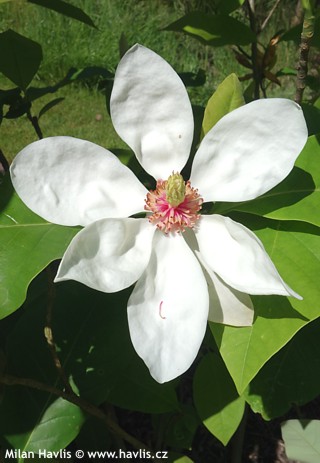
Among deciduous magnolias there are varieties that bloom later than most of the Asian ones. This selection named Charles Coates originated in England in Kew, famous for its Kew Gardens, by crossing m.sieboldii and m.tripetala.It makes leaves first, and only at the end of spring it shows a magnificen ...
V - VI
3 - 5m
1,5 - 2,5m
full to partial sun
5b (down to -27°C)
for zone 5+6
for zone 7
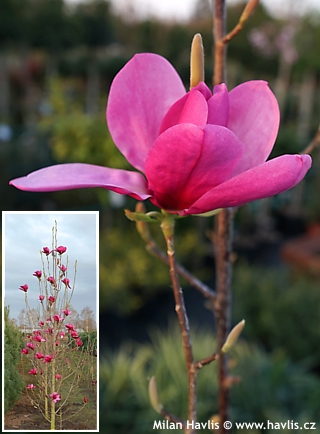
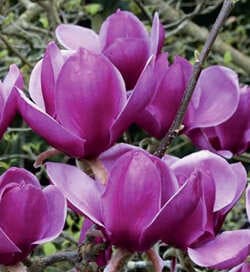
Livingstone magnolia is a cross between m. sprengeri ‘Diva’ and m. ‘Vulcan’. Sprenger’s magnolia is often used in hybridization for flower size and fragrance, and Vulcan was surely chosen for the colour. The result is splendid. A large flower of a vibrant purple red colour and pleasant scent. Bloomi ...
IV - V
4 - 6m
1,5 - 3m
full to partial sun
5b (down to -27°C)
for zone 5+6
for zone 7
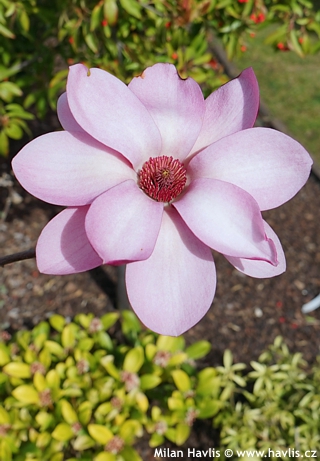
Purple Star magnolia is a modern variety from 2015 from the renowned Belgian breeder Phillippe de Spoleberch, whose perhaps the greatest success, with which he gained fame around the world, is Daphne magnolia, so far considered the best deep yellow available. Purple Star is a cross between m. cylind ...
IV - V
3 - 6m
2 - 3m
full to partial sun
6 (down to -23°C)
for zone 5+6
for zone 7
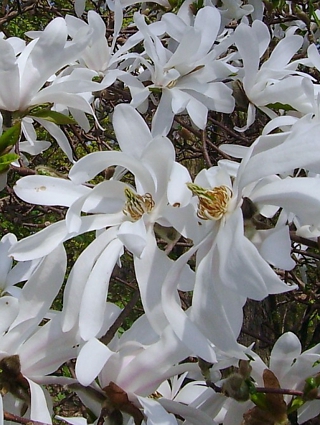
Proctor magnolia is a hybrid of two Japanese magnolia species – m. stellata and m. salicifolia. It is distinguished by early flowering and profusion of star-shaped, white, fragrant flowers, larger than on m. stellata, with less petals but of firmer appearance. Slavin’s Snowy is a selection composed ...
III - IV
6 - 8m
3 - 4m
full to partial sun
5 (down to -29°C)
for zone 5+6
for zone 7
