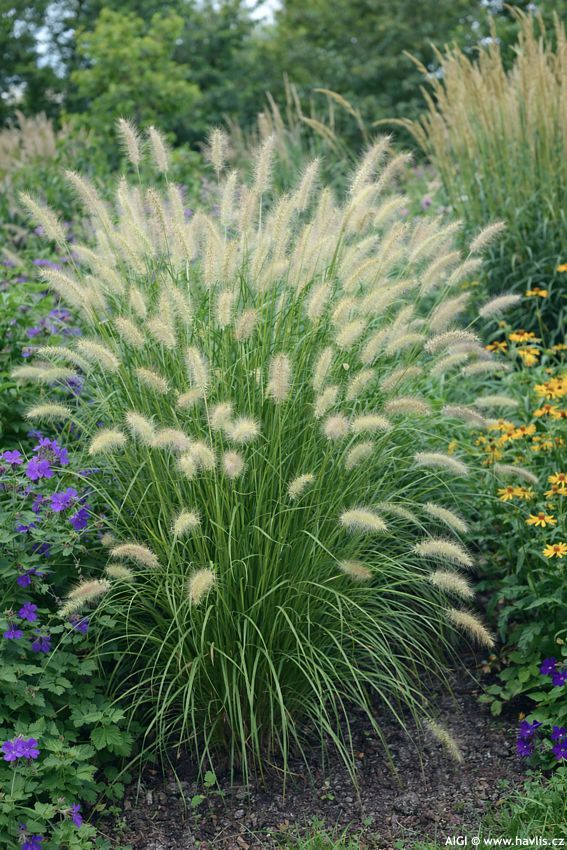
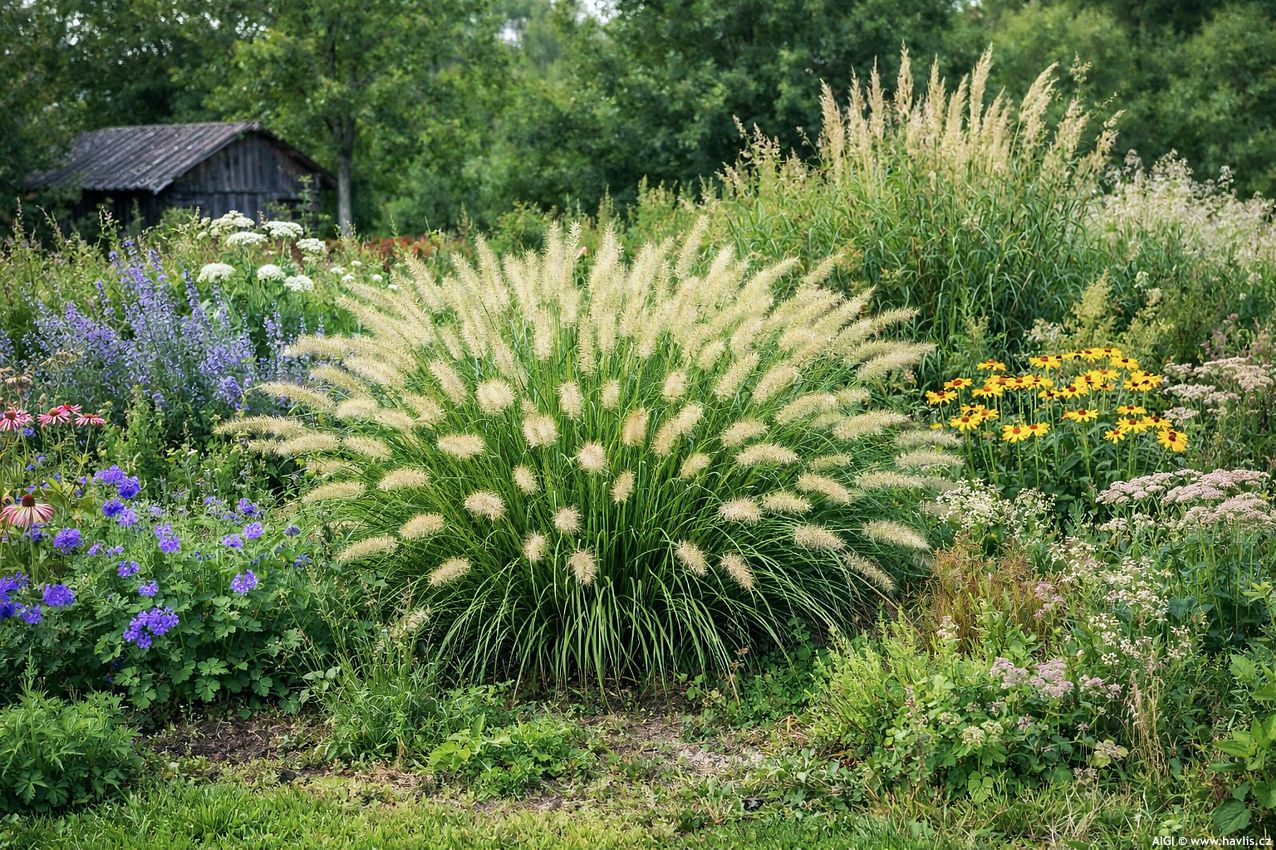
Pennisetum alopecuroides (Cenchrus alopecuroides) Chinese fountain grass

 Symbivit Tric (arbuscular)
 Symbivit (arbuscular)
Pennisetum
The genus Pennisetum, first described in 1812 by the German botanist Johann Heinrich Friedrich Link (1767–1851), was for most of the 19th and 20th centuries understood in a very broad sense and included 80 to 120 species distributed across the tropical and subtropical regions of Africa, Asia and Australia, where they inhabit savannas, river floodplains and the margins of scrub. Its morphological circumscription relied mainly on the characteristic cylindrical inflorescences with dense bristles, which led to the gradual inclusion of species that were similar in appearance but not in true relatedness. As early as the turn of the 19th and 20th centuries, botanists such as Eduard Hackel (1850–1926) pointed out this inconsistency, but it was not until molecular studies at the end of the 20th century that it was demonstrated that the genus is, in fact, a botanical assemblage of superficially similar species lacking a common ancestor, and that most of them rightly belong to the genus Cenchrus, which also has nomenclatural priority dating back to 1753 through the description by Carl Linnaeus. The transfer of species to Cenchrus has now been adopted by major botanical institutions, although the name Pennisetum remains in horticultural use for the sake of stability and long tradition. Fossil evidence for the genus is lacking, but its evolutionary development is associated with the expansion of savanna grasslands in the late Tertiary, when the group adapted to seasonal fluctuations in moisture, intense sunlight and fire disturbance.
Pennisetum (Cenchrus) alopecuroides, Chinese fountain grass, described by the Swedish botanist Carl Peter Thunberg (1743–1828) during his work in Japan, originates from East Asia, where it grows in moist meadows, river floodplains and along the edges of light woodland. It reached Europe in the 19th century together with a new wave of ornamental grasses introduced by botanical gardens as exotic novelties, and it quickly gained popularity thanks to its compact clumps and fine, cylindrical inflorescences, which appeared more refined than many native species. In Asia it also had practical uses, as related species served as fodder or as material for small craftwork, while in Europe it became one of the cornerstones of modern naturalistic plantings, valued for its reliability, longevity and ability to blend visually into the Central European landscape.
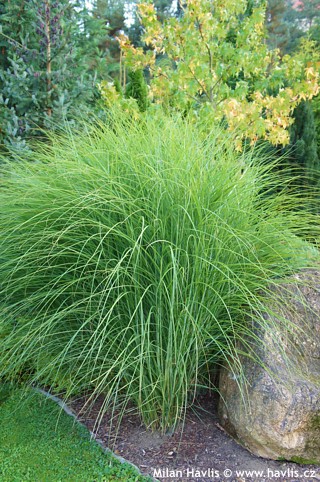
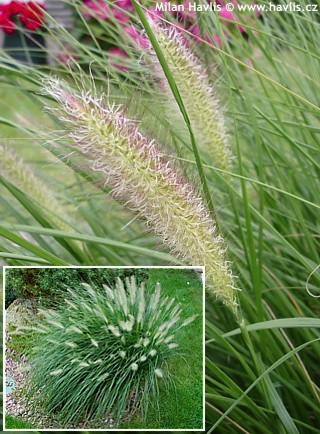
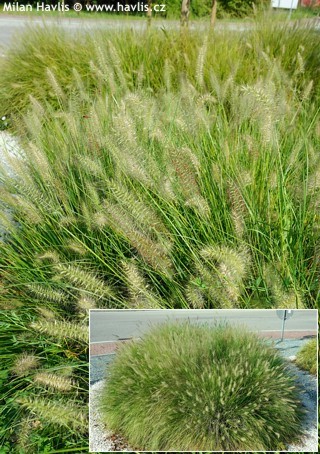
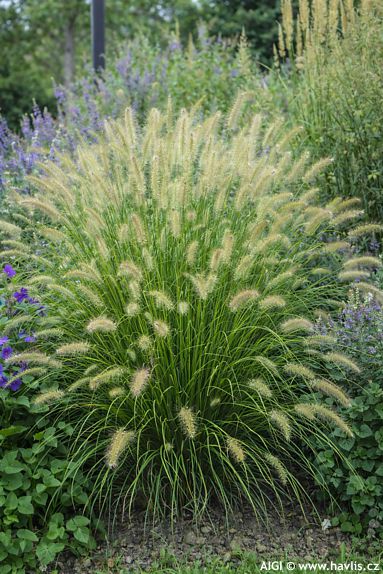
The species of Chinese fountain grass forms regular, dense clumps with gracefully arching leaves that shift in colour through the season from fresh green to warm yellow. The leaves are narrow and fine, moving with a fluid softness that makes the species so effective in garden compositions. In summer, typical cylindrical flower heads appear above the foliage, usually 8 to 15 cm long, made up of tightly packed spikelets with delicate bristles that create the characteristic “foxtail” effect. Their colour ranges from pale green through cream to soft beige, with the anthers adding a fleeting hint of pink or purple. The species is fully clump‑forming, produces no runners and maintains a compact habit that remains stable even in richer soil. At maturity it reaches around 80 to 120 cm in both height and width, and it flowers reliably even in cooler summers. Thanks to this combination of delicacy, regularity and long seasonal performance, it has become one of the most widely used ornamental grasses in contemporary planting design. It is, however, somewhat tender and tolerates frost only down to about –25 to –26 °C (USDA zone 5b-6). For colder regions, its subsequent cultivars are the better choice.
In the garden it excels wherever a planting needs lightness and a natural rhythm without the plant becoming dominant. It works beautifully as a soft backdrop for perennials with a stronger structure, such as Echinacea, upright Hylotelephium or taller Geranium, which visually balance its fine texture. Its clump‑forming nature makes it suitable even for smaller gardens, where it behaves politely and does not overwhelm neighbouring plants. By water it looks natural and effortless, as its arching leaves and soft flower heads echo the grasses of riverbanks. In modern plantings it is often used as a unifying element between shrubs and perennials, linking different textures and heights and giving the composition coherence. In autumn, when the leaves turn yellow and the flower heads take on a warmer tone, it becomes one of the most striking features of the late season and remains decorative well into winter, when the dry inflorescences catch frost and low light.
Last revision: 29‑5‑2007; 7‑8‑2014; 14‑06‑2026
Chinese fountain grasses require a sunny position and well‑drained, rather light soil that does not remain waterlogged for long periods; in heavy clay a drainage layer or planting on a slight mound is essential. They grow best in moderately fertile soils but tolerate poorer conditions provided they receive sufficient light and warmth. Watering is needed only in the first year after planting and during extreme drought; otherwise they are reliably undemanding. Cut them back low to the ground in April, when the risk of severe frost or late snowfall has passed; the old leaves protect the clumps over winter and should not be removed in autumn. Most cultivars are fully hardy, but in exceptionally cold regions a dry winter mulch of conifer branches or a thicker layer of dry leaves is beneficial, though the clumps should never be tied into bundles as is done with taller grasses. It is advisable to divide and rejuvenate the clumps every 4–6 years to maintain their compact form and abundant flowering. Their hardiness generally ranges from –25 to –29 °C, with slight variation between cultivars, so it is always worth checking the description of the individual selection.
Fountain grasses can be grown in containers, but only the compact cultivars such as ‘Hameln’, ‘Hameln Gold’ or ‘Little Bunny’ are suitable. They require a container of at least 30–40 litres, excellent drainage and regular watering in summer, as pots dry out quickly. In winter, the root ball must be protected from freezing from the sides – for example by insulating the container or placing it against a south‑facing wall – otherwise even hardy cultivars may be damaged. On the other hand, summer overheating of containers is not a problem — in fact, the additional warmth benefits the plants and supports strong growth. Larger and more vigorous selections, such as ‘Moudry’ or ‘Black Beauty’, are not suitable for container culture, as they outgrow the available space and suffer from overheating and rapid drying of the roots.