











Hakonechloa macra 'ALL GOLD' Hakone grass, Japanese forest grass

 Symbivit Tric (arbuscular)
 Symbivit (arbuscular)
Hakonechloa
The genus Hakonechloa is something of a botanical rarity. Rather than being one of many genera of ornamental grasses, it is a monotypic genus represented by a single species. It was established on the work of Japanese botanist Tomitarō Makino (1862–1957), often referred to as the "father of Japanese botany", while the valid genus name was formally published by Masaji Honda (1890–1981) in 1930. The name refers to the Hakone mountain region of central Japan, where the plant grows naturally on moist woodland slopes and rocky habitats. Its taxonomic history has been somewhat turbulent. It was once placed in the genus Phragmites among the reeds because early European botanists considered some of its characteristics similar to those of marsh grasses. Only later studies revealed that it represents a distinct evolutionary lineage within the tribe Molineae. Hakonechloa is a Japanese endemic and, although it is cultivated throughout much of the world, its natural distribution remains confined entirely to the Japanese islands.
In Japan, the species is known as Uraha-gusa (ウラハグサ, 裏葉草), meaning "grass of the turned leaves", a reference to the gently twisted blades that often reveal their undersides. For centuries it has been valued primarily for its graceful movement in the wind. Unlike most grasses, which we associate with sunshine and open landscapes, this species chose life in the dappled shade of woodland. That single characteristic made it something of a revolution among ornamental grasses. Gardeners suddenly gained a type of grass capable of brightening shaded areas much as hostas or ferns do, yet offering an entirely different texture and sense of movement. In Japanese gardens it has long been used to soften stonework, water features and path edges. In contemporary landscape design across the world, it has become one of the most respected grasses for (semi)shaded positions, combining the appearance of a miniature bamboo with an unusual ability to thrive where many ornamental grasses struggle over the long term.
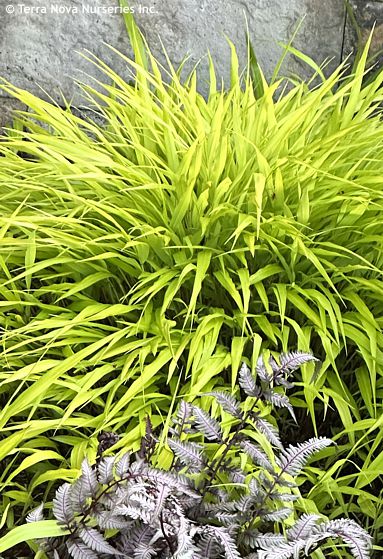
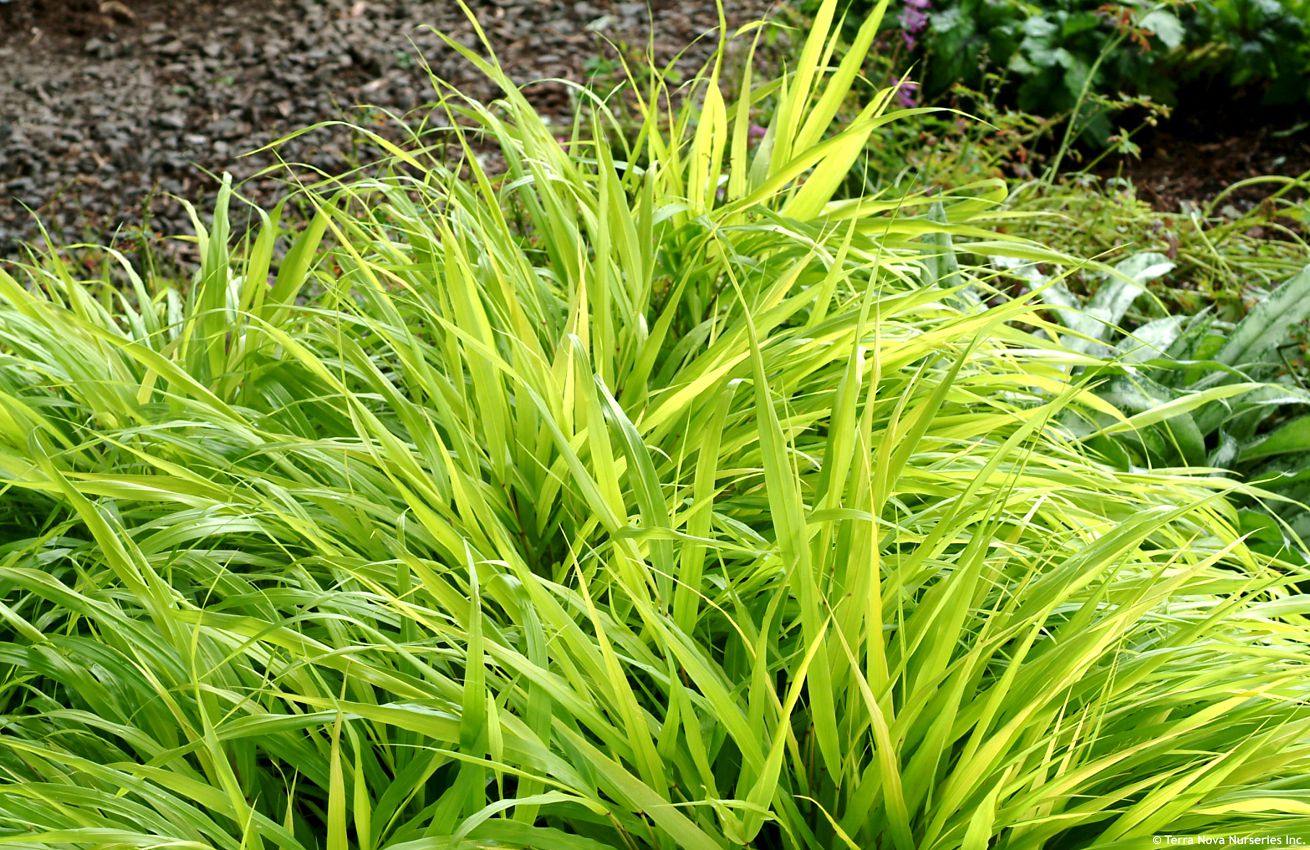
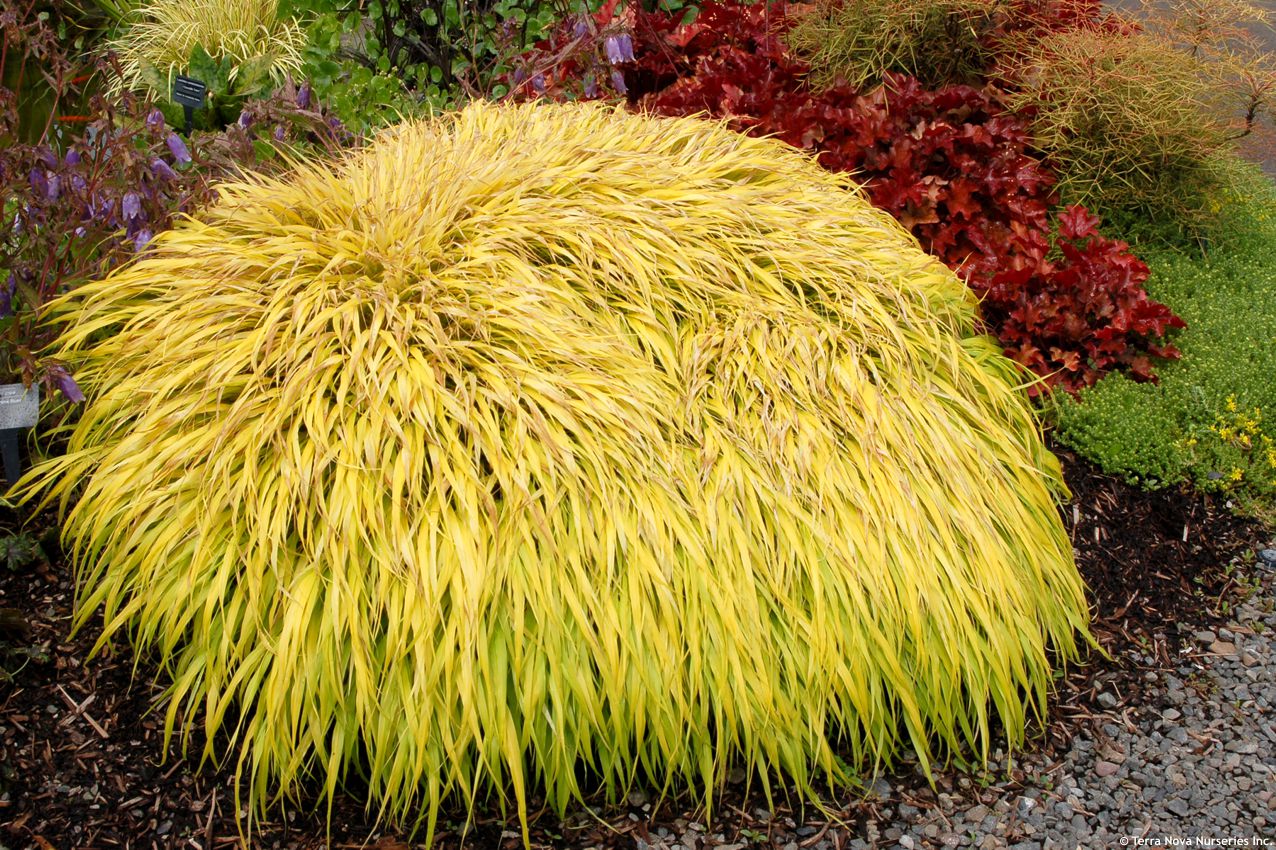
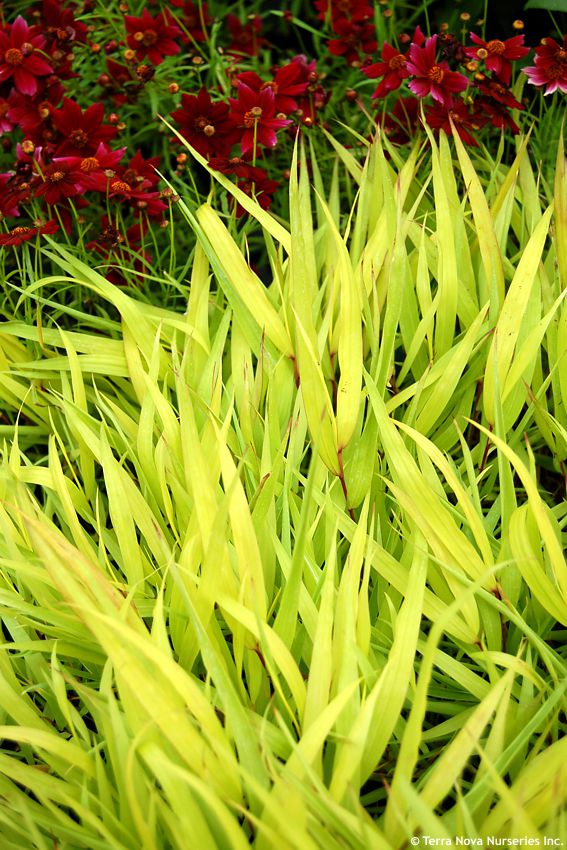
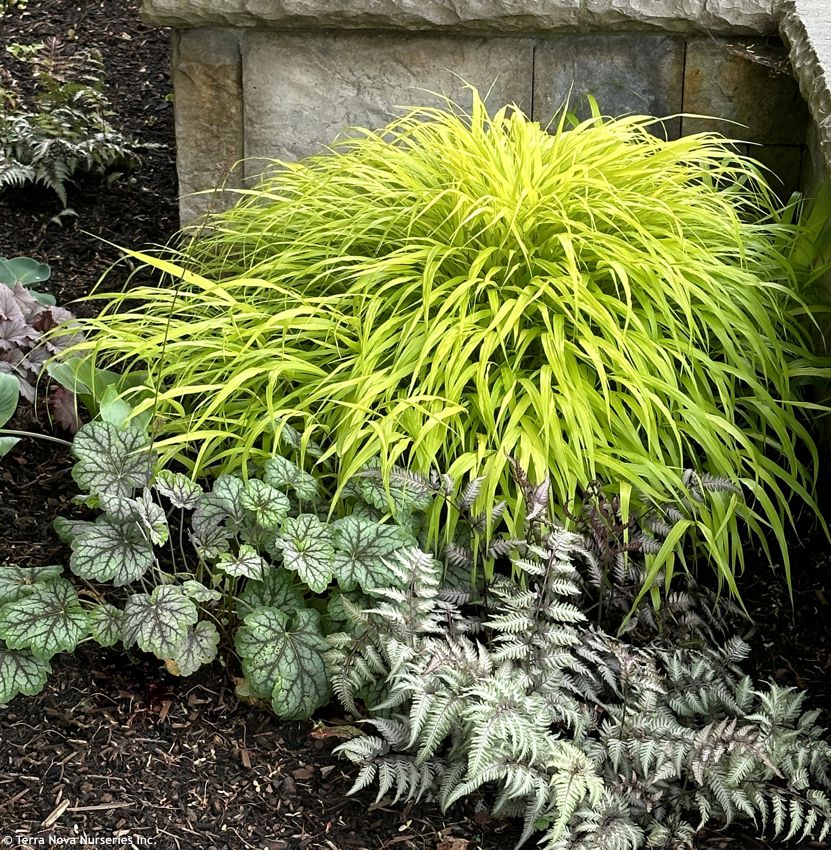
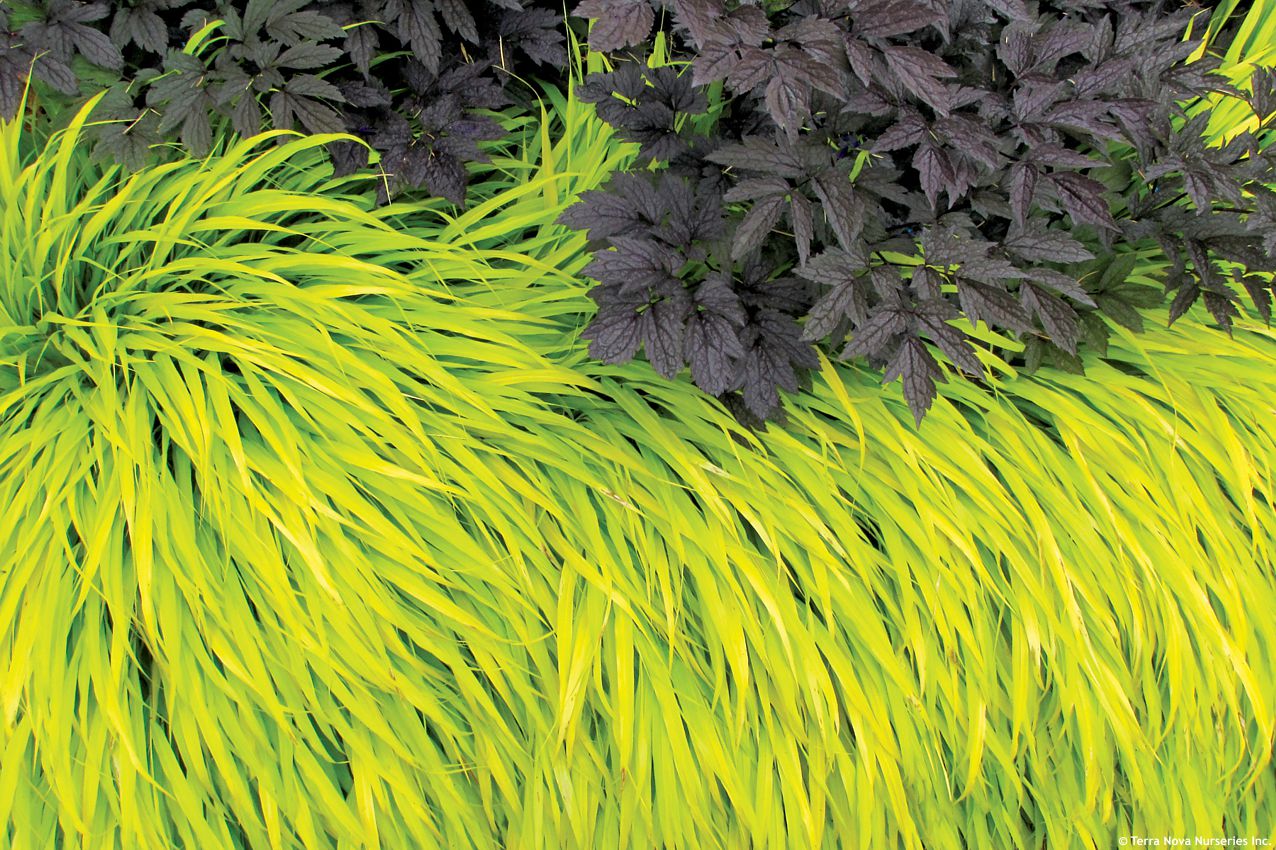
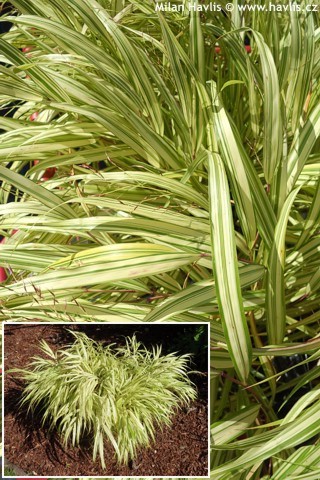
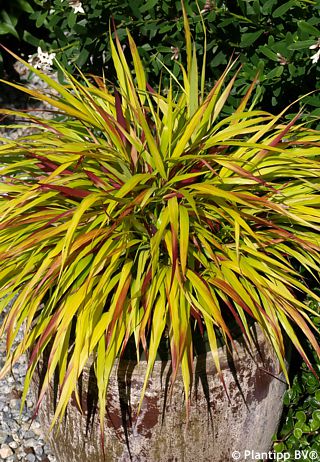
All Gold is a brightly coloured selection of Japanese forest grass, forming soft, cascading mounds with a characteristic, water‑like movement of its foliage. The leaves are narrow and silky, with a vivid lemon‑yellow to chartreuse colour that shifts gently through the season: brightest in spring, deepening into a warmer gold in summer, and turning a soft straw shade in autumn. In partial shade it keeps its cleanest colour, while full sun may lighten it slightly or bring a faint lime tint. It typically reaches 35–45 cm in height and 50–60 cm in width. Growth is slow but steady; the clump gradually expands into an elegant, low cushion that acts as a source of light and colour in darker planting schemes. The flowers are discreet, appearing in late summer as small, lightly drooping panicles that add texture rather than altering the plant’s overall expression.
It is used mainly as a colourful underplanting beneath larger shrubs, such as Japanese maples, multi‑stem birches, smoke bushes or other species with an open lower branch structure. Its bamboo‑like appearance makes it a welcome companion in Japanese gardens, where it complements tightly clipped box and Japanese azaleas, and near stone “streams” it evokes the effect of falling water. It also performs beautifully in containers, where its arching foliage creates a soft, trailing edge. It looks natural on slopes or among rocks, and thanks to its slow spread it requires very little intervention.
Last update: 30-09-2026
Japanese forest grass thrives in humus-rich, evenly moist yet well-drained soils. It performs best in partial shade, although it tolerates deeper shade and will also grow in sunnier positions provided sufficient moisture is available. Old foliage should be removed in late winter or very early spring before new shoots emerge. The plant suffers from few significant pests or diseases, adapts well to container cultivation provided the compost never dries out completely, and is not known to be poisonous. Extreme cold is rarely a problem, although prolonged winter wet and repeated freeze-thaw cycles may cause more damage than low temperatures alone. It is hardy to approximately -29 °C (USDA zone 5).
Most horticultural references describe Japanese forest grass as a slow-spreading, non-invasive species. Our experience has been somewhat different. In ordinary borders without landscape fabric, it forms gradually widening clumps and behaves exactly as expected. However, when confined to small planting holes cut into weed-control fabric, it may eventually produce surprisingly long underground rhizomes. We have repeatedly found new shoots emerging as far as two metres from the original plant. The young shoots are so fine and sharply pointed that they can penetrate non-woven landscape fabric with little difficulty, simply piercing through it. Although this behaviour cannot truly be described as invasive in strict sense, we strongly recommend allowing the plant more space than is commonly suggested whenever landscape fabrics are used.

Goods are shipped all over Europe. For Russia and U.K. and for further details please read about SHIPPING OPTIONS HERE.
Are you interested in a serious discount for orders NOV-FEB? Check your options here.
THE PRICES INCLUDE VAT of 15%. For quick conversion you can use 1 CZK = approx. 0.04 EUR
- STANDARD QUALITY - Plants of this group are 1st class quality with number of branches and overall density adequate to their size and age, considering they were container grown.
- DE LUXE QUALITY - This label guarantees a luxurious quality of manually selected plants that, compared to their height and age, are exceptionally dense and beautiful.
- EXTRA - These plants are usually mature and bigger specimens with exceptional overall appearance.
- STANDARD (as described in the plant form) means a tree with a trunk of 190-210 cm and a crown at the top, unless specified differently. The commercial size for trees is their girth measured in the height of 1m from ground.
- HOBBY - These plants are of the same quality as our standard-quality plants but younger and therefore cheaper.
- SHRUB - a woody plant with branches growing bushy from the ground level.
- HALF-STANDARD or MINI-STANDARD - a small tree with shorter trunk, its size is usually specified.
- FEATHERED - These are trees with branches growing already from the base of the trunk and up along the stem.
- GRASSES and PERENNIALS - Sizes given usually read the diameter of the pot or the clump, as specified.
