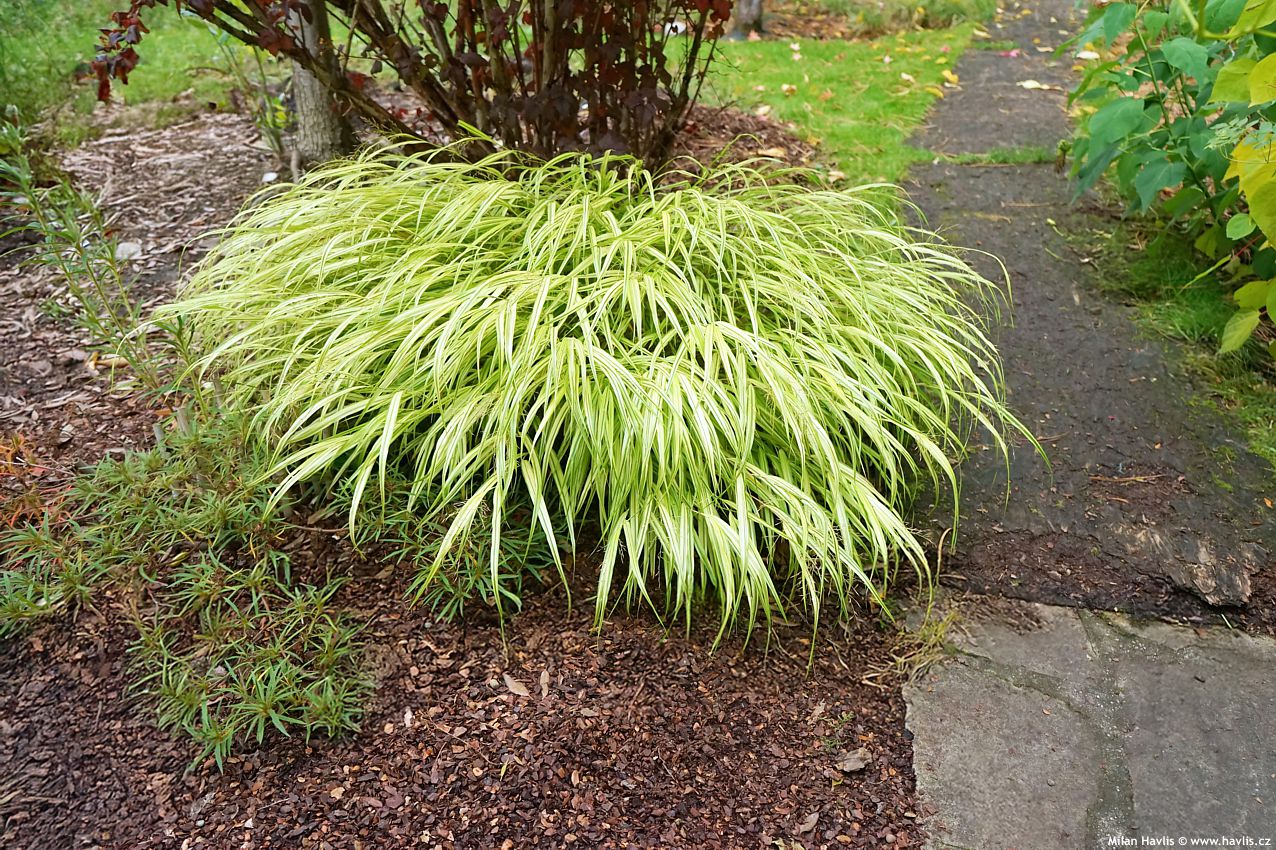
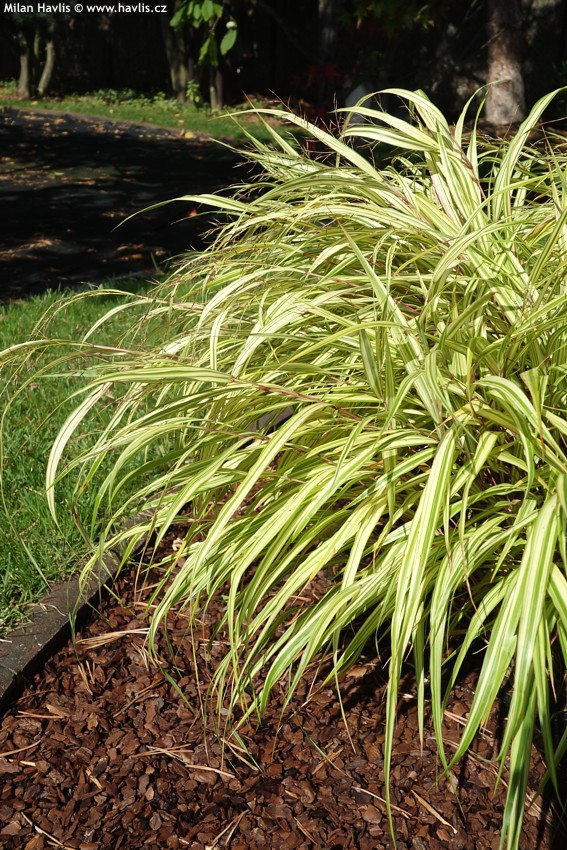
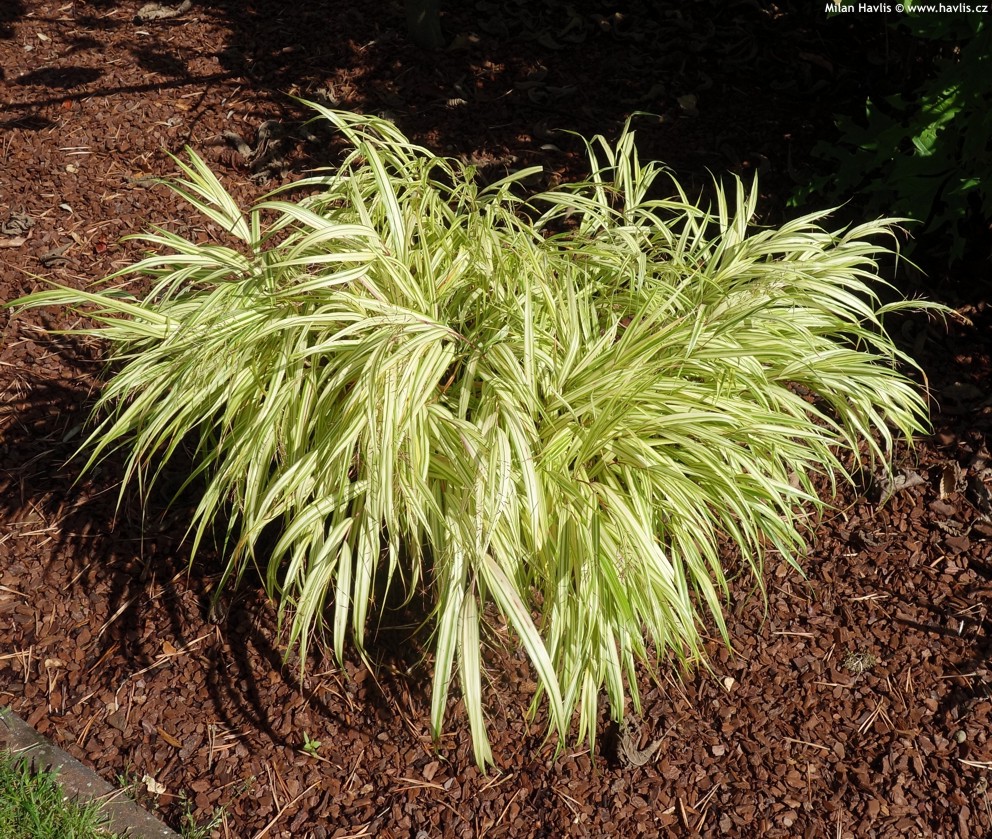
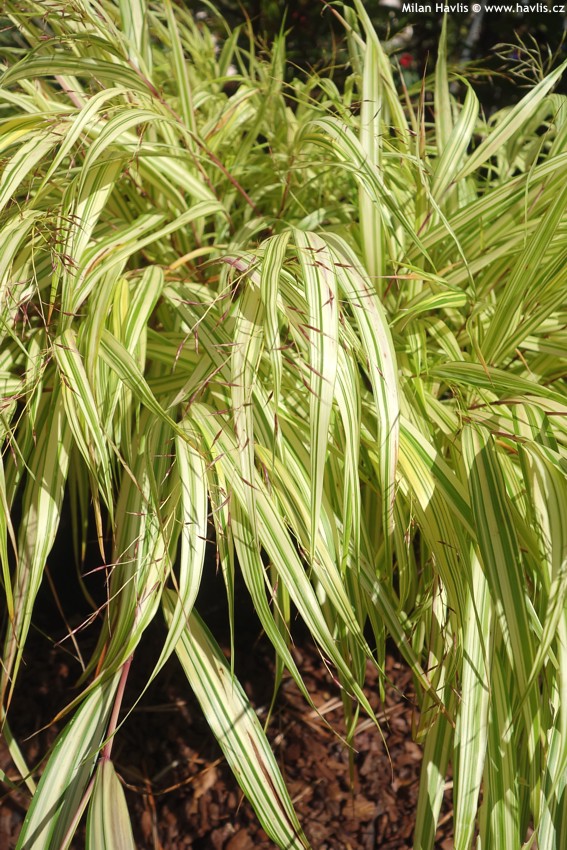
Hakonechloa macra 'AUREOLA' Hakone grass, Japanese forest grass

 Symbivit Tric (arbuscular)
 Symbivit (arbuscular)
Hakonechloa
The genus Hakonechloa is something of a botanical rarity. Rather than being one of many genera of ornamental grasses, it is a monotypic genus represented by a single species. It was established on the work of Japanese botanist Tomitarō Makino (1862–1957), often referred to as the "father of Japanese botany", while the valid genus name was formally published by Masaji Honda (1890–1981) in 1930. The name refers to the Hakone mountain region of central Japan, where the plant grows naturally on moist woodland slopes and rocky habitats. Its taxonomic history has been somewhat turbulent. It was once placed in the genus Phragmites among the reeds because early European botanists considered some of its characteristics similar to those of marsh grasses. Only later studies revealed that it represents a distinct evolutionary lineage within the tribe Molineae. Hakonechloa is a Japanese endemic and, although it is cultivated throughout much of the world, its natural distribution remains confined entirely to the Japanese islands.
In Japan, the species is known as Uraha-gusa (ウラハグサ, 裏葉草), meaning "grass of the turned leaves", a reference to the gently twisted blades that often reveal their undersides. For centuries it has been valued primarily for its graceful movement in the wind. Unlike most grasses, which we associate with sunshine and open landscapes, this species chose life in the dappled shade of woodland. That single characteristic made it something of a revolution among ornamental grasses. Gardeners suddenly gained a type of grass capable of brightening shaded areas much as hostas or ferns do, yet offering an entirely different texture and sense of movement. In Japanese gardens it has long been used to soften stonework, water features and path edges. In contemporary landscape design across the world, it has become one of the most respected grasses for (semi)shaded positions, combining the appearance of a miniature bamboo with an unusual ability to thrive where many ornamental grasses struggle over the long term.
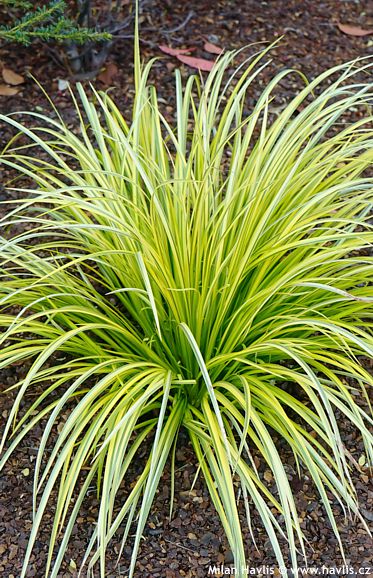
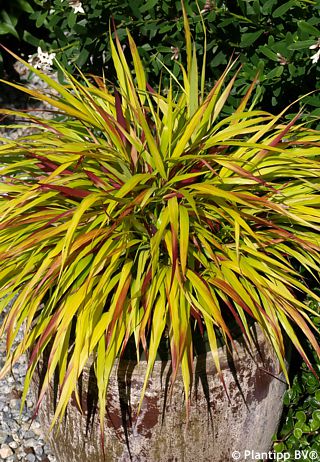
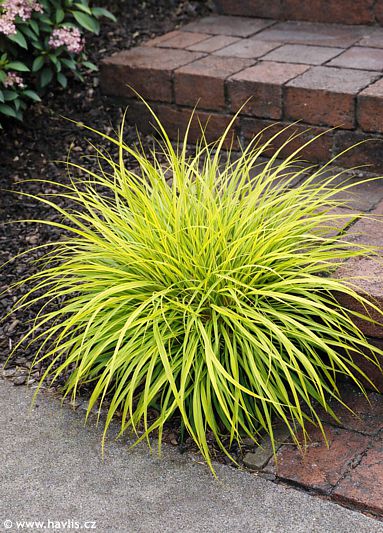
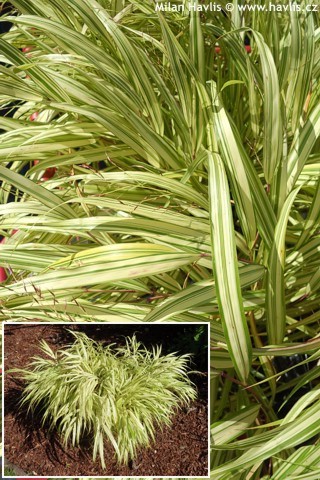
Aureola is a distinct hakone grass variety with variegated foliage. Its leaves have narrow stripes of banana yellow, pale green, and light butter yellow colour. They are only about one centimeter wide leaves and grow from slender, partly arching, pink flushed stems, reaching 30 to 60 cm height with age. In midsummer appear tan coloured, airy panicles composed of small flowers in terminal panicles, and last almost 2 months. In autumn leaves turn fantastic shades of pink and purple red. Tufts of this hakone grass will look great among dark green plants of different texture. Being similar to dwarf bamboos it is often used in Japanese style landscapes, and it is beautiful at ponds and around stones.
Though it is a spreading plant it does not spread too fast and for the best result it is suggested to use more (three) young plants for one square meter. Undesirable spreading can be controlled by heavy mulching foil placed above the areas where it should not grow.
Last update: 14-10-2018
Japanese forest grass thrives in humus-rich, evenly moist yet well-drained soils. It performs best in partial shade, although it tolerates deeper shade and will also grow in sunnier positions provided sufficient moisture is available. Old foliage should be removed in late winter or very early spring before new shoots emerge. The plant suffers from few significant pests or diseases, adapts well to container cultivation provided the compost never dries out completely, and is not known to be poisonous. Extreme cold is rarely a problem, although prolonged winter wet and repeated freeze-thaw cycles may cause more damage than low temperatures alone. It is hardy to approximately -29 °C (USDA zone 5).
Most horticultural references describe Japanese forest grass as a slow-spreading, non-invasive species. Our experience has been somewhat different. In ordinary borders without landscape fabric, it forms gradually widening clumps and behaves exactly as expected. However, when confined to small planting holes cut into weed-control fabric, it may eventually produce surprisingly long underground rhizomes. We have repeatedly found new shoots emerging as far as two metres from the original plant. The young shoots are so fine and sharply pointed that they can penetrate non-woven landscape fabric with little difficulty, simply piercing through it. Although this behaviour cannot truly be described as invasive in strict sense, we strongly recommend allowing the plant more space than is commonly suggested whenever landscape fabrics are used.