Hakonechloa macra 'Habsf1007' SUNFLARE™ Hakone grass, Japanese forest grass

 Symbivit Tric (arbuscular)
 Symbivit (arbuscular)
Hakonechloa
The genus Hakonechloa is something of a botanical rarity. Rather than being one of many genera of ornamental grasses, it is a monotypic genus represented by a single species. It was established on the work of Japanese botanist Tomitarō Makino (1862–1957), often referred to as the "father of Japanese botany", while the valid genus name was formally published by Masaji Honda (1890–1981) in 1930. The name refers to the Hakone mountain region of central Japan, where the plant grows naturally on moist woodland slopes and rocky habitats. Its taxonomic history has been somewhat turbulent. It was once placed in the genus Phragmites among the reeds because early European botanists considered some of its characteristics similar to those of marsh grasses. Only later studies revealed that it represents a distinct evolutionary lineage within the tribe Molineae. Hakonechloa is a Japanese endemic and, although it is cultivated throughout much of the world, its natural distribution remains confined entirely to the Japanese islands.
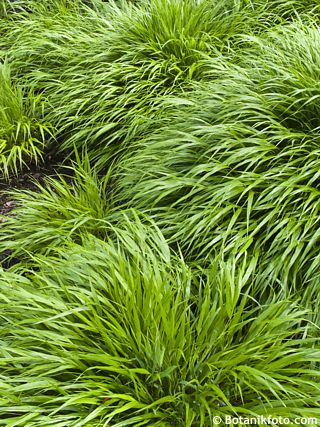
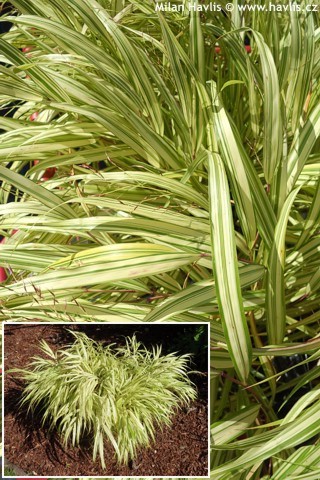
In Japan, the species is known as Uraha-gusa (ウラハグサ, 裏葉草), meaning "grass of the turned leaves", a reference to the gently twisted blades that often reveal their undersides. For centuries it has been valued primarily for its graceful movement in the wind. Unlike most grasses, which we associate with sunshine and open landscapes, this species chose life in the dappled shade of woodland. That single characteristic made it something of a revolution among ornamental grasses. Gardeners suddenly gained a type of grass capable of brightening shaded areas much as hostas or ferns do, yet offering an entirely different texture and sense of movement. In Japanese gardens it has long been used to soften stonework, water features and path edges. In contemporary landscape design across the world, it has become one of the most respected grasses for (semi)shaded positions, combining the appearance of a miniature bamboo with an unusual ability to thrive where many ornamental grasses struggle over the long term.
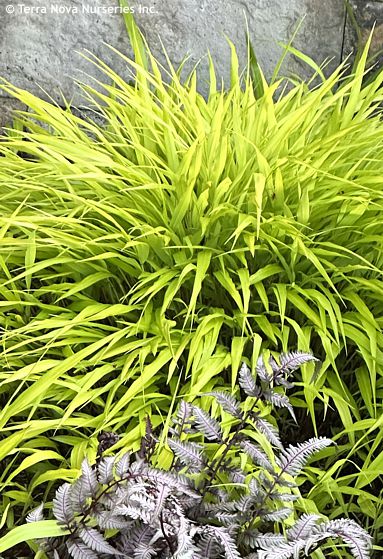
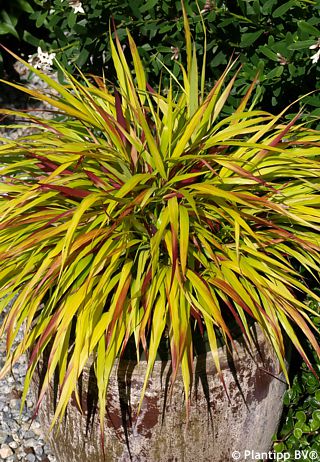
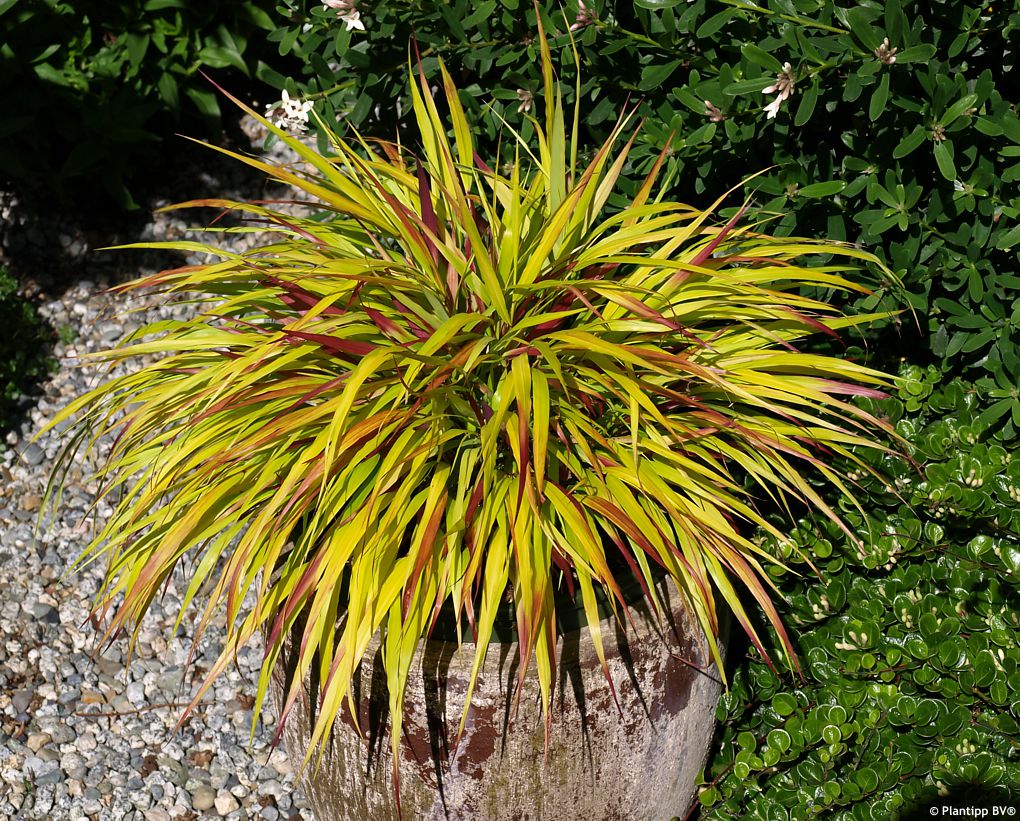
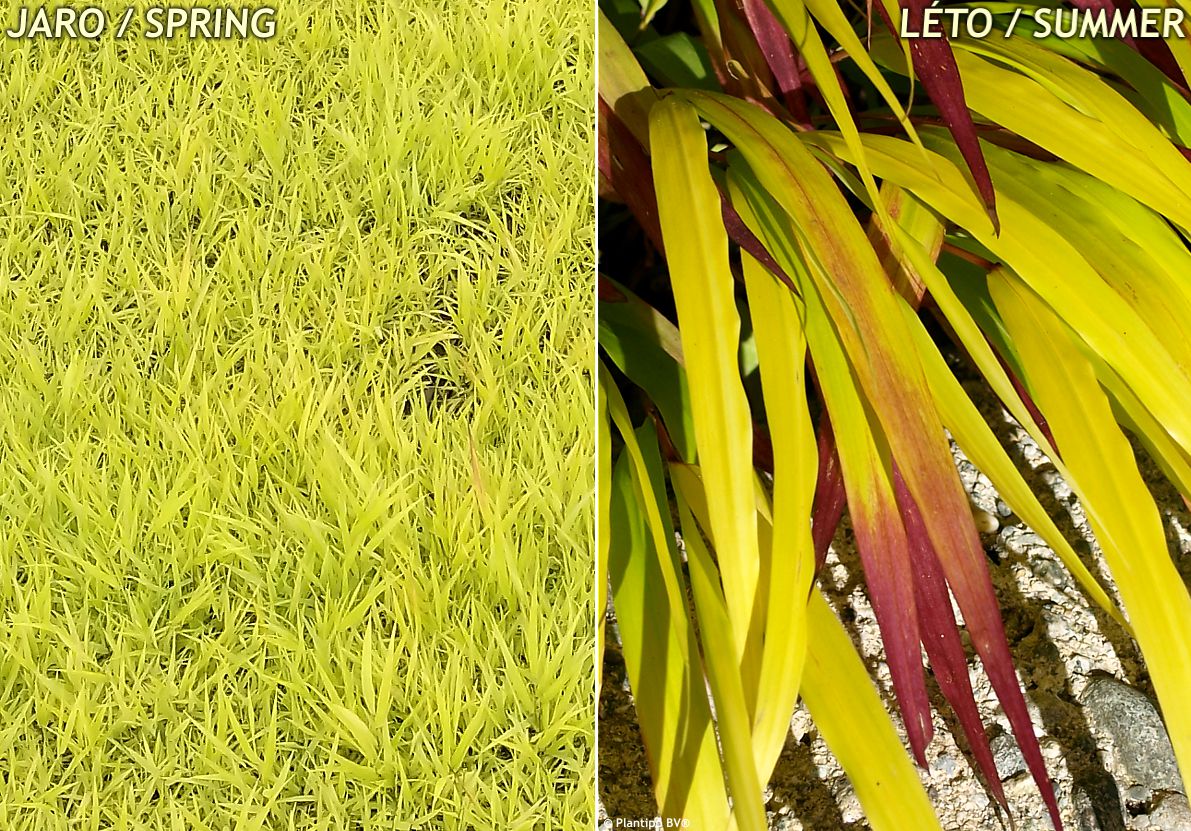
SUNFLARE™ is a 2016 variety of Hakone grass, whose name, as a synonym for solar flare, suggests something vivid and striking. How true. It is a deciduous grass that in early spring floods your garden with thin, about 1 cm wide, soft leaves of the brightest chartreuse colour, which gradually matures to golden yellow with the arrival of hot summer days, highlighted by deep burgundy-red flames here and there at the tips of the leaves. The plant grows to a height of 30 to 40 cm and the leaves gracefully arch to the sides, giving the clump a pleasantly relaxed, groomed appearance. It blooms from mid-summer atop thin stems in delicate panicles that hang down like the leaves. From a distance, they are not very conspicuous, but up close you can see an interesting combination of bronze and pink colors.
It is mainly used as a colorful undergrowth for large shrubs, such as Japanese maples, multi-stemmed birches, golden rain trees, or similar species with exposed lower branches. Due to its similarity to bamboos, it is a welcome companion in Japanese gardens, where it complements the neatly trimmed boxwoods and Japanese azaleas, and near dry riverbeds where it evokes the effect of falling water.
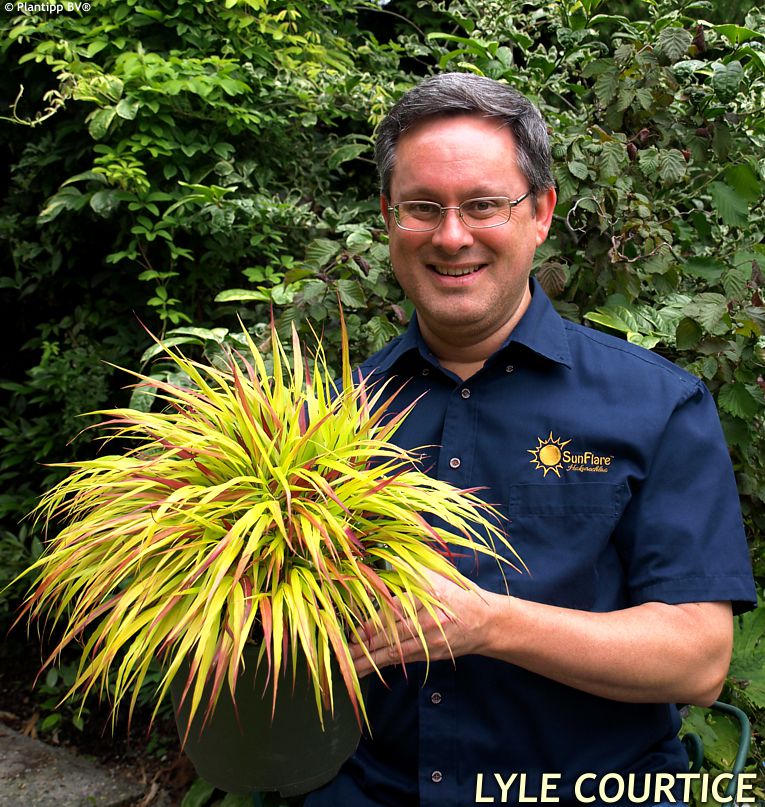
SUNFLARE™ variety of Hakonechloa macra was found as a spontaneous mutation of the All Gold variety in 2010 by Canadian avid collector and grower of rare plants Lyle Courtice. He is known for his meticulousness and thoroughness when it comes to adhering to precise procedures in propagating his unique plants, for which he often travels far away to the mountains of Japan and China. He owns HarkAway Botanicals in the province of British Columbia, and the name of his company reflects the nature of its very owner because the old English word "hark" in conjunction with "away" means "to listen attentively" or "to perceive carefully," which is exactly what he does on his expeditions – he perceives the wild nature and carefully observes everything around him so as not to miss any interesting plants, which he is happy to share with us.
Last update: 03-01-2025
Japanese forest grass thrives in humus-rich, evenly moist yet well-drained soils. It performs best in partial shade, although it tolerates deeper shade and will also grow in sunnier positions provided sufficient moisture is available. Old foliage should be removed in late winter or very early spring before new shoots emerge. The plant suffers from few significant pests or diseases, adapts well to container cultivation provided the compost never dries out completely, and is not known to be poisonous. Extreme cold is rarely a problem, although prolonged winter wet and repeated freeze-thaw cycles may cause more damage than low temperatures alone. It is hardy to approximately -29 °C (USDA zone 5).
Most horticultural references describe Japanese forest grass as a slow-spreading, non-invasive species. Our experience has been somewhat different. In ordinary borders without landscape fabric, it forms gradually widening clumps and behaves exactly as expected. However, when confined to small planting holes cut into weed-control fabric, it may eventually produce surprisingly long underground rhizomes. We have repeatedly found new shoots emerging as far as two metres from the original plant. The young shoots are so fine and sharply pointed that they can penetrate non-woven landscape fabric with little difficulty, simply piercing through it. Although this behaviour cannot truly be described as invasive in strict sense, we strongly recommend allowing the plant more space than is commonly suggested whenever landscape fabrics are used.