












.jpg)
Prunus serrula Tibetan cherry, Birchbark cherry

 Symbivit Tric (arbuscular)
 Symbivit (arbuscular)
Prunus
The genus Prunus is one of the largest genera in the rose family and includes hundreds of species distributed across the Northern Hemisphere. It contains not only fruit trees such as cherries, plums and apricots, but also ornamental trees that have become symbols of spring. There are evergreen species and forms that perform well in Central European gardens, either as specimen trees or as hedging plants. The first fossil records of prunus trees date back to the Tertiary period and show that the genus was widespread long before the rise of present-day cultures. Ancient civilisations knew mainly the fruiting species, but the Greeks and Romans also noticed the ornamental value of cherries, whose spring flowering was one of the most reliable signs of the new season, as described by Pliny the Elder (AD 23–79) in his Naturalis historia. Modern botany began to organise the genus in the 18th century, when Carl Linnaeus placed Prunus in the rose family in 1754. Since then, the taxonomy of ornamental prunus trees has changed several times. The ornamental group includes species such as P. serrulata, P. yedoensis, P. subhirtella, P. incisa, P. campanulata, P. sargentii, P. maackii, P. serrula, P. × blireana and the European bird cherry P. padus. Each has a different origin, from Japan and Korea through northern China to Tibet and even Europe, but all share a strong cultural connection with people. This is most evident in the so-called sakura, the Japanese term for ornamental cherries, especially species and hybrids related to Prunus serrulata. The word appears in the earliest Japanese texts of the Nara period (AD 710–794), where it referred to the spring flowering trees near sacred places and gradually became one of the most important symbols of Japanese culture.
Prunus serrula, the Tibetan cherry, originates from the high mountain regions of Tibet and the adjacent Himalayan ranges, where it grows along mountain streams and on the edges of open woodland at elevations of two to three thousand metres. The species was first described by the French botanist Adrien René Franchet (1834–1900), who introduced it into scientific literature based on late 19th-century collections made during intensive exploration of the Chinese flora. It was later studied by other European botanists, including David Prain (1857–1944), whose work helped to establish the species firmly within the genus. The Tibetan cherry reached Europe thanks to the growing interest in Tibetan and Himalayan plants, documented by collectors such as Ernest Wilson (1876–1930), and quickly became valued for its unusual winter beauty. While most ornamental prunus trees are known for their blossom, Prunus serrula became an exception because it attracted attention primarily through its distinctive bark, which in winter light resembles polished mahogany. In its native range it was a common part of the landscape, but European gardens gave it the role of a striking solitary tree that offers its strongest effect when other trees are dormant.
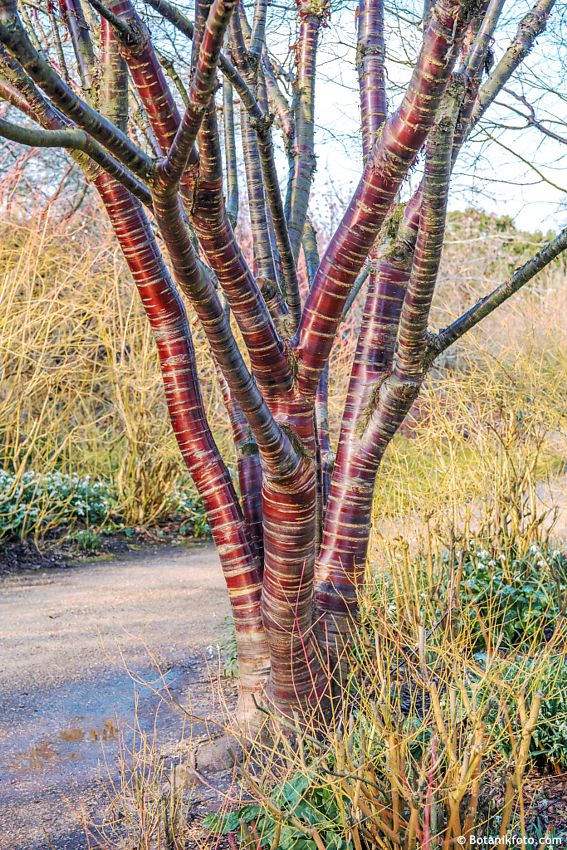
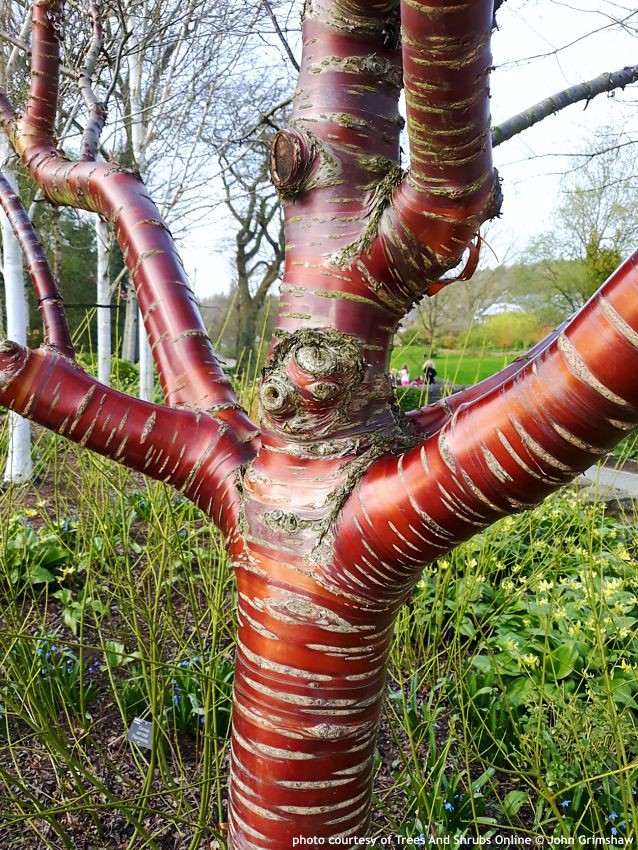
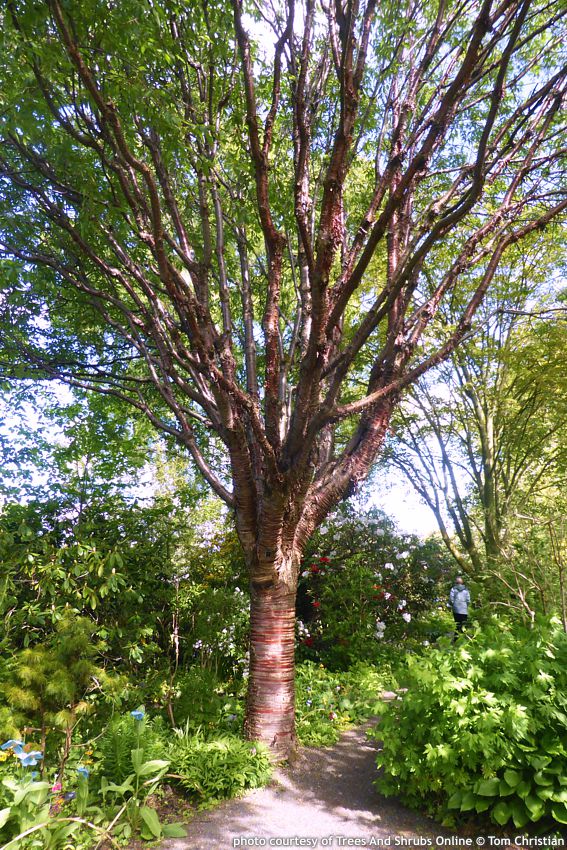
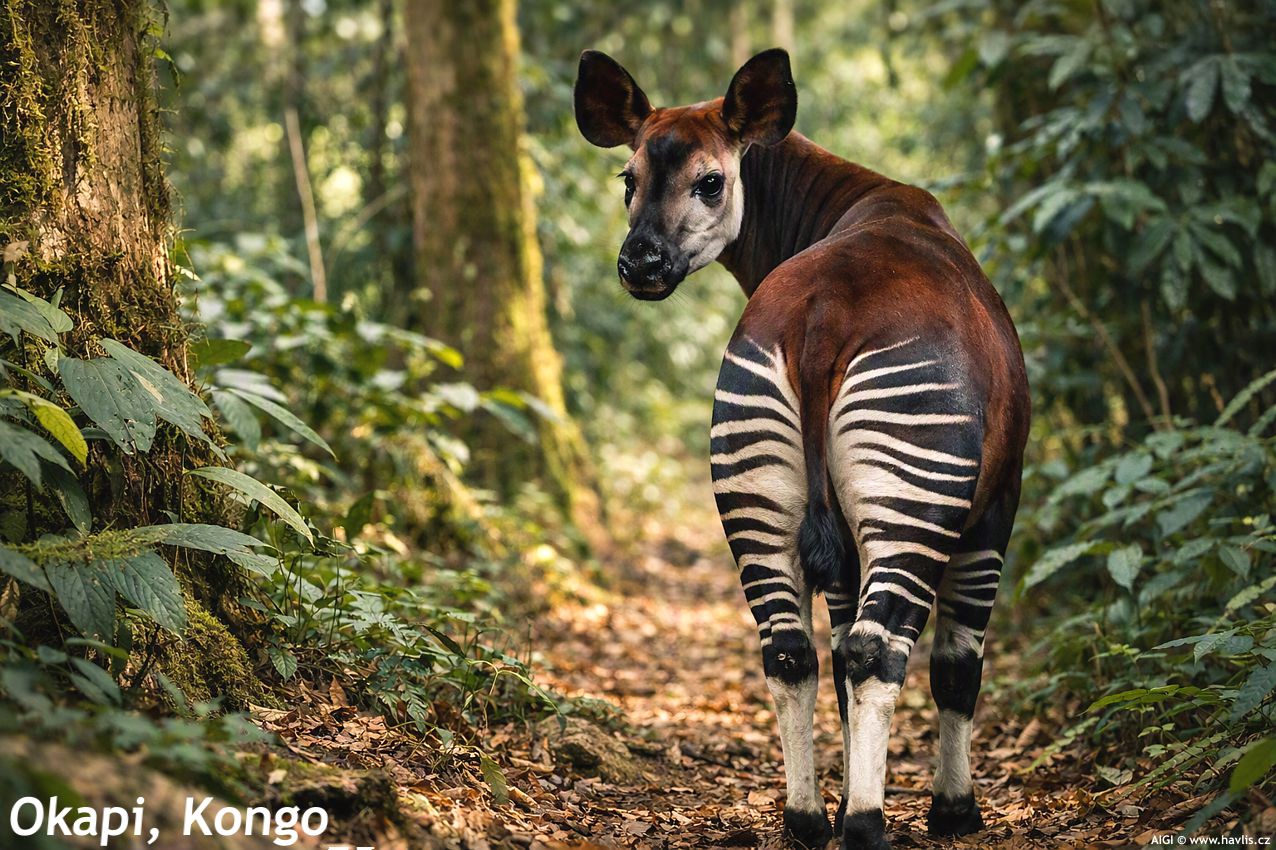
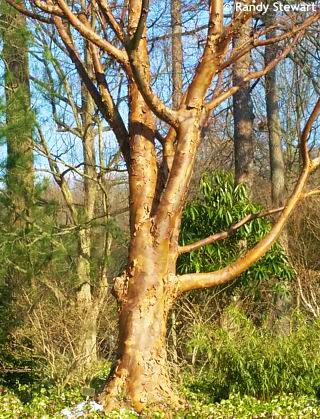
The Tibetan cherry is an exceptionally beautiful deciduous tree with a subtle, almost understated aesthetic. Unlike most flowering cherries, it does not offer a mass of blossom in spring, but draws attention through its bark, whose detail is so compelling that one naturally steps closer to appreciate both sight and touch. It is strikingly glossy, mahogany to deep amber brown, and on young trees it peels horizontally in thin ribbons like delicate shavings. Over time it develops irregular pale markings that resemble the striping of an okapi, the African relative of the giraffe. This highly attractive bark earned the species considerable recognition in horticulture, and in 1944 it received the Award of Merit from the Royal Horticultural Society.
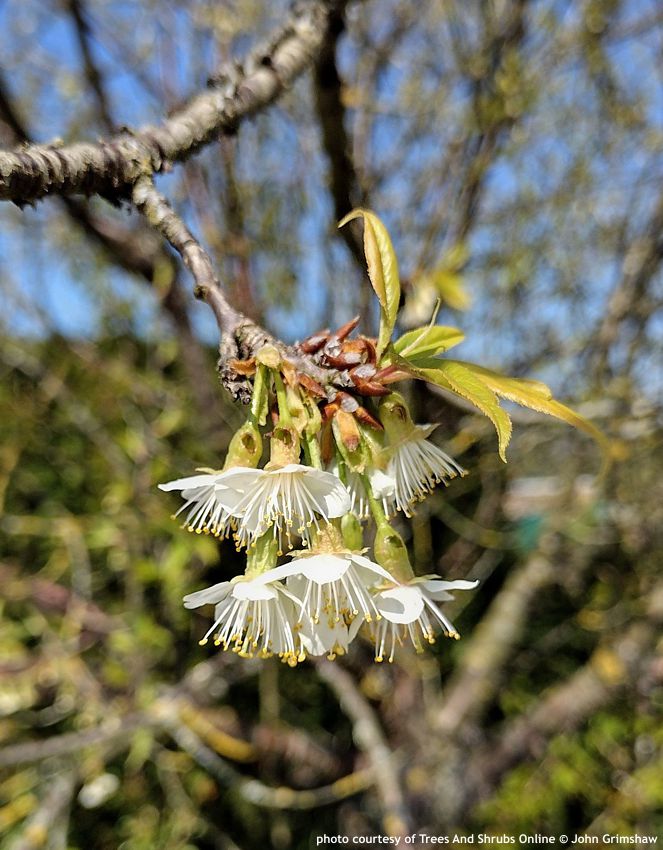
The leaves are deciduous, narrowly lanceolate, long and finely pointed, with regular, delicate serration along the margin. They measure 5 to 10 cm in length and 1.5 to 3 cm in width and do not resemble typical cherry leaves; because they are slightly pendulous, they are often compared to willow leaves. The flowers are white, about 1.5 to 2 cm across, usually produced in twos or threes, sometimes singly or in fours, and appear in April without creating a dramatic display. The fruits are small, oval, about 1.2 cm long, red and glossy, and ripen in summer. They are edible but not palatable and are not eaten.
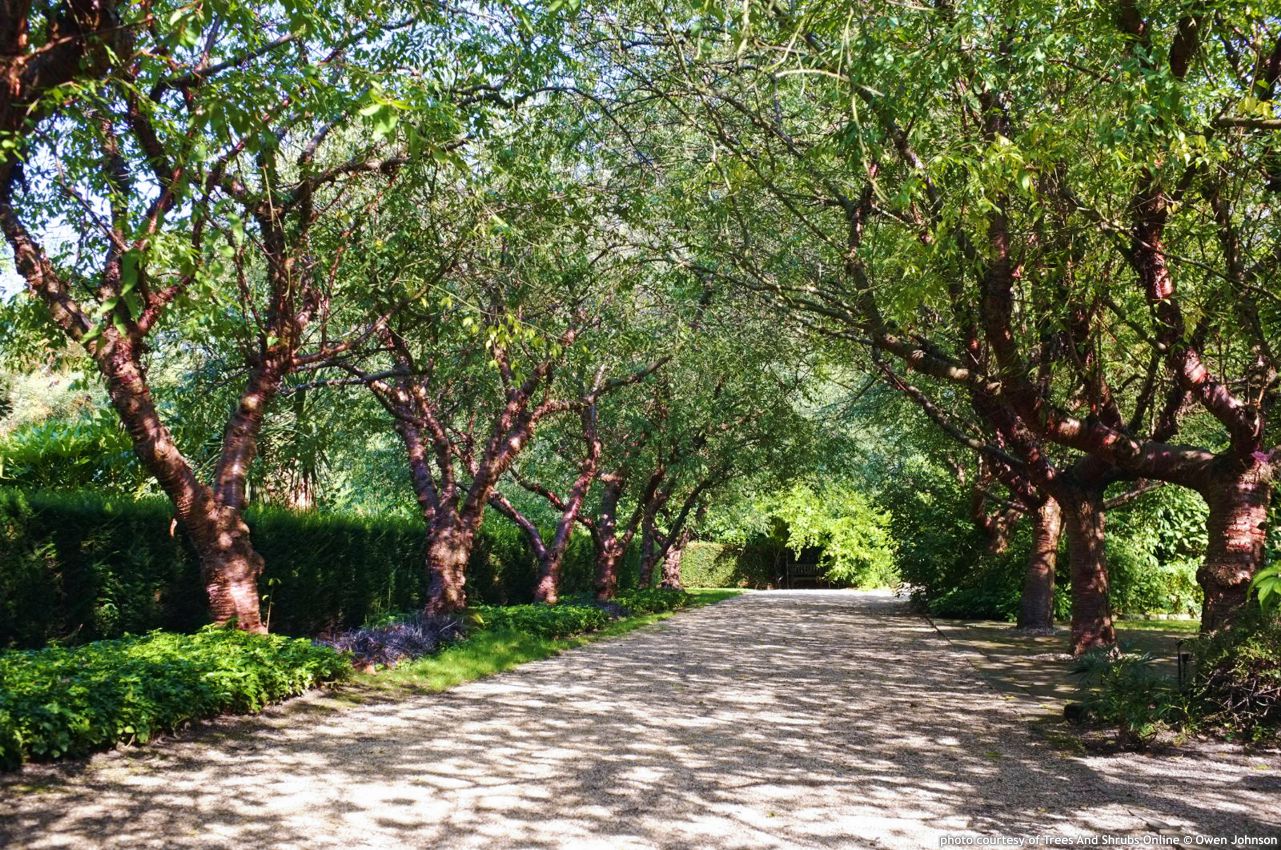
The Tibetan cherry is a medium-sized tree reaching 10 to 15 metres in height with a moderate growth rate of 30 to 40 cm per year. Young shoots are softly downy and grow upright, giving the tree a distinctly ascending crown. In gardens it is used mainly as a specimen tree, because its winter effect is strongest when it has enough space and direct winter light. In parks it performs well in small groups, where the repeated pattern of trunks becomes a strong compositional element. It is often combined with spring bulbs, which benefit from the stable structure, and later with Japanese anemones, which in dense single-species plantings create long-flowering clumps in late summer and autumn. The tree looks best where its bark can be fully appreciated, such as in winter sun, near paths, terraces, water features or light-coloured walls that reflect light.
Last revision 26–08–2026
The Tibetan cherry requires a sunny to lightly shaded position with humus-rich, moderately moist, well-drained soil that is not heavy or waterlogged. It grows reliably in ordinary garden soil provided it is not extremely dry or alkaline. Young trees need regular watering during the first two or three years and are later fairly tolerant of dry periods. Because it is usually cultivated as a standard (a single-stem tree), it needs a firm support for the first three to four years like all newly planted trees. Keep the area above the roots mulched and free of lawn during this period. Pruning is not necessary and should be done only occasionally, ideally in summer. Diseases are rare, most commonly monilia blight in exceptionally wet years. The Tibetan cherry is moderately long-lived, usually reaching 40 to 60 years, sometimes more in optimal conditions. To achieve the best effect, it is important to leave enough space around the trunk so that the bark, the main ornamental feature of the species, can be fully appreciated. Its frost tolerance is around -30 °C (USDA zone 5), which makes it fully hardy in Central Europe without the need for winter protection. Still, growers all around the world confirm it is able to withstand short spells of deeper frosts.

.jpg)
Goods are shipped all over Europe. For Russia and U.K. and for further details please read about SHIPPING OPTIONS HERE.
Are you interested in a serious discount for orders NOV-FEB? Check your options here.
THE PRICES INCLUDE VAT of 15%. For quick conversion you can use 1 CZK = approx. 0.04 EUR
- STANDARD QUALITY - Plants of this group are 1st class quality with number of branches and overall density adequate to their size and age, considering they were container grown.
- DE LUXE QUALITY - This label guarantees a luxurious quality of manually selected plants that, compared to their height and age, are exceptionally dense and beautiful.
- EXTRA - These plants are usually mature and bigger specimens with exceptional overall appearance.
- STANDARD (as described in the plant form) means a tree with a trunk of 190-210 cm and a crown at the top, unless specified differently. The commercial size for trees is their girth measured in the height of 1m from ground.
- HOBBY - These plants are of the same quality as our standard-quality plants but younger and therefore cheaper.
- SHRUB - a woody plant with branches growing bushy from the ground level.
- HALF-STANDARD or MINI-STANDARD - a small tree with shorter trunk, its size is usually specified.
- FEATHERED - These are trees with branches growing already from the base of the trunk and up along the stem.
- GRASSES and PERENNIALS - Sizes given usually read the diameter of the pot or the clump, as specified.
